
When fire didn't burn …
In a world of broken trust, family conflicts, religious extremism and spiritual emptiness, Ibrahim (AS) offers a complete role model of faith with practical lessons.
By Manzar Quasim
Imagine being thrown into a massive, blazing fire because you refused to bow to a statue.
Imagine leaving your infant son and his mother in a waterless desert.
Imagine raising a knife to sacrifice your own beloved son out of obedience to the Creator.
This is the life of Prophet Ibrahim (peace be upon him) known as Abraham in Jewish and Christian traditions – a man described in the Qur'an as a "comprehensive leader” and the "friend of Allah".
His story is more than 4,000 years old, yet it speaks directly to our lives today.
He is the father of many prophets including Ishaq (Isaac), Yaqub (Jacob), Yusuf (Joseph), Musa (Moses), Dawud (David), and Sulayman (Solomon).
His legacy flows through Judaism, Christianity, and Islam.
In a world of broken trust, family conflicts, religious extremism and spiritual emptiness, Ibrahim (AS) offers a complete role model of faith with practical lessons.
The Qur'an calls him an "excellent example" (Surah Al-Mumtahanah 60:4).
Let us discover why – through five powerful lessons.
Lesson 1: Complete Trust in ALLAH – Even when the fire is lit
When Prophet Ibrahim (AS) smashed the idols of his people, the punishment was brutal: he was tied up and thrown into a massive fire.
Everyone else would have panicked. But he calmly responded by saying “Allah is sufficient for us, and He is the best Disposer of affairs."
Allah commanded the fire: "Be cool and safe for Ibrahim" (Quran 21:69).
The fire lost its burning power.
Ibrahim (AS) teaches us that trust is not passive; it is an active obedience, even when the world around you is burning.
Trust in God does not mean avoiding hardship. It means walking through hardship without losing hope.
Lesson 2: Dawah with logic – Respectful dialogue across beliefs
Ibrahim (AS) did not force anyone to believe.
Instead, he used reason and kindness.
When he debated King Namrud, who claimed to give life and death,
Ibrahim said: "Allah brings the sun from the east – so you bring it from the west." The king was speechless (Quran 2:258).
When his people worshipped stars, the moon and the sun, he showed them logically: these objects rise and set. Only the Creator of all things is worthy of worship (Quran 6:76–79).
In a multicultural society, university classrooms and community centers, the style of Ibrahim (AS) is needed: Speak with respect and logic.
Never mock the other person's belief.
Lesson 3: Sacrifice – Giving up what you love most
The most famous story of Ibrahim (AS) is to sacrifice his son Ismael (AS).
After a repeated dream, Ibrahim (AS) understood that Allah wanted him to sacrifice what he loved most: his long-awaited, righteous son.
Both father and son submitted. But the knife did not cut; afterwards Allah replaced Ismael (AS) with a ram.
This is the moment celebrated by millions on Eid al-Adha yearly. But his sacrifices began long before that:
- He left his motherland, home and father for the sake of truth.
- He endured being thrown into fire.
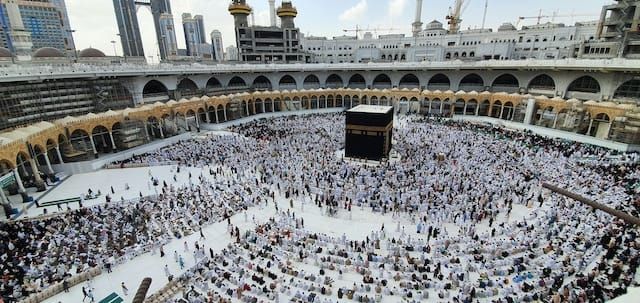
- He left his wife Hajra and infant son Ismael (AS) in the barren desert of Makkah.
- He was willing to sacrifice his son.
In our society, sacrifice often looks different – a parent working two jobs to put a child through university, and a volunteer giving weekend hours to a food bank.
Ibrahim's (AS) story universalizes sacrifice as the currency of sincere faith.
It resonates across cultures because every community honours those who give up their comfort for a higher purpose.
Lesson 4: Making Mindful Duas – Prayer as a Lifestyle
Prophet Ibrahim (AS) did not only pray in moments of crisis.
He prayed constantly for himself, his parents, his children and even future generations.
Some of his most beautiful prayers:
"My Lord, make me an establisher of prayer, and from my descendants as well. Our Lord, accept my prayer."* (Quran 14:40)
"Our Lord, forgive me and my parents and the believers on the Day the reckoning takes place."* (Quran 14:41)
"Our Lord, I have settled some of my descendants in a barren valley near Your sacred House so that they may establish prayer. Make the hearts of people incline toward them."* (Quran 14:37)
"Our Lord, send among them a messenger from themselves who will recite Your verses to them, teach them the Book and wisdom, and purify them."* (Quran 2:129).
Ibrahim’s (AS) example reminds us that dua is not an emergency tool – it is a continuous conversation with the Creator. He prayed in gratitude, in fear, in hope and for strangers he would never meet.
Lesson 5: Parents and Children – A Forgotten Balance
This is one of the most overlooked lessons from the life of Ibrahim (AS) and perhaps the most urgently needed today.
In Surah Maryam (19:43–47), young Ibrahim (AS) speaks with incredible gentleness to his father, who was an idol maker:
"O my father, indeed there has come to me knowledge that has not come to you. so follow me, I will guide you."
"O my father, do not worship Satan."
"O my father, I fear that punishment will touch you."
His father replied harshly: "If you do not stop, I will stone you. Leave me for a long time." Ibrahim (AS) replied with the most beautiful words: "Peace be upon you. I will ask forgiveness for you of my Lord."
Parents are not always right and children are not always wrong but love, respect, and dua can keep the door open – even when the other side slams it shut.
Ibrahim's (AS) respectful disagreement with his father offers a powerful model. Imams and interfaith counselors use this exact story to help young Muslim navigate differences with non-Muslim parents.
You can disagree without disrespect, maintain family bonds without compromising your faith, Kindness to parents continues even when they reject your beliefs. Ibrahim's (AS) story teaches a balanced path: Speak truth respectfully, Do not sever family ties and continue to pray for your parents' guidance even if they reject yours.
An Invitation to rethink
The life of Prophet Ibrahim (AS) is not meant to be admired from a distance. It is meant to be lived.
- Are you facing a fire today – a health crisis, a family breakdown, a financial struggle? Trust like Ibrahim (AS).
- Do you need to speak truth to someone who disagrees with you? Do it with logic and respect – like Ibrahim (AS).
- Is there something you love that you may need to sacrifice for a higher purpose? Be honest – like Ibrahim (AS).
- Have you forgotten to pray except in emergencies? Start praying like Ibrahim (AS).
- Are you a parent who refuses to listen, or a child who speaks without respect? Relearn family love – like Ibrahim (AS).
- Do we have the courage to follow in his footsteps?
Author Bio:
Manzar Quasim is a Mechanical Engineer, P.Eng., PMP®, CEC and community contributor based in Mississauga, Ontario. A proud father and newcomer to Canada, he writes about faith, education, and the immigrant experience.