
Beyond the Click: Reclaiming Our Moral Agency in a Digital World
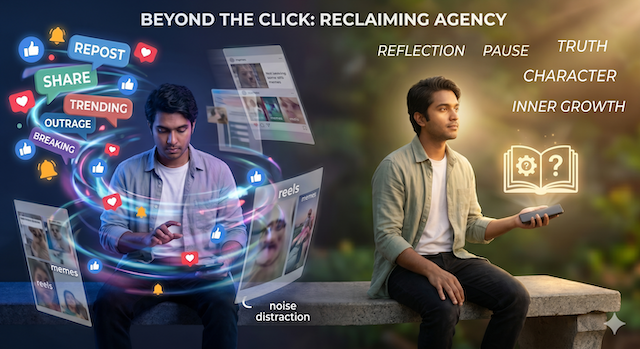
If our social media profiles were read as a record of our character, what would they reveal? Would they show a person of patience, truth, and care? Or would they reveal someone swept away by the winds of outrage?
By Muneeb Nasir
We live in an era of the "instant share."
With a single tap, a message can travel from our palm to thousands of screens across the globe.
It has become a reflex so common that we rarely stop to think about the weight of what we are doing.
But for the believer and the conscious citizen, no action is truly neutral.
Beneath the ease of the "repost" lies a profound question of identity, accountability, and what it means to be a person of reflection in an age of distraction.
The Illusion of Activism
At its best, sharing content is an act of solidarity.
We see a call for justice, a beautiful quote, a reel showing human resilience, and we want the world to see it too.
We want to bear witness.
However, we must be honest with ourselves: social media often rewards speed over sincerity.
It encourages us to curate an identity rather than build character.
We "borrow" conclusions without wrestling with the questions that lead to them.
In this rush to align ourselves with the "right" side of a trending topic, we risk becoming mere transmitters of information rather than authors of our own thoughts.
As Muslims, we are reminded of the gravity of our speech—and by extension, our digital "speech."
The Qur’an warns us: "Do not follow blindly what you do not know to be true: ears, eyes, and heart, you will be questioned about all these" (17:36).
When we repost without verification or reflection, we dilute our own moral agency.
We become part of a digital crowd where responsibility is spread so thin that no one feels accountable for the misinformation or the vitriol that may follow.
From Reflex to Reflection
We have been given a megaphone before we have learned the discipline of silence.
To lead meaningful lives we must reclaim the "pause."
How do we move from a culture of reposting to a culture of reflection?
- Own Your Thoughts: Before hitting share, ask: Could I explain this in my own words? If we cannot articulate the "why" behind a post, we are merely echoing noise.
- The Power of Silence: In a world that demands an opinion on everything, choosing not to post is often an act of restraint. Not every headline requires our immediate commentary. Silence creates the space necessary for reflection.
- Seek Depth Over Slogans: Wisdom is not found in a character limit. It is cultivated through long-form engagement—books, deep conversations, and sustained study. We must resist the urge to collapse complex human issues into shareable memes or reels.
- Move Toward Action: It is easy to signal our values online; it is much harder to live them. If we share a post about poverty or injustice, the real test of our integrity is what we do for our neighbour or our community once the screen is turned off.
A Digital Trust
As a community, we should view our digital presence not as a megaphone for our egos, but as a trust.
Every link we share and every "like" we give shapes the hearts and minds of those around us.
If our social media profiles were read as a record of our character, what would they reveal? Would they show a person of patience, truth, and care? Or would they reveal someone swept away by the winds of outrage?
The challenge is not a lack of information—we have more than enough of that.
The real challenge lies within: the slow work of inner growth. Independent thinking may never be as clickable as a repost, but it is the only way to genuine integrity.
Let us resolve to be people who reflect before we react, ensuring that our digital footprints lead toward truth rather than just more noise.