
The Beauty of Aging
Aging is not merely about adding years to life. It is about adding meaning to those years. Every stage of life carries its own responsibilities and gifts. Youth may possess energy, but elders possess perspective.
By Farhad Khadim
In a world that often glorifies youth, speed, and constant productivity, aging can sometimes be portrayed as something to resist rather than embrace.
Yet within many faith traditions—and particularly within Islam—aging is not viewed as decline alone, but as a stage of profound wisdom, perspective, and spiritual opportunity.
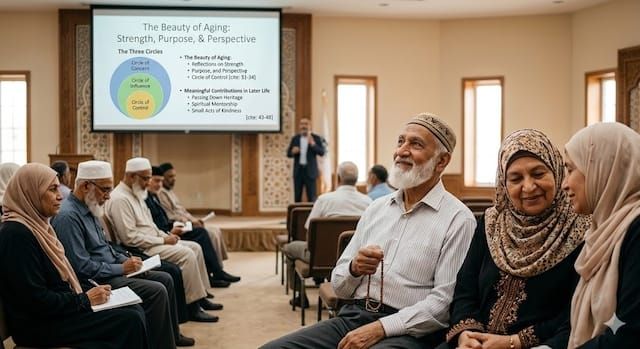
At a recent presentation for seniors at the Islamic Institute of Toronto (IIT), the theme of “The Beauty of Aging” invited attendees to reflect not only on growing older, but on growing deeper: deeper in understanding, gratitude, resilience, and closeness to Allah.
The Stages of Life
Human life unfolds in stages.
Childhood brings dependence. Youth brings strength and ambition. Later years often bring physical limitations, but also clarity and reflection.
The Qur’an beautifully captures this cycle in Surah Ar-Rum:
“It is Allah Who created you in a state of weakness, then developed your weakness into strength, then developed your strength into weakness and old age. He creates whatever He wills. For He is the All-Knowing, Most Capable.” (30:54)
This verse reminds us that aging is not an interruption of life—it is part of the divine design of life itself.
Every phase carries its own purpose and beauty.
Strength is not permanent, nor is weakness. Both are temporary states through which human beings journey.
For many seniors, this realization can be liberating.
The later years of life need not be measured only by physical capacity, but by wisdom, sincerity, and spiritual maturity.
Recognizing Potential While Accepting Limitations
One of the greatest challenges of aging is learning to navigate changing abilities.
Tasks once done effortlessly may become difficult.
Energy may diminish. Health concerns may emerge.
Yet aging also brings a unique opportunity: the ability to focus on what truly matters.
Rather than dwelling solely on limitations, seniors can recognize their enduring potential:
- The potential to guide younger generations
- The potential to strengthen families
- The potential to mentor communities
- The potential to deepen spiritual insight
- The potential to influence hearts through patience, dignity, and experience
aging teaches an important balance: acknowledging limitations without losing purpose.
The Three Circles
An especially meaningful framework discussed during the presentation was the concept of the “Three Circles”:
- Circle of Concern
- Circle of Influence
- Circle of Control
The Circle of Concern includes the many things people worry about but cannot directly change—global events, social trends, economic instability, or the behavior of others.
The Circle of Influence includes areas where a person can still make a difference: family relationships, community involvement, encouragement, mentorship, and advocacy.
The Circle of Control focuses on what lies directly within oneself: one’s character, reactions, worship, kindness, and daily choices.
As people age, this framework becomes increasingly valuable. Rather than becoming overwhelmed by concerns beyond reach, energy can be directed toward meaningful influence and intentional living.
There is peace in understanding the difference between what must be accepted and what can still be shaped.
Meaningful Contributions in Later Life
Many seniors underestimate the importance of their presence in the lives of others. Yet communities are often sustained by the quiet contributions of elders.
Among the meaningful acts highlighted were:
- Passing down heritage and family history
- Preserving cultural and religious traditions
- Connecting with others and reducing loneliness
- Offering spiritual mentorship
- Performing small acts of kindness
- Participating in virtual volunteering and advocacy
These actions may appear modest, but their impact can be profound. A conversation, a prayer, a shared memory, or a word of encouragement can shape lives in ways that are never fully seen.
In Islam, value is not measured solely by public achievement. Sincerity, wisdom, and consistency often carry greater weight than visibility.
The Perspective of Umm Ayman
One of the most inspiring stories in the Seerah is that of Umm Ayman, a remarkable woman deeply connected to the life of the Prophet Muhammad ﷺ.
She was present during many defining moments of his life: his birth, the death of his mother, his marriage, and eventually his passing.
Her loyalty and devotion were extraordinary. When the Prophet ﷺ migrated to Madinah, she journeyed alone for hundreds of kilometers over many days to join him.
After the Prophet’s death, Abu Bakr and Umar ibn al-Khattab once visited her and found her crying. Assuming she was grieving the Prophet’s passing, they attempted to comfort her.
But her response revealed a remarkable spiritual perspective.
She explained that she knew the Prophet ﷺ would one day pass away. What truly saddened her was that revelation from heaven had ended.
This insight—coming from an elderly woman whose life had been shaped by faith—offers a powerful lesson. Her concern was not merely personal loss, but the ending of the divine connection between heaven and earth through revelation.
Such perspective demonstrates the spiritual depth that can emerge through a lifetime of reflection, faith, and devotion.
Redefining aging
Modern society often associates aging with loss. But perhaps aging can also be understood as refinement.
With time comes:
- greater perspective,
- stronger patience,
- deeper gratitude,
- clearer priorities,
- and increased awareness of what truly endures.
The beauty of aging lies not in denying the realities of growing older, but in
discovering the opportunities hidden within them.
A slower pace can create room for reflection. Reduced worldly distractions can strengthen spiritual focus. Life experience can transform into wisdom that benefits others.
In many ways, elders become custodians of memory, identity, and perspective for entire communities.
A Final Reflection
Aging is not merely about adding years to life. It is about adding meaning to those years.
Every stage of life carries its own responsibilities and gifts. Youth may possess energy, but elders possess perspective.
And in a rapidly changing world, perspective is one of the most valuable treasures a community can have.
The later years of life can become a time of spiritual richness, emotional depth, and lasting influence—if approached with purpose, gratitude, and faith.
The beauty of aging is ultimately found in recognizing that while physical strength may diminish, the soul still has the capacity to grow.