The Pope, the President, and the African Saint Who Saw It All Coming
When religious leaders of different traditions speak the same moral language — about the sanctity of life, the limits of power, the universality of human dignity — they are not being naively utopian. They are drawing on the deepest wells of their respective traditions.
By Muneeb Nasir
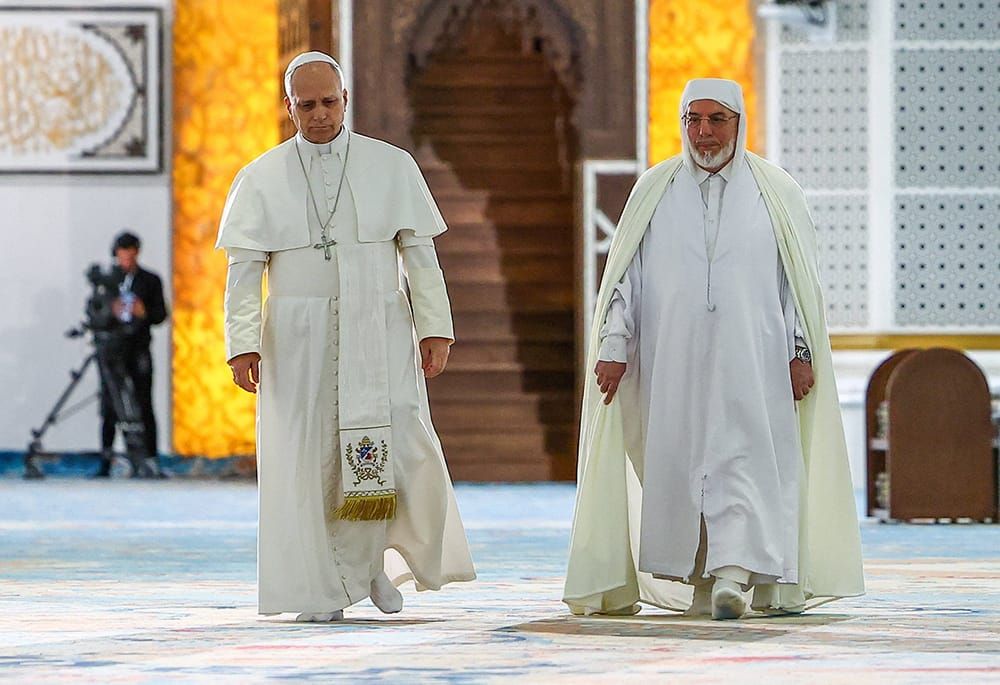
The backdrop could not be more dramatic. Pope Leo XIV — the first pope ever to set foot in Algeria — arrived there this week as the opening leg of an 11-day apostolic journey to four African countries, with Christian-Muslim relations high on his agenda.
He visited the Basilica of St. Augustine in Annaba, the very city where St. Augustine served as bishop.
Even though the vast majority of Algerians are not Catholic, the Pope noted that many of them "very much honor and respect the memory of St. Augustine as one of the great sons of their land."
He arrived carrying an open conflict with the most powerful political leader on earth.
Pope Leo had emerged as an outspoken critic of the US-Israeli war on Iran, and Trump had responded on social media calling him "Weak on Crime, and terrible for Foreign Policy," suggesting Leo should "get his act together" and "stop catering to the Radical Left."
Vice President JD Vance, himself a Catholic convert, weighed in saying the pope should "be careful when he talks about matters of theology."
Pope Leo's response, delivered from the papal plane over the Mediterranean, heading toward the land of St. Augustine: "I have no fear of neither the Trump administration nor of speaking out loudly about the message in the Gospel. Too many people are suffering in the world today. Too many innocent people are being killed."
The Two Cities Are Always in Tension
This confrontation is almost a textbook enactment of St. Augustine's City of God, written after Rome fell in 410 — not far from where Pope Leo just stood.
St. Augustine's core argument was that earthly power, however great, is not ultimate, and that anyone who invokes God to sanctify their political project has committed a profound confusion of categories.
Trump escalated threats to Iran around Easter, when Christians celebrate the resurrection.
Pope Leo used his Palm Sunday message to call Jesus the "King of Peace" and declare that God "does not listen to the prayers of those who wage war."
Meanwhile, Trump told reporters he believes God supports US military action in Iran because "God is good and God wants to see people taken care of," and shared a social media post showing him embraced by Jesus.
St. Augustine would have recognized this pattern immediately.
He spent his career warning against the libido dominandi — the lust for dominance — which he saw as the City of Man's defining pathology.
The moment a political leader begins to claim divine endorsement for violence, St. Augustine's framework says an alarm should sound.
And notably, Islam sounds the same alarm: the Qur'an explicitly states "God does not love the aggressors" (2:190). Both traditions converge on this point.
JD Vance and the Heresy of Ranked Love
Perhaps the most theologically significant thread involves JD Vance.
As a cardinal, the future Pope Leo had shared a news article criticizing Vance for justifying harsh immigration policy by arguing that Christianity sets a pecking order of caring for others — putting family, community, and fellow citizens above foreigners.
The headline he shared read: "JD Vance is wrong: Jesus doesn't ask us to rank our love for others."
This is a direct Augustinian controversy.
St. Augustine's concept of ordo amoris — the right ordering of loves — is genuinely complex, and Vance is drawing on a real tradition.
But St. Augustine's hierarchy of love was never meant to exclude the stranger; it was a framework for how to love, not who deserves love.
His City of God is explicitly universal — it encompasses all peoples.
And in Islamic ethics, the concept of rahma (mercy) and the Prophet Muhammad's teaching that "none of you truly believes until he loves for his brother what he loves for himself" — where "brother" in classical interpretation extends to all humanity — similarly resists the reduction of love to tribal belonging.
Vance telling the Pope to "be careful when he talks about matters of theology" lands particularly oddly here, given that the Pope was, in essence, defending a more rigorous reading of the tradition Vance converted to.
Algeria as Sacred Geography of Reconciliation
The choice of Algeria as the place where this all came to a head matters enormously.
Pope Leo greeted Algerians with "As-salamu ‘alaikum" — peace be upon you — a Muslim greeting that resonated "less as a formula than as a bridge."
He visited the Great Mosque of Algiers, reported to be the largest mosque in Africa, and also the Basilica of Our Lady of Africa, where an inscription reads: "Notre Dame d'Afrique, priez pour nous et pour les musulmans" — Our Lady of Africa, pray for us and for the Muslims.
This is the land of St. Augustine — a man claimed by both the Catholic Church and, with pride, by Muslim Algerians as a son of their soil.
Pope Leo invoked St. Augustine's legacy as offering "a vision in terms of that search for God and the struggle to build community, to seek for unity among all peoples and a respect for all peoples in spite of differences."
The symbolism is almost too precise: the first American pope, in open conflict with the American president over war and human dignity, stood in a majority-Muslim country and invoked a saint revered by both traditions, to argue for the very values being contested back home.
Prophecy vs. Politics
Pope Leo's opposition to the Iran war is not, at its root, political.
It rests on a consistent claim: power must be judged, violence must be restrained, and invoking God to justify destruction is a distortion of both religion and public life.
He was not trying to enter politics — he was trying to define the limits within which politics can operate.
This is the ancient prophetic role, present in all three Abrahamic traditions. The Hebrew prophets spoke to kings.
Prophet Muhammad's community at Medina established a charter of rights for Jews, Christians, and pagans alike.
St. Augustine wrote The City of God to a collapsing empire to say: your fall is not the end of meaning, and your power was never absolute.
Pope Leo, standing in Annaba, was doing something in that same lineage.
The interfaith lesson is this: when religious leaders of different traditions speak the same moral language — about the sanctity of life, the limits of power, the universality of human dignity — they are not being naively utopian.
They are drawing on the deepest wells of their respective traditions.
And the fact that an American pope and Algerian Muslims found themselves, this week, on the same ground, honoring the same ancient African saint, while the world argued about war, is not a coincidence. It is a sign worth reading carefully.
The Core Lesson
Augustine wrote: "Thou hast made us for Thyself, and our heart is restless until it rests in Thee."
The restlessness of this moment — the wars, the political fury, the fracturing of shared moral language — is the restlessness of civilizations that have forgotten what they are actually for.
Pope Leo went to Africa to say that. It happens to be exactly what St. Augustine said from the same soil, sixteen centuries ago.
And it is, at its heart, what Islam has been saying in its own language all along.
References
- Vatican News — "Pope Leo XIV reflects on visit to Algeria, Augustine, and dialogue" https://www.vaticannews.va/en/pope/news/2026-04/pope-leo-xiv-reflects-visit-algeria-augustine-dialogue.html
- Vatican.va — "Apostolic Journey of Pope Leo XIV to Algeria, Cameroon, Angola and Equatorial Guinea, 13–23 April 2026" https://www.vatican.va/content/leo-xiv/en/travels/2026/documents/africa-13-23aprile2026.html
- CNN — "In pictures: Pope Leo's trip to Africa" https://www.cnn.com/2026/04/13/world/gallery/pope-leo-africa-visit
- ACI Africa — "Standing in the Rain for Hope: Algerian Expatriate Returns Home for Pope Leo XIV's Historic Visit" https://www.aciafrica.org/news/21303/standing-in-the-rain-for-hope-algerian-expatriate-returns-home-for-pope-leo-xivs-historic-visit
- Newsweek — "Donald Trump, Pope Leo Popularity Compared Amid Iran War Feud" https://www.newsweek.com/donald-trump-pope-leo-popularity-compared-iran-war-feud-11822124
- NPR — "Popes have spoken out on politics before. But with Trump and Pope Leo it's different" https://www.npr.org/2026/04/15/nx-s1-5779690/pope-leo-donald-trump-war-iran-vance-history
- Al Jazeera — "Pope Leo says he does not fear Trump after attack over Iran peace appeal" https://www.aljazeera.com/news/2026/4/13/terrible-for-foreign-policy-trump-attacks-pope-leo-after-peace-appeal
- The Washington Times — "The Trump and Leo chronicles: A president and a pope square off over Iran and its aftermath" https://www.washingtontimes.com/news/2026/apr/14/trump-leo-chronicles-president-pope-lock-horns-iran-aftermath/
- The Conversation / Australian Catholic University — "Pope Leo's resolute response to Trump attack reveals a man of God, not politics" https://theconversation.com/pope-leos-resolute-response-to-trump-attack-reveals-a-man-of-god-not-politics-280469
- Fortune — "Trump finds a tough guy from Chicago that he can't intimidate: Pope Leo" https://fortune.com/2026/04/14/trump-versus-pope-leo-explained/