
Water as a Teacher: Shared Lessons from Indigenous and Islamic Traditions
Two profound traditions—one rooted in the Nishnaabeg wisdom of this land and the other in the timeless guidance of the Qur’an—offer us a shared map for these turbulent times. By viewing water not as a commodity but as a sacred teacher, we find a "sacred current" that can guide us through the storm.
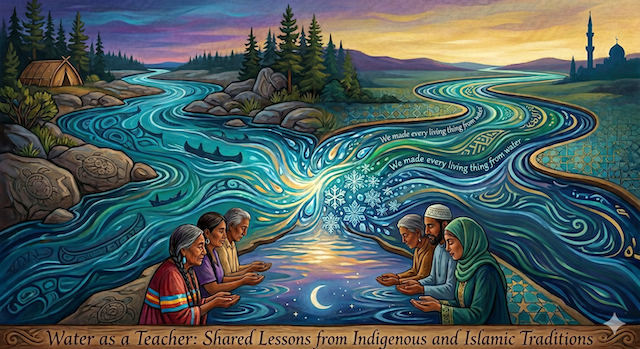
By Muneeb Nasir
In a time when many feel the world is unravelling, we often find ourselves searching for a solid foundation to stand on.
From the escalating climate crisis to the fractures in our social and political systems, the "old normal" seems to be vanishing.
Yet, perhaps the answer isn't to look for solid ground, but to learn how to move with the water.
Two profound traditions—one rooted in the Nishnaabeg wisdom of this land and the other in the timeless guidance of the Qur’an—offer us a shared map for these turbulent times.
By viewing water not as a commodity but as a sacred teacher, we find a "sacred current" that can guide us through the storm.
Water as a Teacher
Nishnaabeg scholar Leanne Betasamosake Simpson explored the concepts in her work, Theory of Water.
She suggests that "listening very carefully to water" allows us to see beyond the immediate crises of the present.
For Indigenous peoples, "unmaking" and "remaking" the world is a familiar cycle of resilience.
This perspective finds a beautiful mirror in the Islamic tradition.
The Qur’an identifies the natural world as a series of Ayaat—signs—that require our active reflection.
Water is the primary sign of life and divine mercy:
"It is God who sends water down from the sky and with it revives the earth when it is dead. There truly is a sign in this for people who listen." (Qur’an, 16:65).
Both traditions challenge us to move from being passive consumers of water to active students of its logic.
To "listen" to water is to recognize its persistence, its humility, and its role as the source of all existence.
The Strength of Sintering
Simpson introduces a powerful metaphor for community called sintering.
This is the physical process where snowflakes bond together to form a stronger whole without losing their individual identity.
It is a model of interdependence—building collective strength without extraction or erasure.
For the Muslim community, this resonates with the ethic of the Ummah and our role as Khalifah (stewards).
Our strength lies in our ability to bond together for the common good.
The Quran describes this movement toward truth: "He sends water from the sky that fills riverbeds to overflowing... in this way God illustrates truth and falsehood—the froth disappears, but what is of benefit to man stays behind..." (13:17).
Just as water carries away the "froth" of falsehood, our community efforts must focus on what is truly beneficial: justice, mercy, and the protection of our shared environment.
Navigating via Relationship
Modern maps are often about boundaries and ownership—lines that tell us where we don't belong.
In contrast, "Nishnaabe maps" and the guidance of the Qur’an are maps of relationship.
They show us how we are connected to the Creator, to each other, and to the living world.
If we are to remake our world, we must adopt these sacred currents.
We cannot act as stewards of the earth while treating its most vital element as a mere resource.
"...We made every living thing from water? Will they not believe?" (Qur’an, 21:30).
This verse is a call to profound ecological humility.
If every living thing is made of water, then our relationship with water is a relationship with life itself.
A Shared Path Forward
As we navigate the "unravelling" of the present, we are invited to join these two streams of wisdom.
By "thinking alongside water," we learn that even when things seem to be falling apart, there is a path toward renewal.
Let us be like the snowflake in the process of sintering—finding strength in our neighbours and building a resilient future together.
The wisdom of the current is clear: when we listen to the water, we learn how to live.