
Rising to the Challenge of AI: A Community Reflection
AI is a powerful tool that will reshape our world. By approaching it with education, ethical grounding, and active participation, non-profits, faith leaders, and professionals can ensure we do not just survive the AI revolution, but help guide it toward the common good.
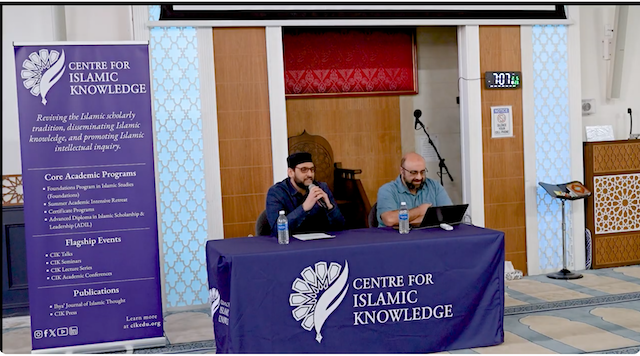
In a recent presentation co-hosted by the Centre for Islamic Knowledge, Dr. Walid Kadous—a leading AI expert with over 25 years of experience at tech giants like Google and Uber—explores the profound implications of Artificial Intelligence for the global community.
Framing the conversation around how society should navigate this technological shift, the talk reframes AI not merely as a piece of software, but as a defining test (fitnah) of our modern era.
The Evolution and Nature of AI
Dr. Kadous begins by charting the history of AI, explaining its shift from "classical AI," which relied on rigid logic and human-coded equations, to the modern era of "deep learning."
Today’s Large Language Models (LLMs), such as ChatGPT or Claude, are essentially sophisticated "next-word predictors" trained on vast amounts of human writing.
Crucially, Dr. Kadous points out that these models are "grown" rather than strictly engineered.
Because developers cannot fully control how the AI forms its digital neural connections, they rely on a process called "alignment"—using human feedback and coded "constitutions" to instill specific values into the system.
This means AI is not a neutral tool; it is inherently embedded with the cultural and moral biases of its creators.
Economic, Educational, and Social Impacts
The impacts of AI will be transformative, carrying both incredible benefits and significant societal risks:
- Economic Disruption: By 2030, AI is projected to add $16 trillion to the global economy. However, it is also expected to displace over 90 million jobs. We are already seeing this in industries like software engineering, and it will soon cascade into finance, legal, and administrative fields.
- Educational Shifts: AI has the potential to provide highly effective, personalized tutoring to students. Yet, studies indicate that over-reliance on AI could also lead to cognitive decline.
- Social Realities: AI is rapidly becoming the primary way people access information and understand the world. Alarmingly, millions of youth now consult AI for mental health care rather than turning to humans. Furthermore, without intentional intervention, the immense wealth generated by AI will likely concentrate at the top.
A Historical Framework
To understand how communities should respond, Dr. Kadous looks to history.
He compares AI to the invention of writing. The Prophet Muhammad recognized writing as a powerful gift and actively integrated it into the early community, a decision that fundamentally shaped Islamic civilization.
In contrast, Dr. Kadous warns against repeating the historical hesitation surrounding the printing press, where delayed adoption contributed to a prolonged period of geopolitical decline for the Ummah.
AI, he argues, represents the "third phase of writing". If community leaders and organizations ignore or reject it, they risk severe marginalization.
The Path Forward: Tech Sovereignty and Ethical Activism
Dr. Kadous outlines a clear, three-pronged strategy to address the technology:
- Adopt with Wisdom (Hikmah): We must actively learn and integrate AI into our professional and organizational work. There is great potential for specialized Islamic AI tools—like Ansari or Usul AI—which can assist in religious education, improve non-profit efficiency, and optimize philanthropic giving.
- Strive for Tech Sovereignty: If communities do not control their own digital infrastructure, they face "tech subjugation." Dr. Kadous highlights how social media algorithms have been manipulated to suppress narratives, such as voices advocating for Palestinian human rights. To safeguard digital independence, we must invest in our own AI models and communication platforms.
- Engage in Civic Activism (Fudul): We cannot stop the AI train, but we can help steer it. By forming coalitions with other ethical and faith-based groups, communities can advocate against the weaponization of AI—such as its use in mass surveillance or warfare—and push for economic justice.
Personal Responsibility
On an individual level, the mandate is clear: we must equip ourselves and our families for this new reality.
As AI automates more tasks, it will free up human time and generate new forms of wealth.
Dr. Kadous suggests treating this sudden windfall as a modern form of rikaz (found treasure)—encouraging professionals to dedicate a portion of their newly freed time and resources back to community service and spiritual growth.
Ultimately, AI is a powerful tool that will reshape our world.
By approaching it with education, ethical grounding, and active participation, non-profits, faith leaders, and professionals can ensure we do not just survive the AI revolution, but help guide it toward the common good.