
How a Toronto Mosque Transformed Urban Friction into Indigenous Connection
This mural is more than just a successful beautification project; it is a masterclass in thoughtful community engagement and an expression of true civic responsibility.
Like many urban institutions, the Toronto Islamic Centre (TIC) has long faced the persistent challenge of recurring property damage and graffiti.
For years, the response followed a familiar, exhausting cycle: a defaced wall, a fresh coat of paint, and a blank canvas waiting for the next incident.
This cycle felt particularly heavy in recent months, as the mosque navigated a sobering string of targeted security threats and Islamophobic incidents that forced the community to implement volunteer safety networks, such as a congregational "buddy system" during Ramadan.
But last month, the Centre decided to break that cycle with an act of creative courage.
Instead of merely erasing the markings of urban friction or retreating behind closed doors, they chose to transform their exterior wall into a meaningful, permanent gift for the neighbourhood.
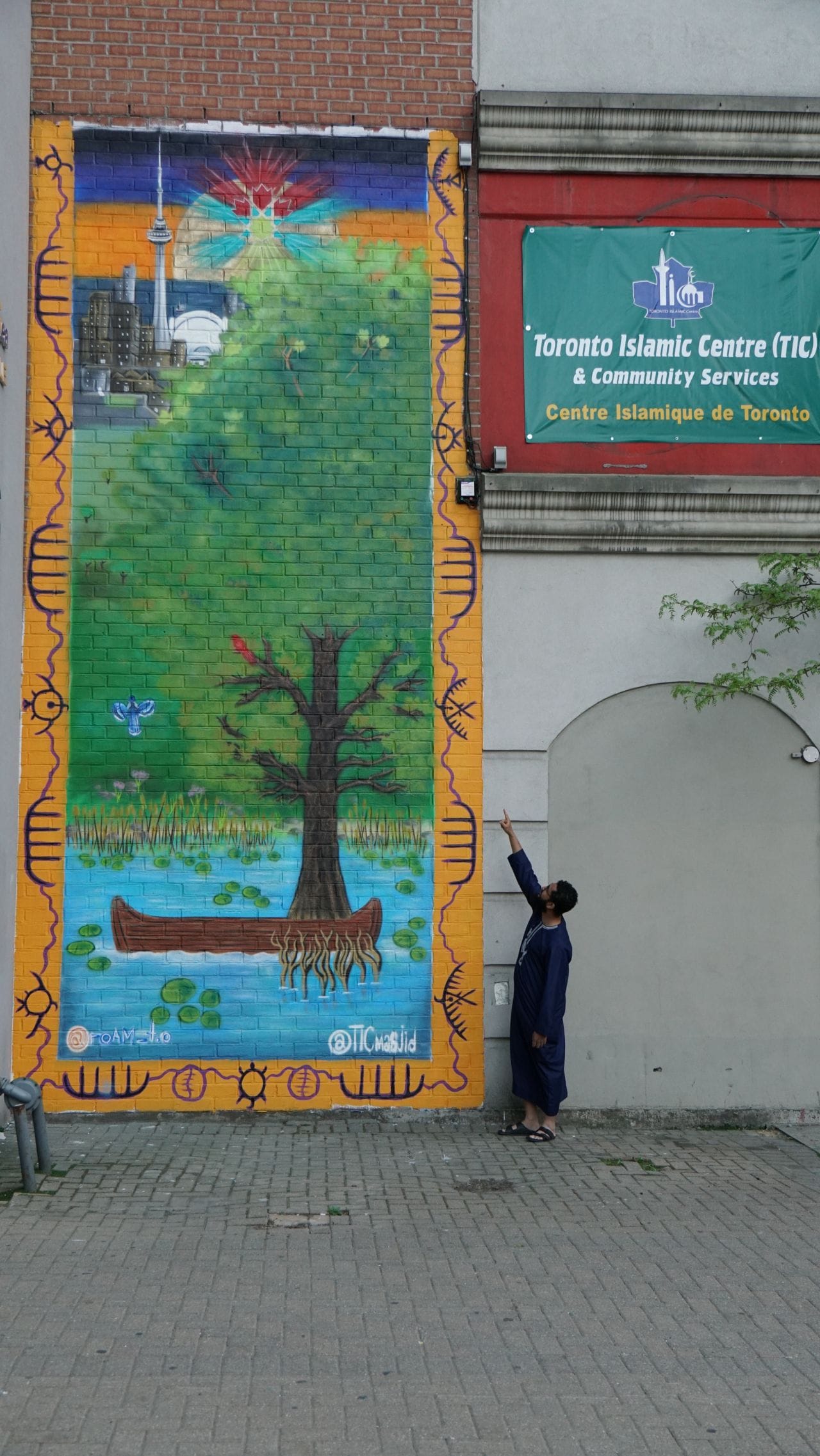
The result is a stunning, collaborative mural that bridges communities, honours the deep Indigenous history of the land, and stands as a vibrant testament to what it means to be both proudly Canadian and confidently Muslim.
Navigating a Unique Artistic Challenge
The project began with an ambitious and delicate creative challenge.
The Centre commissioned local Indigenous artist Tom Tom Sinclair and Toronto street artist Roam to co-create the piece.
The objective was complex: the artwork needed to honour local Indigenous teachings and reflect the neighbourhood’s history, all while adhering to an Islamic artistic framework that consciously avoids the direct depiction of human or animal faces.
The artists met this challenge with brilliant ingenuity, focusing on powerful symbolism, geometric alignment, and silhouettes rather than literal figuration.
The result is a seamless visual dialogue between two rich traditions.
At its core, the mural serves as an homage to the historic Davenport Portage, one of the oldest travel routes in what is now Toronto.
Long before the concrete streets and soaring skyline existed, this trail served as a vital artery connecting Indigenous communities across the region.
The visual architecture of the piece beautifully reflects this layered history.
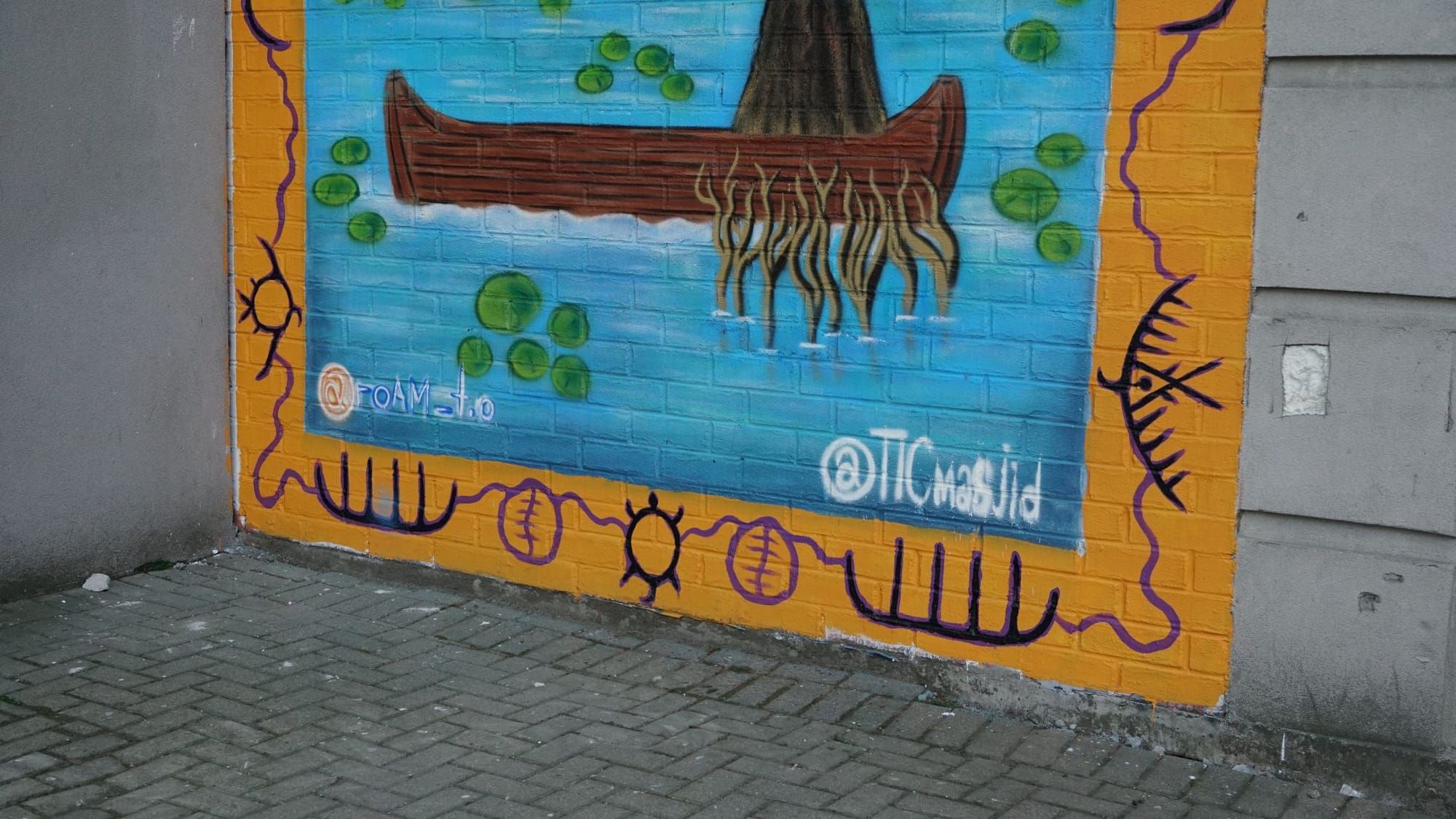
At the centre of the composition, a canoe glides smoothly through the water, representing these ancient pathways and life journeys.
Rising directly from the canoe is a tree—a universal symbol of deep roots, ongoing growth, and community resilience.
At the base rests a turtle, a profound symbol in many Indigenous traditions representing Turtle Island and a shared, sacred connection to the earth.
Framing History and Identity
Framing the entire piece is an intricate, Indigenous-inspired border featuring thunderbirds and canoes.
In local traditions, the thunderbird symbolizes strength, protection, and spiritual power.
Together with the canoes, they frame the mural within the enduring history and teachings of the First Peoples of this region.
As the eye moves across the wall, the ancient path effortlessly meets the present day.
The silhouettes of the Toronto skyline and the mosque connect the historical narrative directly to the urban landscape the Centre proudly serves today.
Capping the entire artwork is the Toronto Islamic Centre logo.
The emblem—a beautiful fusion of the Canadian maple leaf and the Islamic eight-pointed star (rub el hizb)—radiates outward.
It serves as a striking visual metaphor for a community deeply rooted in its faith and equally dedicated to its civic home.
"What was once a wall frequently targeted by graffiti has become an active source of reflection, cross-cultural conversation, and neighbourhood pride."
A Model for Progressive Community Building
This mural is more than just a successful beautification project; it is a masterclass in thoughtful community engagement and an expression of true civic responsibility.
In a multicultural metropolis like Toronto, interfaith and intercultural dialogue can sometimes feel abstract—relegated to academic panel discussions and official institutional statements.
The Toronto Islamic Centre, Tom Tom Sinclair, and Roam have proven that the most enduring connections are often forged when we roll up our sleeves and physically create something tangible together.
By anchoring its presence in the sacred history of the Davenport Portage, the Centre demonstrates an essential, localized Islamic truth: to truly belong to a place, one must understand and respect the stories of those who walked it first.
In Islamic legal scholarship, this is the very foundation of establishing an authentic local custom (‘urf)—the living context through which Muslims practice responsibility, dignity, and care in the place they now call home.
Honouring the hosts of Turtle Island and respecting regional histories is not an optional civic courtesy; it is a spiritual trust (amanah).
What was once a recurring canvas for graffiti has been transformed into a source of pride, safety, and daily conversation.
The Toronto Islamic Centre has effectively rewritten the narrative of its outer wall.
They didn't just cover up the marks of malice; they replaced them with a permanent vision of harmony, reminding every passerby that our journeys, though varied, are ultimately connected by the land we share.
Sources and Contextual References
- The Davenport Portage History: Historical archives of Toronto's ancient Indigenous trail networks and portage routes along the Davenport ridge.
- Islamic Artistic Frameworks: Classical design principles focusing on geometry, silhouettes, and abstract representation (Aniconism in Islamic Art).
- Indigenous Iconography: Traditional teachings surrounding Turtle Island, the Thunderbird protector symbol, and the canoe as a vessel of a shared journey.
- Islamic Jurisprudence and Reconciliation: The legal concept of ‘Urf (local custom) and Amanah (trust) as highlighted by the Canadian Muslims in Indigenous Reconciliation (CMIR) initiative.
- Recent News Context: Documented security challenges and safety responses at the Toronto Islamic Centre (TIC) during early 2026.