
What Happened to the Waqf? Why Muslims Forgot One of Their Greatest Civilizational Tools
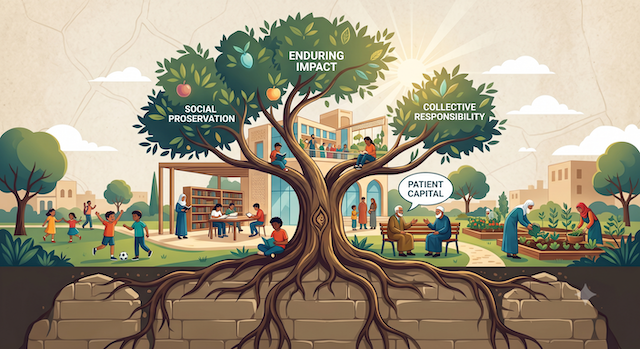
Historically, waqfs translated faith into infrastructure. They allowed ordinary people—not just wealthy elites—to contribute to public good in ways that compounded over time. In modern contexts, this is precisely what Muslim communities lack: patient capital rooted in faith.
By Muneeb Nasir
For centuries, Muslim societies did not wait for rulers, governments, or benefactors to solve their problems.
They built waqfs.
Hospitals, universities, libraries, water systems, orphanages, public kitchens, roads, and cultural institutions were not state programs—they were endowments.
Quiet, permanent, investments that allowed communities to care for themselves across generations.
And yet today, in many Muslim communities, the waqf has nearly vanished from collective consciousness.
Ask the average Muslim about zakāt and they can quote verses and rates.
Ask about ṣadaqah and emotions stir immediately.
Ask about waqf—and you are likely met with silence, confusion, or the assumption that it is something only the wealthy could afford.
This is not a small loss. It is a civilizational amnesia.
How Did We Forget?
The disappearance of waqf culture did not happen overnight.
It unfolded quietly through several forces working together.
Colonial disruption dismantled Muslim-managed institutions and transferred public welfare to centralized states.
Over time, Muslims were conditioned to see social responsibility as something handled by governments—or by emergency charity—rather than by permanent community institutions.
At the same time, religious discourse narrowed.
Charity became transactional: give, feel relief, move on.
The deeper theological imagination—of planting for the afterlife, of collective responsibility, of building institutions that outlive us—was sidelined.
Even fard kifāyah, the doctrine of communal obligation, faded from public conversation.
We forgot that Islam does not only ask individuals to pray and fast—it asks communities to ensure education, justice, care for the vulnerable, cultural continuity, and intellectual life.
When these obligations go unmet, the accountability is collective.
The Cost of Forgetting
The result is visible everywhere.
Mosques struggle to fund social services.
Muslim youth lack sustainable cultural and intellectual institutions that speak to their lived reality.
Community organizations operate in survival mode, chasing short-term donations.
Long-term planning is rare. Endowments are almost nonexistent.
We have learned how to respond to crises—but forgotten how to build permanence.
And so our communities remain fragile, reactive, and dependent, even in societies where Muslims possess wealth, professional expertise, and civic freedom.
Why Waqf Still Matters—Perhaps More Than Ever
The waqf was never merely a fundraising tool.
It was a worldview.
A waqf says: I am responsible for more than my lifetime.
It says: My wealth is not only for consumption, but for continuity.
It says: I believe the afterlife is real, and I am investing accordingly.
Historically, waqfs translated faith into infrastructure.
They allowed ordinary people—not just wealthy elites—to contribute to public good in ways that compounded over time.
In modern contexts, this is precisely what Muslim communities lack: patient capital rooted in faith.
Reclaiming the Waqf: From Charity to Responsibility
Reclaiming the waqf requires more than nostalgia.
It requires a shift in religious imagination.
First, religious leadership must re-center fard kifāyah in public teaching.
Community well-being is not optional.
Education, mental health, civic engagement, cultural preservation—these are religious responsibilities, not luxuries.
Second, philanthropy must move beyond emotion-driven giving.
Emergency relief will always matter, but it cannot be the sum total of Muslim generosity.
We must relearn how to give strategically, collectively, and permanently.
Third, waqf must be democratized again.
Historically, waqfs thrived because ordinary people participated.
Small, consistent contributions—not grand gestures—built enduring institutions.
A Living Example: Olive Tree Foundation
This is where the Olive Tree Foundation matters.
The Foundation represents a quiet but radical idea: that Canadian Muslims can reclaim the waqf tradition here and now, within modern legal frameworks, without waiting for wealth or consensus.
By functioning as a public endowment foundation, it preserves capital while deploying investment income to address communal obligations—social services, education, civic engagement, arts, culture, and policy development.
These are not incidental choices. They are modern expressions of fard kifāyah.
More importantly, the Olive Tree Foundation challenges a deeply ingrained assumption: that legacy is something only the wealthy leave behind.
It invites families, individuals, and organizations to participate in ongoing charity—ṣadaqah jāriyah—that strengthens community life long after donors are gone.
This is not charity as charity.
This is charity as responsibility.
The Question We Must Ask Ourselves
The real question is not whether Muslims can afford to revive the waqf.
It is whether we can afford not to.
What does it say about us if we build beautiful mosques but neglect the social, intellectual, and cultural ecosystems that allow faith to flourish?
What future are we preparing if our giving addresses symptoms but never builds structures?
The waqf was never about money alone.
It was about vision, patience, and belief in continuity beyond the self.
If Muslims are serious about flourishing—not merely surviving—in modern societies, the waqf must return from the margins to the center of our communal life.
The tools already exist. The tradition is ours. The need is undeniable.
The only remaining question is whether we are ready to remember who we once were—and who we are still capable of becoming.
About The Olive Tree Foundation
The Olive Tree Foundation is a Canadian waqf (endowment) that creates lasting impact by growing permanent charitable funds whose investment earnings support critical community priorities and emerging social needs. Through the enduring power of endowment giving, we help strengthen communities today while creating a legacy of generosity for generations to come. Together, we are building a stronger, more compassionate society.