
How a Chance Taxi Ride Opened Fort McPherson’s First Food Bank
A unique partnership between a Toronto-based Muslim charity and a Gwich’in community has proven that distance is no barrier to compassion. On June 22, the remote community of Fort McPherson officially opened its first-ever food bank.
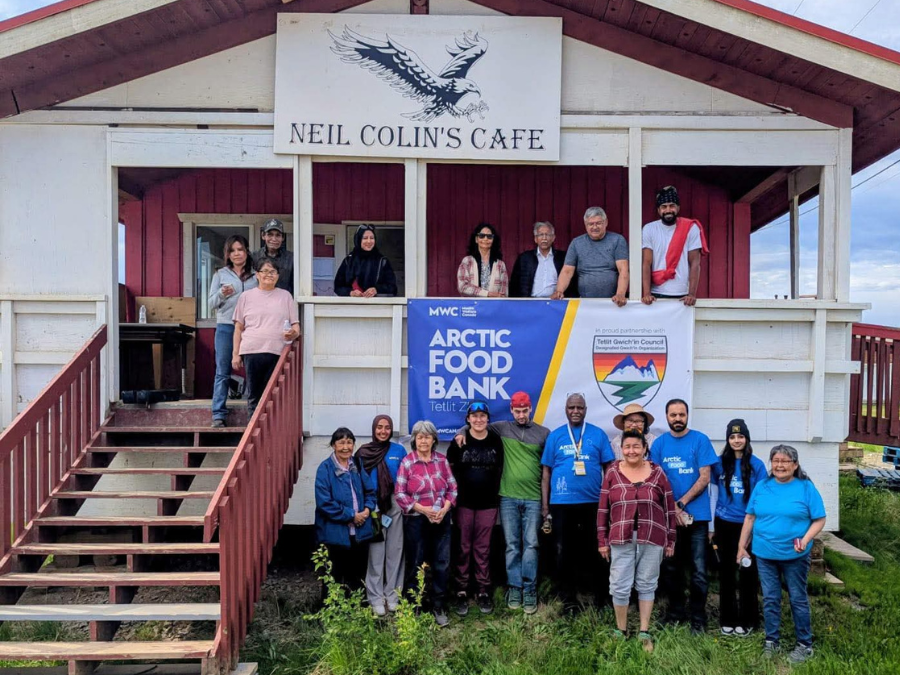
It is a long way from the bustling streets of the Greater Toronto Area to the quiet, wind-swept landscapes of the Northwest Territories.
But a unique partnership between a Toronto-based Muslim charity and a Gwich’in community has proven that distance is no barrier to compassion.
On June 22, the remote community of Fort McPherson officially opened its first-ever food bank.
The initiative, born out of a chance conversation thousands of kilometers away, is a joint effort between Muslim Welfare Canada (MWC) and the Tetlit Gwich’in Council.
On its very first day of operations, volunteers welcomed and served 105 local households.
A Providential Conversation
The story of the food bank begins with Diane Koe of the Tetlit Gwich’in Council.
While attending a conference in Toronto, Koe learned a distressing fact: Fort McPherson was the only Gwich’in community in the Northwest Territories without an active food bank.
The reality weighed heavily on her mind as she headed home.
On her way to the airport, she struck up a conversation with her cab driver and shared her frustration. In a remarkable turn of events, the driver revealed that he had personally helped establish Muslim Welfare Canada's Arctic Food Bank in Inuvik.
That single, providential conversation quickly transformed into a formal partnership.
Upon returning, connections were forged between the Tetlit Gwich'in Council and MWC, setting the wheels in motion to bring essential food relief to Fort McPherson.
The High Cost of Living in the North
For Canadians living in southern urban centers, the depth of the food security crisis in the North can be difficult to fully comprehend.
Due to extreme isolation, the cost of basic groceries in Northern fly-in or ice-road communities is astronomically high.
In Fort McPherson, residents frequently face prices like $10.99 for a single carton of milk. Food insecurity in Canada's North runs four to eight times the national average.
Logistics present a massive hurdle for local communities.
The nearest center where food can be purchased in bulk is more than 3,000 kilometers away—a journey that takes three to four days by heavy truck.
When local stores run dry or prices rise beyond reach, families are left with very few options.
"The need up there is hard to picture from a kitchen in the GTA," said a representative from Muslim Welfare Canada. "Families are really struggling. When the food runs out, they rely on our food banks to put food on the table."
Expanding a Legacy of Northern Care
While Fort McPherson is MWC's newest northern endeavor, the charity is no stranger to the region.
This opening marks MWC’s third dedicated food bank in the North, building on existing operations in Inuvik and a decade-long presence in Iqaluit, Nunavut.
The newly established food bank is designed to serve approximately 100 local families twice a month, providing a reliable safety net of non-perishable goods and essentials.
The program relies heavily on the ongoing support of monthly donors to keep the shelves stocked in the face of demanding transport logistics.
For the Gwich’in community, the arrival of the food bank is a major relief and a testament to the power of unexpected friendships.
"Thank you to the Muslim community in Toronto for coming all the way to our community," said Diane Koe, reflecting on the journey from that initial cab ride to opening day.
In a world where divisions often dominate the headlines, the collaboration in Fort McPherson stands as a beautiful reminder of what can be accomplished when communities listen to one another, find common ground, and decide to build a bridge.