
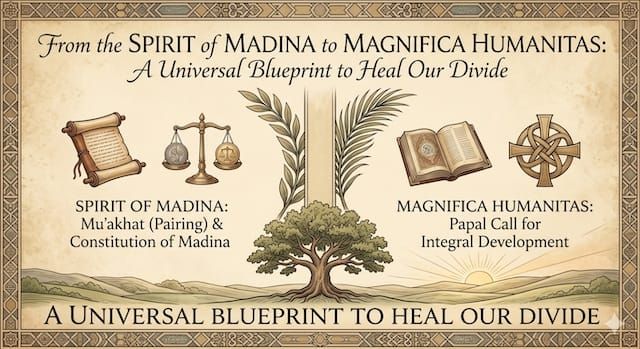
From the Spirit of Madina to Magnifica Humanitas: A Universal Blueprint to Heal Our Divide
Unity is never an accident; it is an active, courageous moral choice. By anchoring our collective lives in the shared values of human dignity, mutual responsibility, and universal justice, we can build communities that heal our fractures and transform our world once again.
By Muneeb Nasir
We are drowning in a digital world that feels deeply divided and thoroughly exhausted.
Today, an unwritten rule seems to govern our lives: protect your own group, look at the outsider with suspicion, and judge a person's worth by their wealth, status, or brand.
This might sound like a harsh critique, but it is also a snapshot of the Arabian Peninsula in the early seventh century.
Yet, in that fiercely divided desert landscape, an extraordinary transformation took place almost overnight.
Fiercely independent tribes, long locked in bitter cycles of blood revenge, united into a single, global community—the ummah.
It was a social reordering so profound that it permanently altered the course of human history.
How did a society fractured by generations of conflict achieve such deep, enduring cohesion?
The answer lies not in political compromises, diplomatic accords, or economic treaties, but in a radical spiritual revolution that fundamentally redefined what it means to be human.
Today, as we grapple with the isolating currents of our hyper-connected age—a reality recently critiqued by Pope Leo XIV in his encyclical Magnifica Humanitas—the blueprint of that early Islamic transformation offers a timeless framework for building communities that inspire, heal, and endure.
The Pillars of Radical Equality
The transformation began by dismantling the spiritual and social justifications for hierarchy.
In pre-Islamic Arabia, lineage dictated an individual's entire worth.
To be born into a weak clan was to live on the margins of society and human dignity.
Early Islam shattered this model through the principle of Tawhid (the oneness of God).
By establishing that there is a singular Creator, the Prophetic message leveled the human playing field.
If humanity shares a common, divine origin, then no tribe, race, or class can claim inherent superiority over another.
This shifted the basis of human worth away from the accidents of birth toward personal character and ethical mindfulness (taqwa).
As the Qur’an beautifully reminds humanity: “People, We created you all from a single man and a single woman, and made you into races and tribes so that you should recognize one another. In God’s eyes, the most honoured of you are the ones most mindful of Him: God is all knowing, all aware.”
This was not passive philosophy; it was an active demand for connection.
Diversity was intentionally framed not as a source of friction, but as a divine invitation to learn from one another.
From Isolation to Shared Destiny
To turn this vision into a lived reality, Prophet Muhammad, peace be upon him, introduced a revolutionary social mechanism during the migration to Madina, known as the Mu'akhat (the pairing system).
Rather than allowing displaced refugees to fend for themselves on the margins of society, the Prophet paired each newcomer with a local resident.
This was not a simple charitable handout; it was an intentional blending of lives.
Total strangers shared their homes, their businesses, and their hearts, creating an unprecedented economic and emotional safety net based purely on a shared moral vision.
They traded the insular safety of the biological tribe for the expansive responsibility of a human fraternity.
Shortly thereafter, the community codified this spirit into law through the Constitution of Madina.
This historic document did not demand that everyone convert or assimilate.
Instead, it established a multi-faith, pluralistic confederation where Jewish tribes, pagan residents, and Muslims were recognized as equal citizens of a single political community.
It guaranteed religious freedom and established a centralized rule of law, effectively breaking the ancient, lawless cycles of tribal retaliation.
A Timeless Convergence
Fourteen centuries later, this ancient wisdom finds a striking echo in the highest echelons of contemporary thought.
In his recent encyclical, Magnifica Humanitas, Pope Leo XIV issued a poignant warning against a modern world that increasingly treats human beings as data points to be optimized or tools to be used for technological and economic efficiency.
The Pope reminded the world that the ultimate measure of any civilization is not its technological prowess, but its ability to honour the "God-given magnificence of the human person".
The convergence between these two traditions reveals a universal blueprint for social renewal.
First and foremost, both models assert that human dignity is absolute and cannot be bargained away for profit, power, or political alignment.
Just as early Islam insisted that character matters more than lineage, the papal call insists that human beings are persons called to relationship and communion, rather than objects to be optimized by machines.
Furthermore, both traditions agree that the true moral health of a community is judged exclusively by how it protects those who hold the least power.
The Madina pairing system offered a proactive, systemic framework to welcome the displaced and vulnerable, mirroring the encyclical's call for integral development that elevates entire peoples rather than leaving the marginalized behind.
Finally, both the historical Constitution of Madina and the contemporary call for global solidarity demonstrate that pluralism requires deliberate intent.
Cohesion is achieved not by erasing our unique identities, but by organizing society around a shared "ambition for peace" and collective ethical responsibilities.
Rekindling the Spirit of Community
The achievements of the past are not meant to be merely admired; they are meant to be mobilized.
The fragmentation we feel today—the loneliness of the digital crowd, the polarization of our politics, and the systemic neglect of the vulnerable—is not a permanent condition.
It is a symptom of a society that has forgotten how to build covenants.
To inspire our neighborhoods and institutions today, we must actively choose the path of Madina and the call of Magnifica Humanitas.
We must build spaces where people are valued for their ethical contribution to the common good, rather than their social status.
We must design proactive systems that welcome the newcomer, protect the isolated, and bridge the divides of faith, culture, and politics without demanding the erasure of our unique identities.
Unity is never an accident; it is an active, courageous moral choice.
By anchoring our collective lives in the shared values of human dignity, mutual responsibility, and universal justice, we can build communities that heal our fractures and transform our world once again.
References
- Abdel Haleem, M.A.S. (Trans.). (2004). The Qur'an. Oxford World's Classics. Oxford University Press. (Specifically referencing Surah Al-Hujurat, 49:13).
- Armstrong, K. (2006). Muhammad: A Prophet for Our Time. HarperOne. (Detailing the tribal landscape of pre-Islamic Arabia and the social impact of the Hijrah).
- Hamidullah, M. (1975). The First Written Constitution in the World. Sh. Muhammad Ashraf. (An analytical study of the Constitution of Madina and its pluralistic framework).
- Leo XIV, Pope. (2026). Magnifica Humanitas. Libreria Editrice Vaticana. (On human dignity, technology, and global solidarity).
- Ramadan, T. (2007). In the Footsteps of the Prophet: Lessons from the Life of Muhammad. Oxford University Press. (Explorations of the Mu'akhat pairing system and community dynamics in Madina).