
Are We Preserving Muslim History — Or Hiding From the Present Behind It?
We admire old achievements while looking away from present problems — like the quiet erosion of shared religious purpose, which leaves us looking more like a patchwork of separate cultural groups than one community united by faith.
By Muneeb Nasir
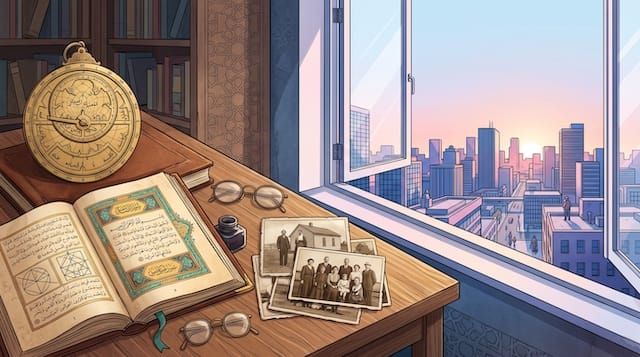
Every October, Islamic Heritage Month brings exhibits to our community centres, libraries, schools, and mosques celebrating the "Golden Age" — the scholars of Baghdad and Córdoba, the medical breakthroughs of that age, the navigation tools that once helped chart the world.
Lately, something valuable has been happening alongside this: Canadian Muslims have started looking closer to home, digging into the many chapters of their own history in this country.
That work is well underway. Groups like the Muslims in Canada Archives (MiCA) are changing how we preserve our collective memory.
Meanwhile, communities outside the big cities — from the Prairies of Manitoba to Newfoundland and Labrador — are collecting oral histories, family records, and old organizational papers to document their own roots.
This growing interest in our history matters. History gives a community its sense of identity — where it came from, how it was shaped, and what it's capable of.
Documenting our past shows that Canadian Muslims aren't newcomers passing through, but people who have been building, working, and contributing here for decades.
But as we dig deeper into this history, we need to ask ourselves an honest question: are we using it to build something better, or are we using it as a comfortable escape from harder conversations happening today?
Celebration has a downside: it can slide into nostalgia. When a community focuses too much on honouring the past, history stops teaching us anything and becomes more like a museum display.
We admire old achievements while looking away from present problems — like the quiet erosion of shared religious purpose, which leaves us looking more like a patchwork of separate cultural groups than one community united by faith.
The Qur'an doesn't treat history as something to feel proud about. It treats it as something to study carefully and learn hard lessons from: "Say, ‘Travel throughout the earth and see what fate befell those who rejected the truth.’" (6:11).
Its approach to the past is analytical and honest — it asks us to find the patterns that explain why some communities thrive and others fall apart.
Applied to Canada, that kind of honest look raises some tough questions we often avoid.
For years, we've discussed what "Canadian Muslim" really means. Are we just a mix of different cultural communities who happen to live in the same country?
Or is something more unified forming — an identity rooted in faith first, rather than in whichever culture each of us grew up with?
Despite decades of growth, hundreds of active local institutions, and a real civic presence, our organizations still tend to work in isolation. We haven't managed to come together as one national community with a shared vision.
Looking honestly at our history, we have to ask: what's been holding us back from speaking with one voice — structural barriers, regional divides, or differences in outlook?
The early pioneers who settled the Prairies, built the Al-Rashid Mosque in 1938, or started the first community associations in St. John's and Winnipeg weren't motivated by sentimentality.
They worked together pragmatically, made quiet sacrifices, and found ways to cooperate across ethnic and language differences — all on tight budgets. For them, building community meant solving real, immediate problems.
Their example isn't something we should just admire from a distance — it's something we're meant to live up to. Preserving records and honouring pioneers matters, but that reflection needs to lead somewhere: toward rebuilding stronger institutions today.
To move past fragmentation and drift, our community needs a clear shared direction — something like a Community Charter.
It would spell out our common values: belief in the Oneness of God (Tawḥīd), justice ('Adl), compassion (Rahmah), mutual consultation (Shura), and service to others (Khidmah).
It would define us not by ethnicity or buildings, but by the values we live out together in Canadian society.
Making that happen will take the same spirit our pioneers had — bringing scholars, imams, thinkers, civic leaders, and everyday community members together in real conversation to build a genuine sense of belonging.
Islamic History Month shouldn't just be a time to look back fondly. It should be time to take stock.
Our predecessors — both in the classical era and here in Canada — faced their challenges with courage and determination.
If we want to honour them, we need to move past nostalgia, face our problems honestly, and shape our future around the values we claim to share.