
Olive Tree Foundation Marks 20 Years of Endowment Giving at Toronto Luncheon
The Olive Tree Foundation celebrated more than two decades of work at a donor luncheon at the Courtyard by Marriott on Sunday, October 25, encouraging a new generation of Canadians to give with the long term in mind.
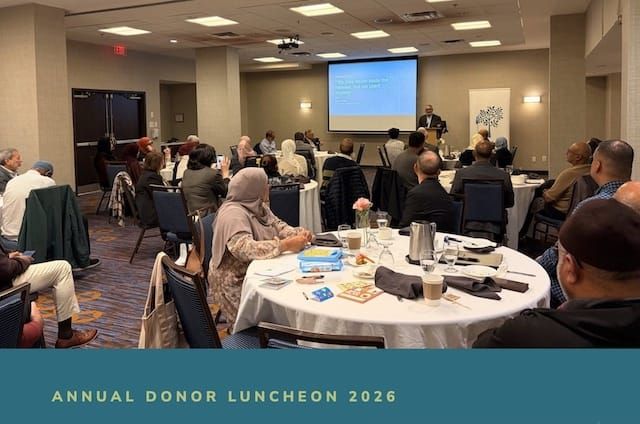
The Olive Tree Foundation celebrated more than two decades of work at a donor luncheon at the Courtyard by Marriott on Sunday, October 25, encouraging a new generation of Canadians to give with the long term in mind.
The Foundation began as a small effort funding after-school homework clubs for newcomer families. It now manages 37 named endowment funds and distributed more than 60 grants between 2004 and 2025.
How the model works
The Foundation's approach draws on the Islamic tradition of the waqf, in which a donated asset is invested and the returns fund charitable work.
Treasurer Muhammed Haseeb Ali explained it with the image of an olive tree: the roots are the donor's original gift, which is never spent; the trunk is the investments; and the fruit is the income that pays for grants and scholarships.
Ali said that paying out 3 to 5 per cent a year means total grants can equal the original donation in about 20 years, while the gift itself stays intact. The idea is linked to sadaqah jariyah, or continuous charity.
Partners describe the impact
Three organizations supported by the Foundation's endowments spoke at the event:
- York University's Islamophobia Research Hub has received funding for a summit for Muslim student leaders, annual student leadership awards, and a 2025 national survey on Muslim student advocacy, said Vice Chair Naeem Siddiqi.
- The Azerbaijani Women's Support Centre, represented by advisory committee member Konul Gurbanova, trains young leaders of different faiths across the Greater Toronto Area and runs workshops on identifying and responding to domestic violence. It is also developing culturally aware risk-assessment tools for frontline workers.
- Faith and the Common Good, whose executive director Victor Reyes described more than a decade of environmental projects with the foundation, from community resilience hubs in 2014 to the Greening Canadian Mosques initiative. Reyes said the foundation's early and repeated funding was a vote of confidence.
An act of faith
Founder and Chair Muneeb Nasir said that charity often moves quickly from one emergency to the next.
Twenty years ago, he said, the foundation chose a different path: finding grassroots groups and funding multi-year projects that deliver lasting benefits.
"An endowment is fundamentally an act of faith," Nasir said. "It says: I may never meet the person this helps."
He traced the foundation's growth from homework clubs to legal and civil rights work and academic research.
Partners have included the National Council of Canadian Muslims, the Canadian Association of Muslims with Disabilities, DEEN Support Services, and the First Nations Child & Family Caring Society, whose Spirit Bear Award the foundation has supported.
He also paid tribute to early supporters Pervez Nasim and Tauqir Yasin, both now deceased.
Two legacies honoured
Nasir also remembered two community leaders who died in the past year. Professor Hind Al-Abadleh, a former atmospheric chemist at Wilfrid Laurier University, created a fund through her will to support environmental research, STEM scholarships and initiatives for underserved communities.
Irfan Alli, a longtime community builder who died in late 2025, is remembered through the Irfan Alli and Rukhsana Khan Family Endowment.
"A meaningful legacy does not happen by chance—it is built with intention," Nasir said.
Board Secretary Usman Hameed moderated the event, and Director Umar Nasir closed with thanks to donors, partners and volunteers.