
Government wants us all to have emergency supplies for 3 days.
Recent public health and civil defence campaigns across Europe have sparked fresh debate about how prepared ordinary families are for modern crises.
Recent public health and civil defence campaigns across Europe have sparked fresh debate about how prepared ordinary families are for modern crises.
In the United Kingdom, officials recently launched public advice urging residents to stockpile three days’ worth of bottled water, non-perishable food, flashlights, and battery-powered radios.
The initiative, framed as a response to severe weather, power grid failures, and potential cyberattacks on critical infrastructure, quickly prompted Canadians to ask a familiar question: is our own emergency planning enough?
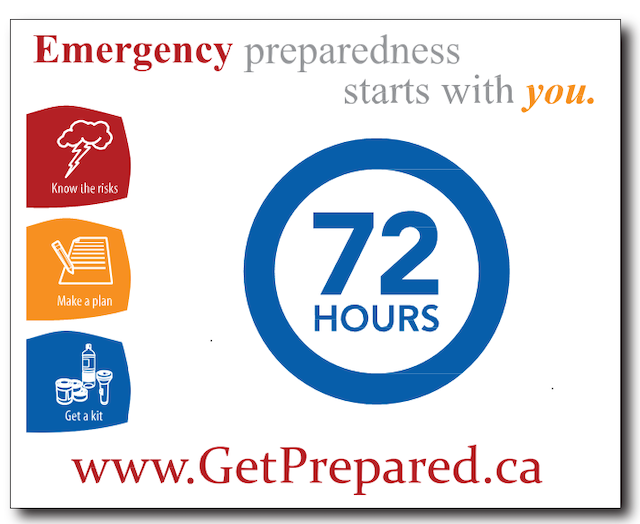
In Canada, Public Safety Canada maintains its longstanding guidance: every household should be self-sufficient for a minimum of 72 hours.
While that core threshold remains unchanged, emergency response planners and community leaders increasingly warn that a three-day kit may only be the starting line.
The Anatomy of the 72-Hour Kit
According to the federal government’s Get Prepared initiative and provincial health advisories, the 72-hour baseline is intended to bridge the critical gap between the immediate onset of a disaster and the arrival of municipal and regional relief services.
Public Safety Canada recommends that every home maintain a grab-and-go kit containing:
- Drinking and Sanitation Water: At least two to four litres of clean water per person per day, stored in durable, portable containers.
- Non-Perishable Food: A three-day supply of canned goods, energy bars, or dried foods that do not require cooking or refrigeration, along with a manual can opener.
- Independent Light and Communications: A wind-up or battery-operated flashlight, extra batteries, a portable phone power bank, and a crank- or battery-powered AM/FM radio.
- Medical and Personal Essentials: A comprehensive first aid kit, at least a week’s supply of prescription medications, infant formula or pet supplies if applicable, and basic hygiene products.
- Cash and Critical Records: Small-denomination cash—crucial when point-of-sale machines and ATMs go offline during widespread blackouts—and physical photocopies of identity documents and insurance policies.
Why Three Days May No Longer Be Enough
While the 72-hour standard has guided disaster planning for decades, recent real-world events have tested those limits.
The prolonged freezing rain of the 2023 eastern Ontario and Quebec ice storms, post-tropical storm Fiona in Atlantic Canada, and recurrent atmospheric rivers in British Columbia demonstrated that severe disruption frequently extends beyond day three.
Furthermore, modern civil risks extend beyond traditional winter blizzards. Security analysts point out that digital infrastructure, telecommunications, and grocery distribution networks face rising vulnerabilities from cyber incidents and international supply-chain chokepoints.
Because of these cascading vulnerabilities, several Canadian disaster-management experts now advise that households capable of doing so should quietly build toward a full seven-day reserve.
The Community Deficit: Who Gets Left Behind?
Stockpiling a week’s worth of food, commercial water jugs, and medical supplies carries a significant financial cost.
For low-income families, elderly individuals living on fixed pensions, and renters facing tight living spaces, maintaining a redundant pantry is often financially out of reach.
This reality highlights the fundamental difference between individual stockpiling and true civic resilience.
When public messaging focuses strictly on household stockpiles, it risks shifting the burden of public safety entirely onto the consumer.
True preparedness is not merely an isolated exercise in buying supplies; it is a community responsibility.
During prolonged power outages or municipal disruptions, local volunteer groups, faith communities, and neighbourhood networks are invariably the first responders on the ground.
A comprehensive emergency plan must balance household readiness with active civic connection—knowing who on your block has mobility challenges, ensuring local community centres have backup heating, and establishing mutual-aid check-ins before a crisis occurs.
As Canada navigates an era marked by erratic climate extremes and complex global risks, gathering a flashlight, water containers, and canned goods remains prudent civic duty.
Yet the greatest asset in any extended emergency is rarely the supplies kept behind locked doors—it is the strength and care of the community standing outside them.
Official Canadian Emergency Preparedness Resources
- Public Safety Canada – Get Prepared: Emergency Kits: The primary federal guidance outlining basic and specialized supplies required to remain self-sufficient for a minimum of 72 hours.
- Government of Canada – Emergency Kit Checklist: A practical, itemized printable list detailing drinking water volumes, non-perishable foods, documentation, and seasonal gear.
- Government of Canada – Emergency Planning Resources: Federal guides for building household plans, supporting individuals with disabilities, coordinating pet safety, and connecting with provincial emergency management agencies.
- Canadian Red Cross – Emergency Preparedness & Grab-and-Go Kits: Step-by-step guidance on tailoring disaster kits for distinct hazards (such as wildfires and extended winter storms), including tailored guidelines for remote and northern communities.
- Public Safety Canada – Emergency Preparedness Portal: Policy briefings and operational overviews on national disaster mitigation, the National Public Alerting System (Alert Ready), and cross-jurisdictional response frameworks.