A June Friday at UofT’s Hart House: How a Nervous Teenager went From Georgetown to the Minbar
Our arrival in this country was never only about what we could receive. It was about what we were destined to give. A community that thinks only in years will always be catching up. We need to think in generations.
By Muneeb Nasir
On June 10, 1973, my family stepped off a plane into a city that felt as if it were standing on the threshold of a new identity.
We had come from Georgetown, Guyana—a place of tropical heat, colonial history, and deep-rooted community—to a Toronto rapidly stretching toward the sky.
To a newcomer, the city was a dizzying array of possibilities and uncertainty.
The newspapers that week mirrored a world in flux.
Local headlines buzzed with the impending arrival of Queen Elizabeth II, who would release tagged bass into Grenadier Pond and open the Scarborough Civic Centre.
For a family arriving from a former British Commonwealth nation, those stories felt like a lingering thread of the old world.
Simultaneously, the Watergate scandal dominated the international news.
At the time, the CN Tower was nothing more than a stump of concrete in the earth, and the heated debates over the Spadina Expressway still hung heavily over municipal politics.
And yet, for all the noise about royalty and rapid urbanization, the most significant landmark I encountered that first week wasn’t a skyscraper or a new civic centre.
It was a Gothic-revival building nestled quietly within the University of Toronto: Hart House.
A First Jumu'ah in a New Land
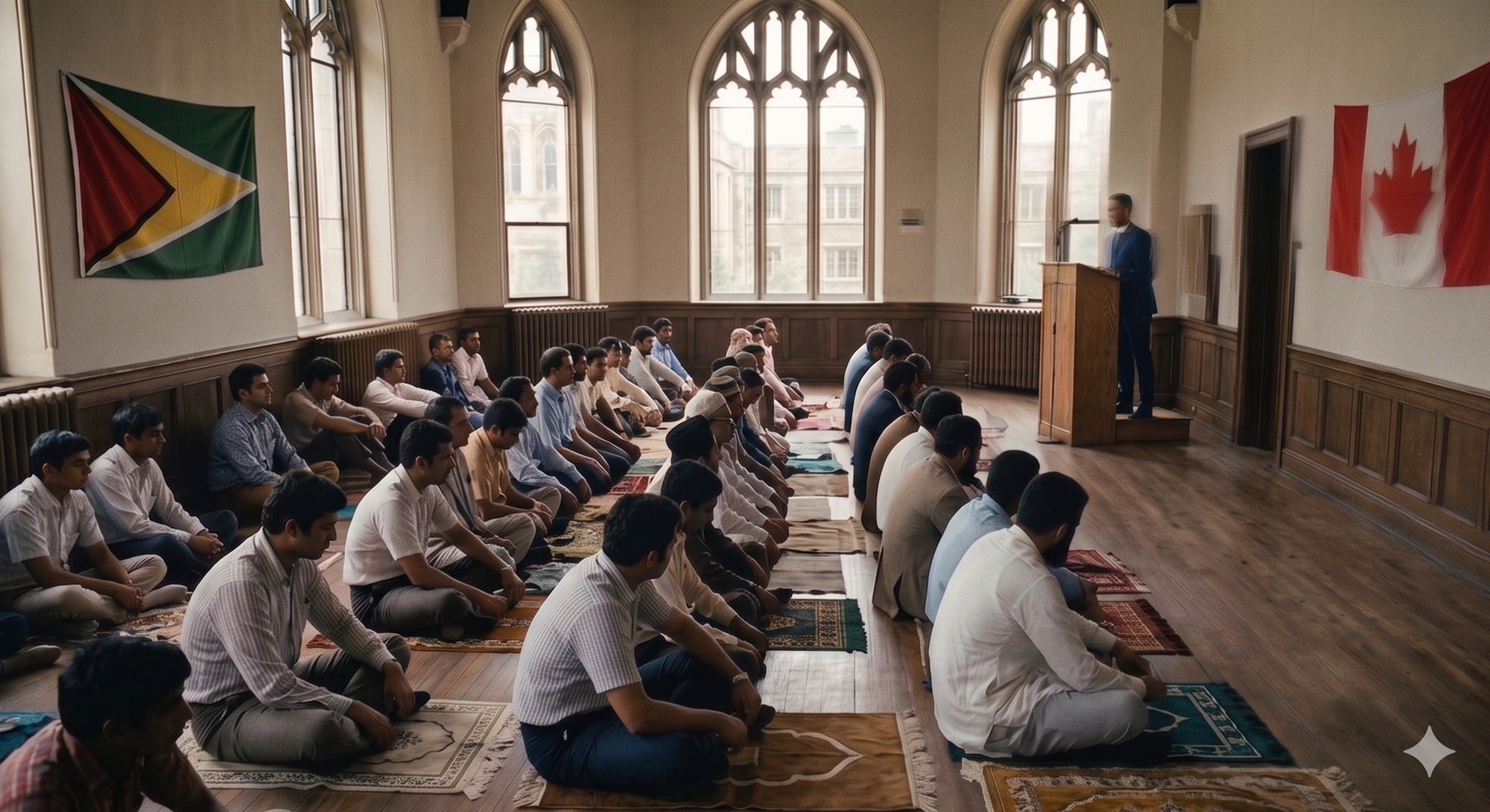
On Friday, June 15, 1973—just five days after landing—my father and I made our way to our first Jumu'ah prayer in Canada.
The Muslim presence in Toronto was not the visible, vibrant community it is today.
No minarets graced the skyline, and you had to know exactly where to look to find a place of worship.
The Muslim Students’ Association had secured space at Hart House years prior, but in 1973, the congregation was still a small, eclectic tapestry of students, professionals, and recent immigrants.
We came from South Asia, the Caribbean, Africa, and the Middle East, filling a university room that felt like a quiet fortress against the unfamiliar city outside.
As the Khateeb rose to deliver the sermon, Toronto’s construction noise and my family’s resettlement anxiety faded away together.
The Qur’an’s call felt immediate, almost physical: “Believers! When the call to prayer is made on the day of congregation, hurry towards the reminder of God and leave off your trading––that is better for you, if only you knew” — (62:9)
I was a seeker that afternoon, looking for belonging in a country I did not yet understand.
The Unseen Path to the Minbar
I could not have known, sitting cross-legged on that floor, that I was standing at the very intersection of my past and my future.
The nervous teenager who arrived in June 1973 would eventually stand on that very minbar, serving as a Khateeb for decades at Hart House.
I would find myself looking out at rows of students and newcomers whose eyes held exactly what mine once had: wide with possibility, heavy with the hopes of their families, and searching for a spiritual home in a secular city.
The transformation from an unfamiliar face in the congregation to a trusted voice on the minbar is a defining story of Canadian Muslims.
It is how a community moves from the periphery to the centre of civic life.
But the lesson it taught me was far more personal than sociological: our arrival in this country was never only about what we could receive.
It was about what we were destined to give.
Building What Endures
This understanding shaped everything that followed—decades of nonprofit, interfaith, civic, and thought leadership built on a single conviction: a community that thinks only in years will always be catching up. We needed to think in generations.
The MSA leaders who secured that room at Hart House in 1965 understood this instinctively.
They were visionary pioneers who built spaces for a future they could not yet see.
While the newspapers wrote about the Queen and Watergate, the real history of Toronto was being written in small, unassuming rooms where people gathered to pray, organize, and imagine.
They paved the way for me to lead, and we are obligated to do the same for those who follow.
The Responsibility We Carry
The Toronto of 2026 is unrecognizable from the Toronto of 1973.
The Muslim community now contributes to every sector of this city—medicine, law, the arts, and public life.
Yet the visible struggle of those early years has matured into something quieter and far more complex: the challenge of ensuring our growth remains rooted in service rather than simply in material success.
The Qur’an frames this responsibility with characteristic precision: “And patiently stick with those who call upon their Lord morning and evening, seeking His pleasure” — (18:28)
That first Jumu'ah was my introduction to those very people—the ones who kept calling.
It planted something permanent in me that no amount of civic achievement has since uprooted.
As we construct institutions and mentor the next generation of leaders, our work is not merely to replicate what came before, but to honour the spirit that made it possible: showing up in an unfamiliar room and choosing to stay.