
Why Our Mosques Need a New Kind of Leadership
It's time to stop running our mosques like corporate boardrooms or private clubs, and start building them as something closer to circles of genuine care.
By Muneeb Nasir
Picture a typical annual general body meeting at a community institution. People argue over membership, parking, procedural technicalities, or a single line in the budget — while just outside the doors, the real life of the community goes on, unnoticed and unaddressed.
This scene repeats itself constantly in mosques especially in the urban centres, and it points to a deeper problem: a crisis of vision, not just a crisis of process. Most boards are made up of sincere, hardworking volunteers. The trouble isn't their character. It's that they've been handed a mission they were never equipped to carry out.
Training Isn't the Fix
When a board struggles, the usual response is to talk about by-law review, membership, and parliamentary procedure. These issues have their place. But they don't touch the real problem.
You can teach someone to take meeting minutes. You can't teach them empathy, or a genuine feel for what their congregation and community actually needs. Treating a vision problem as a paperwork problem doesn't just fail to fix it — it distracts from the fix that's actually needed.
Institutions Built for a World That No Longer Exists
This gap shows up most sharply in communities shaped by immigrant founders. The people who built these institutions had an urgent, unifying mission: construct a building, preserve identity and faith in an unfamiliar country, and give new arrivals a safe place to land. That mission made sense — for that period.
Decades later, the community has changed. The founders' children and grandchildren, along with converts and neighbours who've since joined, are navigating a different world entirely — one shaped by urban pressure, financial strain, mental health struggles, and hard questions about identity and belonging.
Too many boards haven't caught up. They're still governing as if it's the founding era, treating the institution like a fortress to defend rather than a lighthouse meant to guide people in. "Protecting the mission" becomes an exercise in control — while the actual question that matters goes unasked: Is this community being spiritually fed, intellectually engaged, and genuinely supported?
What Real Leadership Actually Requires
No seminar can install these three things — but no institution can thrive without them:
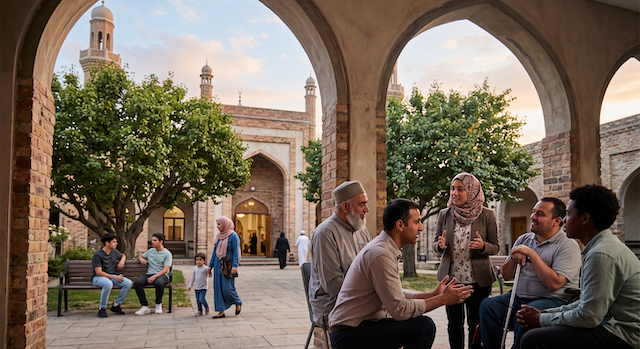
- Connection, not control. A board can't serve people it never talks to. That means leaving the board of directors meeting, walking among your congregation and community, and actually listening — to the teenager who feels invisible, and the woman, the elder, the person with disability who just wants to belong somewhere.
- Real needs, not assumptions. Too many boards design programs around what they think the community needs, based on their own experience and preferences. Real leadership starts with humility: asking hard questions, gathering honest input, and building around the problems people are actually facing.
- Vision, not just upkeep. Paying the bills, replacing the air conditioner and fixing the roof is necessary — but it isn't leadership. Leadership asks a bigger question: What are we doing to make this masjid and neighbourhood, and the people in it, genuinely better?
There's a wider cost, too. An institution turned inward — consumed by internal politics and self-protection — has nothing left to offer the world outside it. That means missed opportunities to partner with other mosque communities and local organizations on problems everyone shares: poverty, isolation, a generation of young people who feel adrift.
A Different Kind of Trust
In the Islamic tradition, leadership is a trust defined by service, not status. It was never meant to be exercised from a distance. Real leaders walk among the people they serve, protect them, and help them grow.
It's time to stop running our mosques like corporate boardrooms or private clubs, and start building them as something closer to circles of genuine care. That shift — from gatekeeping to real engagement — is what turns an institution from a walled-off enclosure into something the whole community can actually lean on.