
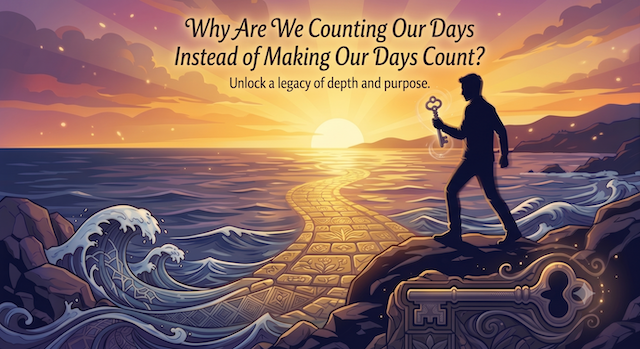
Why Are We Counting Our Days Instead of Making Our Days Count?
Longevity, detached from purpose, risks becoming a vessel well-preserved but entirely unfilled. A profound shift occurs when we stop asking how long we can live and begin asking how well we can live.
By Muneeb Nasir
We live in an age captivated by the promise of a long life.
From health and wellness regimens to technologies promising to push the boundaries of human aging, our culture treats a long life as the ultimate prize.
We count steps, track sleep cycles, and measure biomarkers, often mistaking a long life for a meaningful one.
But a preoccupation with simply adding time to our lives can inadvertently empty those years of their depth.
Longevity, detached from purpose, risks becoming a vessel well-preserved but entirely unfilled.
A profound shift occurs when we stop asking how long we can live and begin asking how well we can live.
To speak of living well is to venture into the realm of faith, a territory that many in modern society approach with hesitation.
For a growing number of people, religion carries a heavy, negative connotation.
It is often viewed through the lens of its institutional shortcomings—seen as dogmatic, overbearing, and rigidly preoccupied with compliance rather than compassion.
When faith is reduced to a set of didactic rules or institutional self-preservation, it loses its soul and alienates the very people it is meant to comfort.
Yet, when we look past the institutional shortcomings, religion practiced with humility and depth offers something indispensable: a compass for navigating life.
It does not merely offer simplistic answers to life’s most difficult issues; it provides the moral and emotional framework required to endure them.
This framework is vividly captured in a profound piece of Prophetic wisdom that redefines how a believer encounters the shifting tides of life:
“Wondrous is the affair of a believer, as there is good for him in every matter; this is not the case for anyone but a believer. If he experiences pleasure, he thanks God and it is good for him. If he experiences harm, he shows patience and it is good for him.” (Saying of the Prophet Muhammad, peace be upon him. Source: Ṣaḥīḥ Muslim).
What this tradition offers is not an escape from reality, but a complete transformation of perspective.
It suggests that living well is entirely independent of having a flawless, anxiety-free life.
Instead, true faith transforms our understanding of life by introducing a dual mechanism of gratitude (shukr) and patience (sabr).
Through this lens, the quality of our days is determined not by our external circumstances, but by the internal depth of our spiritual response to them.
This spiritual orientation offers a striking parallel to conversations happening at the modern frontiers of medicine and public health.
In a recent dialogue on the Staying Human podcast, Dr. Vivek Murthy and surgeon Dr. Atul Gawande explored this exact tension between longevity and living well.
Reflecting on his landmark work Being Mortal, Dr. Gawande noted that for generations, medicine has been trained to treat the preservation of life and independence as the sole, ultimate goal.
Yet, when patients face serious or chronic illness, their priorities often shift dramatically.
They aren't just looking for more time; they want to live in a way that means something to them.
As Dr. Gawande pointed out, living well means discovering what a person’s unique priorities are—whether that is the ability to connect with loved ones, to experience moments of simple joy, or to maintain a sacred daily practice.
When the medical establishment or society at large imposes a rigid, technical focus on safety and survival at all costs, it can inadvertently cause immense suffering by ignoring the very things that give life its texture and meaning.
Faith bridges this gap by shifting our focus from success and survival to significance.
A secular worldview often measures the quality of life by what we can accumulate—wealth, status, influence, and even physical youthfulness.
Faith flips this script entirely. Where society equates a rich life with the accumulation of external markers, the Prophetic tradition firmly anchors value within the internal state of the individual:
“Wealth is not in having many possessions. Rather, true wealth is the richness of the soul.” (Saying of the Prophet Muhammad, peace be upon him. Source: Ṣaḥīḥ al-Bukhārī, Ṣaḥīḥ Muslim)
By defining true prosperity as an inner condition rather than a material tally, faith suggests that a good life is ultimately measured by the depth of our character, the strength of our relationships, and our capacity for service.
It rescues us from the exhausting anxiety of constant self-optimization, resource hoarding, and time-counting, redirecting our energy toward a purposeful, interconnected reality.
This spiritual anchoring provides stability when the material world fractures.
When we are confronted with unavoidable suffering, injustice, or the reality of our own mortality, a purely material perspective can leave us feeling profoundly untethered.
A deeply rooted spiritual practice infuses these hardships with meaning.
By synthesizing gratitude in seasons of ease and patience in seasons of adversity, it assures us that our struggles are not random, lonely occurrences, but part of a larger, purposeful narrative that encourages resilience and hope.
Ultimately, living well is not about the quantity of our days, but the quality of our presence within them.
When stripped of overbearing dogma and lived from the heart, faith stops being a rigid lecture and becomes a source of grace.
It aligns beautifully with the reminder to ask ourselves what truly makes life worth living beyond the numbers on a calendar.
It reminds us that the true measure of a life is found not in how much time we manage to consume, but in how deeply we love, how sincerely we serve, and how quietly we cultivate the wealth of the soul.