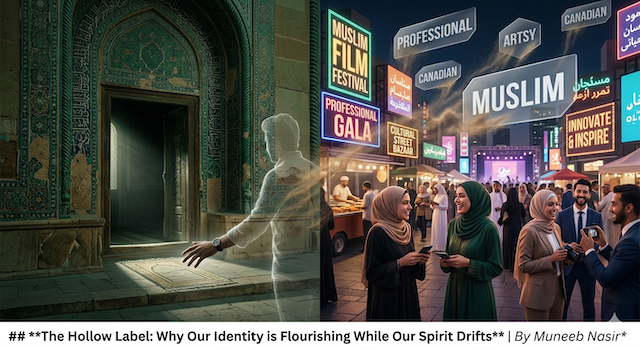
The Hollow Label: Why Our Identity is Flourishing While Our Spirit Drifts
If we do not bridge the gap between our cultural identity and our spiritual reality, we will find that we have gained the world’s recognition but lost our spiritual compass.
By Muneeb Nasir
We are living through a peculiar paradox.
In Canadian society, "Muslim identity" has never been more visible.
We see it in high-gloss film festivals, prestigious professional networking events, sophisticated media projects, gala dinners, and trendy cultural street festivals.
As a demographic, we have "arrived."
Yet, beneath this polished exterior, a spiritual erosion is accelerating.
We are increasingly becoming a community defined by amorphous identity markers—labels that signal where we come from or who we vote for, but not necessarily what we believe or how we live.
We are drifting into a state where we are "Muslim" by affiliation, but secular by habit.
This drift is the result of a deepening schism between our traditional institutions and the modern "third spaces" we’ve built to escape them.
The Foundation: What the Mosque Does Best
Before we critique, we must give credit where it is due.
Our mosques are doing the heavy lifting of spiritual preservation.
They remain the only institutions consistently establishing the five daily prayers, facilitating the memorization of the Qur’an, teaching the tenets of the faith, and holding educational classes and seminars.
Without them, the "skeleton" of Islam in Canada would collapse.
However, many of these institutions struggle to keep pace with the rapid social and psychological changes facing their congregations.
There is often a palpable resistance to change, leading to a culture that can feel rigid or exclusionary.
When a mosque fails to address contemporary issues—from mental health to the complexities of modern identity—with nuance and empathy, it inadvertently pushes its congregants toward the exit.
The Lure of the "Faith-Lite" Third Space
In the vacuum left by the rigid mosque, we have seen a proliferation of "third spaces": media startups, professional mixers, and cultural events.
These spaces are vibrant, inclusive, and socially relevant.
They make being Muslim "cool" and accessible.
But there is a hidden cost.
These spaces can be dismissively secular, often viewing the work of traditional mosques as "backward" or irrelevant.
By prioritizing cultural connection over spiritual grounding, they offer a sense of belonging without the requirement of belief or practice.
In these spaces, Islam is often treated as a demographic category—akin to an ethnicity—rather than a transformative path.
We start seeking "inspiration" from career success stories rather than "revelation" from the Divine.
The Urgency of "Re-Mosquing"
If we continue on this path, we will raise a generation that is proud of the "Muslim" label but a stranger to the prayer mat.
We are at risk of losing the "kernel" of our faith while desperately polishing the "shell."
The solution is not to abandon the mosque, nor to ignore the innovations of the third space.
We must re-mosque our lives.
This requires a two-fold shift:
- Mosques must become "Meaning-Makers": Our institutions must move beyond just teaching the religious beliefs to teaching the meaning of it. They must open their doors to the messy, complex realities of modern life, becoming spaces where people feel seen and heard, not just lectured.
- Third Spaces must be Grounded: Organizers of cultural and professional events must resist the urge to decouple identity from faith. A "Muslim" event that has no room for God, for prayer, or for Prophetic ethics is simply a secular event with a religious name.
We must remember the warning in the Qur'an: "True righteousness is not a matter of whether you turn your faces towards the East or the West..." (2:177).
Righteousness is found in those who believe, who are constant in prayer, and who act with integrity.
If we do not bridge the gap between our cultural identity and our spiritual reality, we will find that we have gained the world’s recognition but lost our spiritual compass.
The time to re-anchor our identity in a spiritually-oriented, mosque-centered community is now—before the label is all we have left.