
The Tribal Instinct in Muslim Institutions
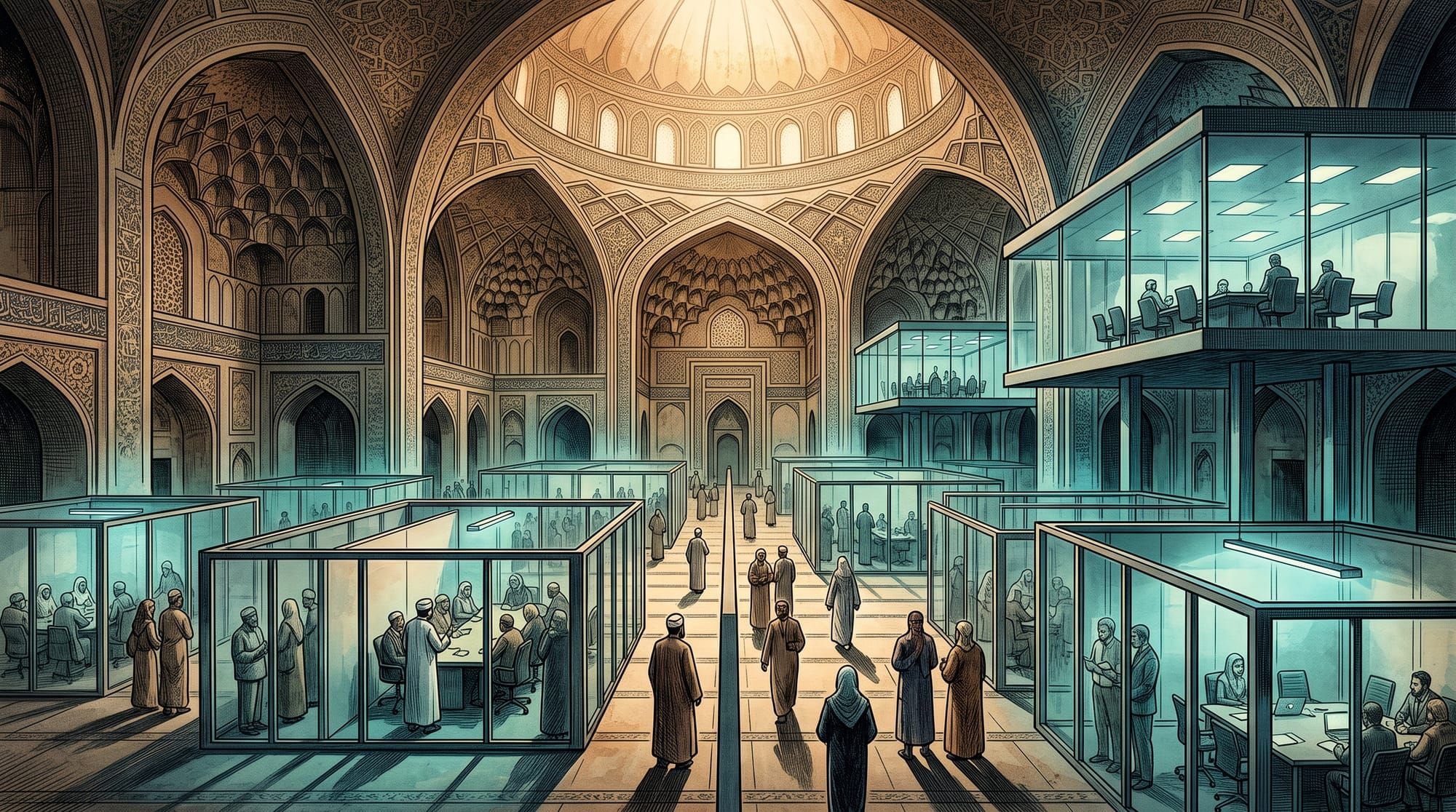
Are our institutions creating larger circles of belonging—or are they simply becoming more sophisticated versions of the tribes Islam came to transcend?
By Muneeb Nasir
This is a question that Muslim communities urgently need to ask themselves:
Are our institutions creating larger circles of belonging—or are they simply becoming more sophisticated versions of the tribes Islam came to transcend?
It is an uncomfortable question because institutions are among the great achievements of Muslim communities.
We have built mosques, schools, charities, youth organizations, advocacy groups, and professional networks. These institutions are essential. They preserve faith, provide services and give communities a sense of permanence.
But institutions can also develop a tribal instinct.
The tribe may no longer be defined by bloodline or geography.
Today, it can be defined by the mosque we attend, the organization we support, the scholar we follow, the school of thought we identify with, the ethnicity we share, or even the ideological camp to which we belong.
The vocabulary has changed. The psychology has not.
Islam’s revolutionary challenge to tribalism
Islam emerged in a society where tribal affiliation profoundly shaped identity, loyalty, and social status. The Qur’an did not deny the existence of tribes or human diversity. Instead, it radically redefined their purpose:
“O humanity! Indeed, We created you from a male and a female, and made you into peoples and tribes so that you may know one another. Surely the most noble of you in the sight of Allah is the most God-conscious of you.” — Qur’an 49:13
The significance is profound.
Tribal identity was not abolished. Tribal superiority was.
Lineage could remain part of who you were, but it could no longer determine your worth.
Your clan could be part of your identity, but it could not become your ultimate allegiance.
Crucially, the foundation for this transformation is the primacy of Tawhid—the absolute oneness of Allah. By centering all devotion, purpose, and allegiance on the One Creator, Islam provides the ultimate antidote to the exclusionary nature of tribalism.
When the heart recognizes the absolute sovereignty of Allah, constructed boundaries of bloodline, ethnicity, and social status lose their power to divide.
The oneness of the Creator necessitates the recognition of the inherent dignity of all human beings, dismantling the psychological roots of tribal arrogance.
Islam replaced the narrowness of inherited identity with something much larger: the Ummah.
People who would otherwise have been separated by ethnicity, class, geography, and lineage were brought together through a common commitment to Allah and a shared moral purpose.
This was not merely a theological innovation. It was a social revolution.
And it helps explain something remarkable about the early growth of Islam.
Islam gave people an identity larger than themselves.
A person did not have to abandon their heritage to become Muslim. They could bring their culture, language, and history into a much larger human and spiritual community.
Islam did not require everyone to become the same. It gave different people a reason to belong together.
The danger of recreating the tribe
The irony is that human beings have a powerful tendency to recreate what they have been asked to transcend.
When one form of tribalism disappears, another can emerge.
Today, our tribes may be institutional rather than genealogical.
- “My mosque.”
- “My organization.”
- “My movement.”
- “My scholar.”
- “My community.”
- “My people.”
- “My interpretation.”
There is nothing inherently wrong with belonging to any of these. The problem begins when belonging becomes allegiance, and allegiance becomes blindness.
We begin to defend our own regardless of whether our own is right.
We judge the same behaviour differently depending upon who committed it.
We become suspicious of criticism from outside our circle.
We celebrate our institution’s successes as though they were victories for Islam itself, and perceive criticism of the institution as an attack on Islam.
This is precisely where religious identity can become tribal identity.
The question subtly changes from:
“What is right?”
to:
“What is right for us?”
And eventually:
“How do we make sure our side wins?”
That is a dangerous transformation.
When identity becomes more important than truth
One of the clearest signs of tribal thinking is that we become more interested in who said something than whether it is true.
If someone from our institution says it, we instinctively defend it.
If someone from another institution says the same thing, we scrutinize it.
If our leader makes a mistake, we find an explanation.
If another leader makes the same mistake, we find criticism.
This is not simply an inconsistency. It is a spiritual problem.
The Qur’an commands:
“Stand firm for justice as witnesses for Allah, even if it is against yourselves, your parents, or close relatives.” — Qur’an 4:135
That is an extraordinary challenge to tribal thinking.
The Qur’an is effectively saying: Truth cannot be subordinated to loyalty.
Justice cannot depend upon who is involved.
And faith cannot mean protecting our own at the expense of what is right.
The hidden cost: smaller circles
Perhaps the greatest danger is not conflict.
It is exclusion.
A tribal institution tends to become increasingly comfortable serving people who already understand its language, culture, and customs.
The people who don’t quite fit can quietly disappear:
- The convert.
- The young person who asks difficult questions.
- The Muslim from another cultural background.
- The person with a disability.
- The single parent.
- The newcomer.
- The Muslim whose level of religious observance is different.
- The person who doesn’t know the “right” people.
They may technically be welcome, but do they actually feel that they belong?
There is a profound difference between opening the doors and opening the circle.
An institution can be physically accessible while remaining socially closed.
It can have a beautiful mission statement about inclusivity while operating through informal networks that determine who gets heard, trusted, invited, and promoted.
This is how tribalism survives in sophisticated organizations.
It no longer needs a bloodline.
It only needs an insider culture.
Are we building institutions—or ecosystems of belonging?
The real measure of an institution should therefore not simply be how many people attend its programs or how much money it raises.
We should ask:
- Who feels that this institution is for them?
- Who doesn’t?
- Who has a voice?
- Who is always in the audience but never at the table?
- Who benefits from our services?
- Who has quietly stopped coming?
These are uncomfortable questions, but they are essential if we genuinely believe in the universality of Islam.
An institution worthy of Islam should continually expand the circle of belonging.
It should make room for difference without sacrificing principle.
It should welcome newcomers without making them feel like outsiders.
It should allow disagreement without turning disagreement into disloyalty.
It should be able to receive criticism without becoming defensive.
And it should be willing to acknowledge that someone outside its circle may sometimes see something that insiders cannot.
From competition to complementarity
Another manifestation of institutional tribalism is competition:
- Who has more members?
- Who has more donors?
- Whose event attracts more people?
- Whose scholar is more popular?
- Whose organization receives more attention?
But the Ummah does not need every institution to become everything.
We need institutions that recognize their distinct contributions and see themselves as part of a larger ecosystem.
A mosque does not have to compete with a social-service organization.
A charity does not have to compete with an advocacy organization.
A school does not have to compete with a youth organization.
The question should not always be: “How can we become bigger?”
It should sometimes be: “How can we make the whole community stronger?”
That is a very different measure of success.
The test of institutional maturity
Perhaps institutional maturity is reached when an organization no longer needs to be the centre of everything:
- It can celebrate another organization’s success without feeling diminished.
- It can refer a person to another institution because that institution is better equipped to help.
- It can collaborate with people with whom it disagrees.
- It can acknowledge its mistakes.
- It can develop leaders who eventually outgrow the organization.
- It can serve people who may never become members, donors, or supporters.
- And most importantly, it can distinguish between the institution and the mission.
The institution is a vehicle.
The mission is larger.
When the vehicle becomes more important than the destination, we have a problem.
Returning to the spirit of the Ummah
The challenge before Muslim institutions today is therefore not simply organizational.
It is spiritual.
We need to recover the expansive imagination of Islam.
An Islam that does not ask first:
“Which group are you from?”
but:
“How can we serve you?”
An Islam that does not ask:
“Do you belong to us?”
but:
“How can we belong to one another?”
An Islam that understands diversity not as an inconvenience to be managed but as part of Allah’s design.
And an Islam in which institutional loyalty never outranks loyalty to truth, justice, and the common good.
Our mosques, organizations, and institutions matter enormously.
But they must remain servants of the Ummah rather than substitutes for it.
Because the ultimate test is not whether we have built impressive institutions.
It is whether those institutions have helped us build larger hearts, wider circles of belonging, and a stronger sense of shared purpose.
The question before us is therefore not whether we should have institutions.
We absolutely should.
The question is:
What kind of institutions are we building?
Are they becoming bridges between people—or boundaries between tribes?
Are they enlarging the Ummah—or simply organizing its fragmentation more efficiently?
And ultimately:
Are our institutions creating larger circles of belonging—or are they becoming more sophisticated versions of the tribes Islam came to transcend?