
The Shia-Sunni Divide: How Our Internal Walls Strengthen the Islamophobia Industry
If we continue to let sectarian differences feed the narratives of those who wish us harm, we will remain perpetually divided and weak. It is time for our community leaders and activists to speak a language of universal justice.
By Muneeb Nasir
In recent months, the world has witnessed a powerful surge of global solidarity.
From the streets of London to the campuses of Toronto, millions have marched to demand justice for Gaza.
Yet, as a new and dangerous conflict plays out over Iran, the silence from the same quarters—including within our own faith communities—is deafening.
This selective empathy is deeply troubling.
It suggests a fracture in our collective conscience.
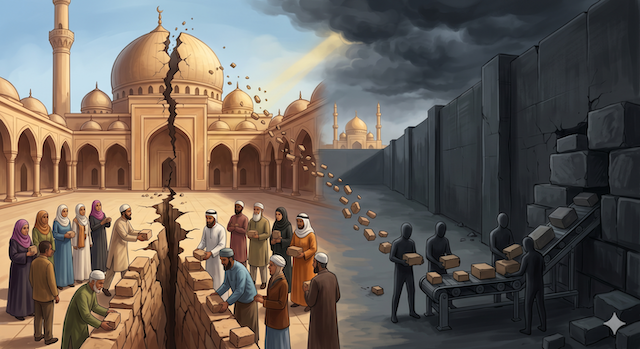
When we allow geopolitical labels or sectarian divides to dictate whose life is worth a prayer, we aren't just failing a segment of our global family; we are providing the "Islamophobia industry" with the very bricks it needs to build its walls.
The Myth of the "Complicated" Victim
Recent reporting from Al Jazeera highlights a striking disparity.
While the genocide in Gaza sparked immediate and sustained mass protests, the response to the escalating U.S.-Israeli conflict with Iran has been remarkably muted.
Analysts suggest that because Iran is viewed as a "sovereign state" rather than a "colonized people," protesters struggle to separate their opposition to military aggression from their criticisms of the Iranian government.
Furthermore, we are witnessing what some call a "video game war."
This conflict is defined by high-tech drone strikes and missiles that often obscure the human cost from Western audiences.
Unlike the visceral, ground-level footage from Gaza that shocks the collective conscience, the suffering in Iran often remains invisible.
This lack of "conscience shock" allows us to remain ambivalent, even as lives are lost and infrastructure is destroyed.
The Geopolitical Weaponization of Faith
Dr. Hatem Bazian, in his recent analysis of anti-Iran and anti-Shia discourses, argues that this rhetoric is not a mere geopolitical disagreement.
Instead, it is a central pillar of the global "Islamophobia industry."
This industry relies on what Bazian calls the "sectarianization of politics"—a strategy where external powers stoke Shia-Sunni tensions to distract from issues of resources, sovereignty, and resistance to hegemony.
By framing every conflict in the Middle East as an "ancient religious feud," the industry makes violence appear inevitable.
Bazian points out that the portrayal of Iran as an "irrational" or "apocalyptic" actor is a classic Orientalist trope.
This framing dehumanizes an entire population, making the prospect of devastating sanctions or military strikes more palatable to the public.
When we, as Muslims, treat the suffering of our Shia brothers and sisters as "complicated," we are inadvertently validating the very narratives used to target all of us.
The "Prayer Gap" in Our Communities
The most heartbreaking manifestation of this discord is found in our own local communities.
In many of our mosques, we hear passionate, tearful prayers (du’as) for the oppressed in Palestine, Sudan, or Kashmir.
Yet, when it comes to the people of Iran—who face internal repression and the threat of external bombardment—the minbar often goes silent.
This "prayer gap" reflects a deep-seated sectarian wall.
Sunni Muslims may hesitate to show support, fearing that a prayer for the people of Tehran might be misconstrued as support for a specific government or theological school.
This ambivalence sends a message to our congregations: that our solidarity has conditions, and our empathy has a sectarian limit.
A Call for Radical Unity
To effectively challenge Islamophobia, we must dismantle the sectarian walls within our own hearts.
We must learn to decouple the people of a nation from the actions of their government.
The Qur’an provides us with a clear directive: “this community of yours is one single community and I am your Lord, so serve Me” (Qur’an, 21:92).
This "single community" is not defined by geopolitical borders or legal interpretations; it is a community of shared dignity.
If we continue to let sectarian differences feed the narratives of those who wish us harm, we will remain perpetually divided and weak.
It is time for our community leaders and activists to speak a language of universal justice.
Our prayers and our protests must not be reserved for those who pray exactly as we do.
Silence in the face of suffering is a luxury we can no longer afford.
If we do not stand for the humanity of all, we will find that, eventually, there is no one left to stand for ours.
References
- Bazian, Hatem. (2026). "Anti-Iran and Anti-Shia Discourses." Hatem Bazian Substack. Available at: https://hbazian.substack.com/p/anti-iran-and-anti-shia-discourses
- Siddiqui, Usaid. (2026). "Why are anti-war protests in the West muted on Iran?" Al Jazeera English. Available at: https://aje.news/42puzj
- The Qur'an. Translation by M.A.S. Abdel Haleem. Oxford University Press.