
From Diapers to Degrees: A Profile of Dr. Mona Rahman
Her story is one of academic excellence, personal resilience, and a deep-seated commitment to making campus culture more inclusive for those who follow in her footsteps.
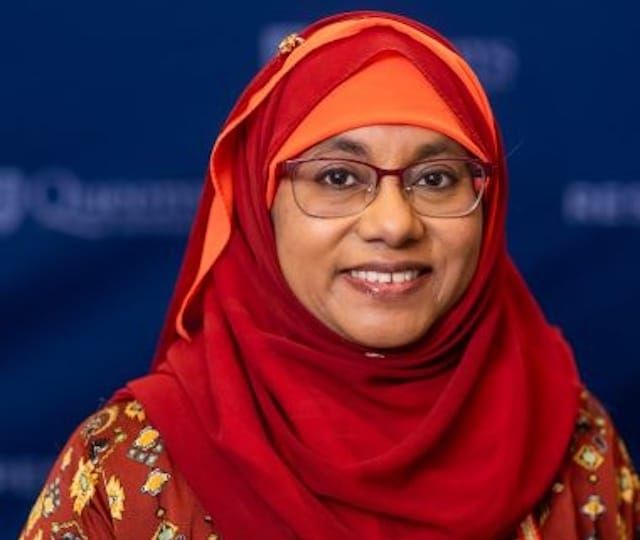
Dr. Mona Rahman likes to say she has been at Queen’s University from “diapers to degrees.”
As the Research Awards Officer in the Vice-Principal Research Portfolio at Queen’s University her connection to the Kingston, Ontario, campus is more than professional — it is elemental.
Born at the Hôtel Dieu Hospital to a father who arrived at Queen’s in 1968 to pursue a PhD in Electrical Engineering, Mona’s life has been inextricably linked to the stone buildings and academic hallways of the university where she has spent the majority of her life.
In a recent interview for The EDII Catalyst podcast, Dr. Rahman reflected on a journey that took her from the specialized world of biochemistry research to the broader, systemic impact of research administration.
Her story is one of academic excellence, personal resilience, and a deep-seated commitment to making campus culture more inclusive for those who follow in her footsteps.
A Natural Path to STEM
Growing up in a tight-knit Muslim community in Kingston — which consisted of only about ten families at the time — academic pursuit was the norm.
“If you asked me what I wanted to be at five years old, I would have told you that I want to get my PhD and I want to be a professor,” Mona recalls.
While the stereotype of the South Asian immigrant family often pushes children toward medicine or engineering, Mona’s father, Hafizur Rahman, offered a different perspective.
He believed that while STEM was vital, it was the historians, journalists, and political scientists who changed the world.
This balanced upbringing allowed Mona to embrace her love for science while remaining grounded in social justice and the importance of diverse perspectives.
Mona eventually chose biochemistry, a path that led her through a PhD at Queen’s and a postdoctoral fellowship at the Robarts Research Institute.
Her research specialized in the structure-function relationships of proteins and genetic fingerprinting, and later X-ray crystallography — work that required precision, patience, and many hours in the lab.
The Pivot to Administration
The transition from the lab bench to research administration was not a traditional one, but it was driven by both necessity and a desire for a wider impact.
During a period of significant cuts to fundamental research funding in Canada, Mona found herself navigating a precarious landscape.
“I like research,” Mona says, “but research administration is very eye-opening. I like it because I can interact with all the researchers across campus rather than my own little silo.”
The move also allowed for a better balance between her professional life and her family.
In administration, she found she could still contribute to the advancement of science—not by running experiments, but by ensuring that researchers have the institutional support and recognition they need to thrive.
Confronting the "Cyclical" Culture
Despite her deep roots at Queen’s, Mona’s journey has not been without its hurdles.
She describes herself as having lived a "privileged" life due to the supportive community her parents built, yet she is candid about the systemic barriers she encountered as a woman of colour in STEM.
From an academic advisor who discouraged women from taking high-level chemistry and math courses to a professor who once suggested she wouldn't understand a concept pertaining to ice-skating because she wasn't "Canadian" — despite being born and raised in Kingston — Mona has seen the ways the "Ivory Tower" can exclude.
She even recalls being overlooked by the student newspaper and yearbook for major national awards she won, while her peers were celebrated.
These experiences shaped her view that university culture is often cyclical, dependent on the specific individuals on campus at any given time.
Her solution? Moving beyond short-term programs toward permanent institutional infrastructure.
“We need to actually develop a campus culture that is not necessarily dependent on who's there,” she explains. “To put in infrastructure and say, ‘these are the principles by which our campus will run.’”
High Hopes, Low Expectations
Today, Dr. Rahman uses her platform to advocate for others, particularly those who feel their voices aren't being heard in group meetings or departmental decisions.
Her personal motto — “High hopes, low expectations”— reflects a pragmatic optimism.
It is a philosophy that encourages striving for the best while being prepared to forge one's own path when doors aren't voluntarily opened.
Even her choice of a "favourite element" speaks to her ability to find beauty in the process.
She cites Nickel, not for its industrial uses, but for the way it changes colour from green to a "nice baby blue" during pH changes during protein purification.
For Dr. Mona Rahman, the goal is simple: to make the university a place where everyone, regardless of their background or identity, can find the "fun in science" and the support to reach the stars.
As she continues her efforts to transform campus culture through equity and inclusion, she remains a testament to the power of staying true to one's roots while growing far beyond them.
References:
Carbon to Metal Coating Institute. (n.d.). Transforming Campus Culture Through Equity & Inclusion [Podcast transcript]. Queen’s University. Retrieved from https://www.carbon-2-metal-institute.queensu.ca/post/transforming-campus-culture-through-equity-inclusion