
Performing Charity vs Doing Charity
When you are close enough to someone’s struggle—close enough to be changed by it—you cannot turn that struggle into a marketing asset without feeling the contradiction. Distance enables performance. Proximity demands authenticity.
By Muneeb Nasir
There is a growing gap in how we understand generosity—and it comes down to one defining question: is this authentic, or is it a performance?
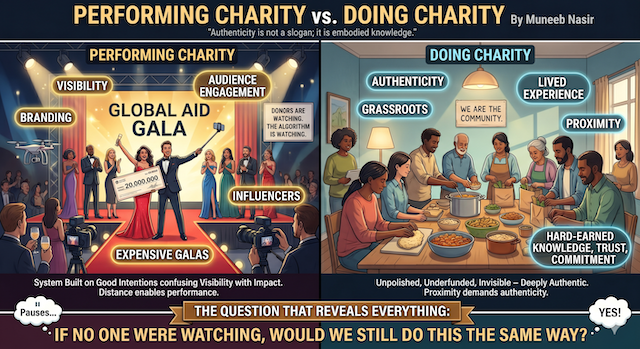
When a charity uses images of suffering to provoke quick donations, hosts expensive galas that consume a large share of what they raise, or pays influencers more than the programs they promote, something has gone off course.
The stated mission—helping vulnerable people—becomes secondary. The real focus shifts to visibility, branding, and audience engagement.
The donors are watching. The algorithm is watching.
But the people in need are no longer at the center.
This is performing charity: a system built on good intentions that has confused visibility with impact—and performance with authenticity.
Now contrast that with a small, community-based group—people gathered in a modest hall, doing the work quietly.
They don’t just “serve” the community—they are the community.
They’ve lived the struggle.
They understand the system not from reports, but from experience.
They know what it means to be overlooked, to need help, and not find it.
There are no glossy campaigns here. No celebrity endorsements.
Just hard-earned knowledge, trust, and commitment.
This is doing charity: unpolished, underfunded, and often invisible—but deeply authentic.
Why Authenticity Matters
1. Authenticity builds real trust Where an organization puts its energy reveals its truth.
If the focus is outward—on image, donors, and optics—it signals that reputation comes first.
If the focus is inward—on people and community—trust doesn’t need to be manufactured. It grows naturally from authenticity.
2. Authenticity comes from lived experience People who have lived through disability, homelessness, or mental illness bring a form of expertise no degree can replicate.
They know what dignity feels like—from the inside.
Authenticity here is not a slogan; it is embodied knowledge.
And it shapes programs that respect rather than reduce the people they serve.
3. Authentic work is often invisible The most authentic efforts are rarely the most visible.
Large organizations attract funding because they are seen. Grassroots groups struggle because they are not.
The system, as it stands, often rewards the performance of care over the reality of it.
And so authenticity is pushed to the margins—while performance takes center stage.
Let’s Be Clear
This is not about size.
Large organizations are not inherently inauthentic, and small ones are not automatically pure.
The real question is orientation:
Where does the organization’s loyalty lie?
An organization can be large and still act with authenticity—centering dignity, accountability, and real impact.
Or it can drift into performance, where the appearance of doing good overtakes the substance of it.
The dividing line is not budget—it is authenticity.
The Missing Ingredient: Proximity
Authenticity requires closeness.
It demands proximity to the people and realities an organization claims to serve.
When you are close enough to someone’s struggle—close enough to be changed by it—you cannot turn that struggle into a marketing asset without feeling the contradiction.
Distance enables performance. Proximity demands authenticity.
The Question That Reveals Everything
There is one question every charity should be able to answer honestly: If no one were watching, would we still do this the same way?
Authentic charity answers yes—without hesitation.
Performing charity pauses. And in that pause, the truth becomes clear.