
Becoming "Of the People"
The true test of belonging lies in the profound transition from merely residing in a society to becoming genuinely of the people.
By Muneeb Nasir
For any community settling into a new land, the ultimate test of belonging is not simply obtaining a passport, finding economic stability, or building a successful career.
Neither is it measured by the flurry of cultural activities that new communities organize within their own ethnic or national circles.
To be sure, these internal networks are vital; they provide a crucial safety net, comfort, and a sense of continuity for families navigating the difficult early years of settlement.
However, a community cannot mature if it remains forever in survival mode.
The true test of belonging lies in the profound transition from merely residing in a society to becoming genuinely of the people.
In the Islamic tradition, leadership and social responsibility were never practiced from a distance.
Prophets were never detached observers, isolated commentators, or leaders who lived in enclaves separate from the masses.
The Qur’an emphasizes that they were sent explicitly to their people (li-qawmihi), deeply rooted in the daily realities, languages, and struggles of their specific societies.
They did not view the people around them as "others," but as their own.
From this perspective, they carried a profound, inescapable sense of responsibility for the collective welfare, spiritual health, and social justice of their neighbors.
The companions of the Prophet Muhammad, peace be upon him, and the early generations of Muslims were thoroughly schooled in this principle.
They understood that they were witnesses to a universal message, which required them to integrate seamlessly into their new homes across the globe.
They did not seek to replicate Arab society everywhere they went; instead, they adopted and celebrated the best cultural expressions of their new environments, while contributing the positive, transformative values of their faith to the wider community.
This dynamic, reciprocal relationship was their mindset and their priority.
The "Outsider" Mindset in Modern Giving
Yet, when we look at the contemporary Canadian Muslim landscape, our collective philanthropy and institutional focus frequently reflect an "outsider" mindset.
Despite decades of deep roots, we often operate as temporary visitors or isolated enclaves, looking outward to global concerns rather than looking downward at the soil beneath our feet.
This detachment manifests most clearly in our charitable giving, where an overwhelming majority of institutional and individual funds are directed toward overseas relief projects
While global solidarity and alleviating international suffering are noble, necessary expressions of faith, the persistent neglect of domestic needs reveals a significant spiritual and civic blind spot.
Local food insecurity, homelessness, mental health crises, and systemic inequities are unfolding in the very neighborhoods where we live and work, yet they rarely receive a fraction of our collective financial backing.
This imbalance is not just a civic failure; it is a theological oversight. Classical Islamic jurisprudence explicitly reminds us that our primary moral and financial obligations—specifically Zakat and Sadaqah—belong fundamentally to the locality where our wealth is generated.
Wealth is meant to purify and strengthen the immediate community that helped produce it.
When we export almost all of our philanthropy, we inadvertently signal that we are not fully invested in the future of the society we call home.
The Foundation of Belonging: Indigenous Reconciliation
To truly become "of the people" in Canada, we must reorient our priorities from the ground up.
And that journey cannot begin in mid-air, nor can it bypass the foundational history of this continent, Turtle Island.
It must start at the very bedrock of Canadian society: with the original stewards of this land, the Indigenous peoples.
True civic leadership for Canadian Muslims requires us to move beyond a generic understanding of citizenship and actively engage in the process of Truth and Reconciliation.
We cannot speak of justice, equity, and prophetic excellence while remaining indifferent to the historical and ongoing injustices faced by First Nations, Inuit, and Métis communities.
Our treaties and obligations as treaty people are not just legal technicalities; they are moral covenants.
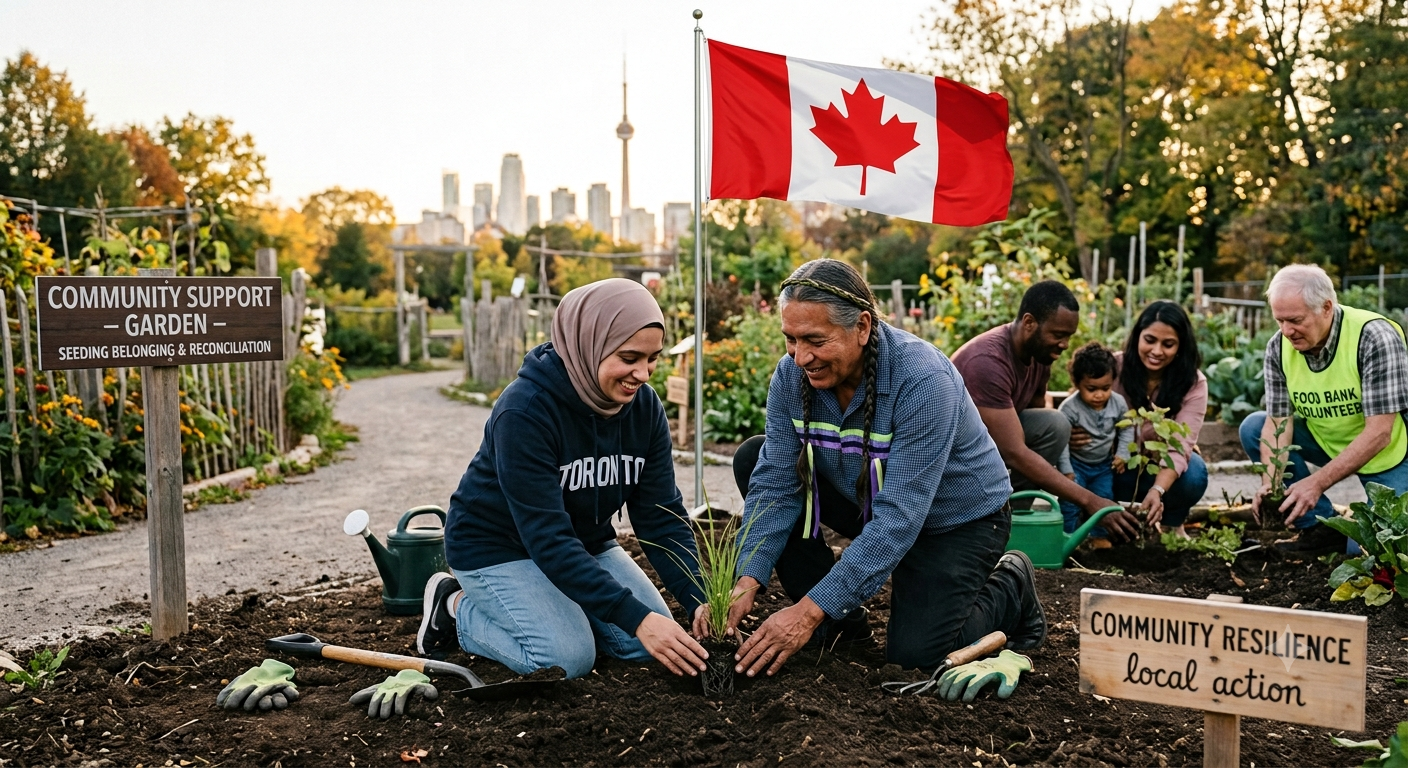
Becoming "of the people" means making their struggles our struggles, their joys our joys, and their future our shared responsibility.
By anchoring our local charity, civic advocacy, and interfaith partnerships in the soil we stand upon, we move away from the margins of Canadian life and step into our rightful role as co-builders of a more just, compassionate, and reconciled society.