
Overcoming Power Imbalances on Mosque Boards
A seat on a charity board is neither a reward for past service nor a platform for personal prestige—it is a heavy, sacred guardianship.
By Muneeb Nasir
Over many years of non-profit engagement within the Canadian Muslim community, the issue of institutional governance continues to plague many of our mosques and charities.
Far too often, we witness internal disputes escalate into painful public spectacles—sometimes ending up in costly legal action among board members, or manifesting as community protests when an Imam is abruptly dismissed or a faction on a board takes over an institution and systematically pushes out others.
These fractious disputes do more than disrupt daily operations; they fracture community cohesion, deplete funds that were donated in good faith, and tarnish the public image of our faith.
At the heart of these crises is a fundamental misunderstanding of power, authority, and accountability.
To move forward, we must realign our leadership structures with both the legal frameworks and the deep ethical principles of our faith tradition.
In our community institutions, leadership is far more than a civic title.
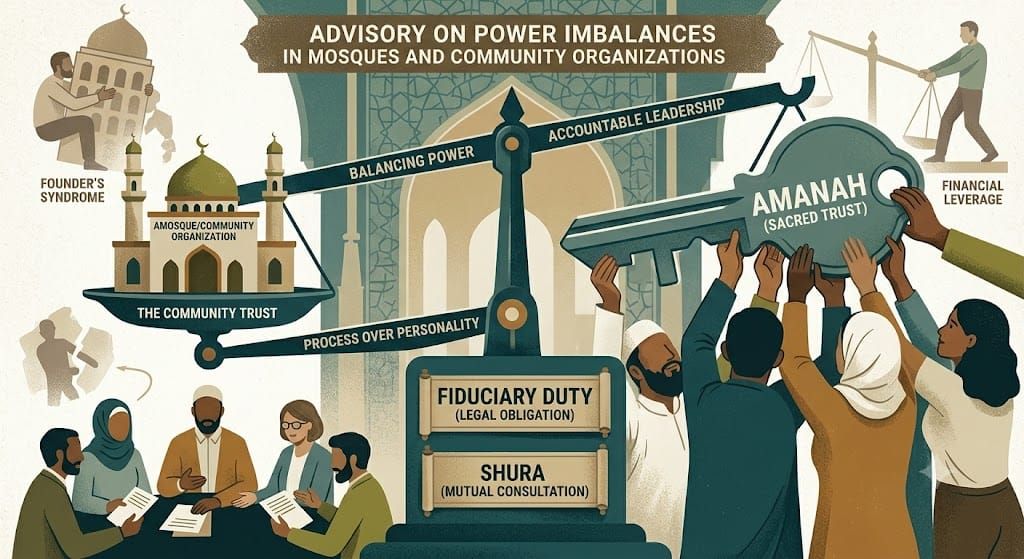
When we step onto the board of a mosque or community charity, we inherit a dual responsibility: the legal requirements of fiduciary duty under the law, and the profound moral weight of Amanah (sacred trust).
Yet, across many faith-based organizations, a painful reality persists.
Boards frequently become contentious, dominated by a few powerful personalities who unilaterally dictate the mission, finances, and future direction of the charity.
When this happens, governance breaks down, the community loses faith, and the institution is exposed to serious legal and ethical risks.
This advisory addresses why these imbalances happen, how they violate our core obligations, and how boards can transition from a culture of personality to a culture of collective service.
1. The Core Misalignment: Where Governance Fails
When a single individual or a small faction dominates a board, it creates a systemic failure across both legal and ethical frameworks.
The Legal Reality (Fiduciary Duty)
Secular charity law treats every board member as an equal custodian of the public trust. Power imbalances typically trigger two severe legal vulnerabilities:
- A Collective Breach of Care: Fiduciary duty applies equally to all trustees. If passive board members remain silent, capitulate to a dominant voice, or simply "rubber-stamp" decisions to avoid conflict, they remain legally responsible. In governance law, silence is considered complicity.
- A Breach of Loyalty: A dominant member who pushes a personal agenda, protects a specific faction, or operates with a lack of financial transparency is failing the fundamental test of loyalty—which demands acting solely in the best interest of the charity as a whole.
The Ethical Reality (Amanah)
From an Islamic ethical perspective, community leadership must be rooted in Shura (genuine mutual consultation).
- Monopolizing the Trust: When one or two voices hijack the decision-making process, Shura is effectively destroyed. The collective Amanah is replaced by an individual ego (Hawa).
- Eradicating Moral Agency: A dictatorial environment inevitably drives away competent, sincere, and qualified members who refuse to serve as mere figureheads. This leaves the institution isolated, vulnerable to blind spots, and negligent toward the community it was built to serve.
2. Root Causes of Board Domination
To implement lasting solutions, boards must first honestly diagnose how these unhealthy dynamics develop within their structures:
- Founder’s Syndrome: Individuals who sacrificed their own time and wealth to establish the institution often develop a deep sense of psychological ownership. They frequently struggle to transition from "hands-on builders" to "governing trustees," viewing new board members as guests rather than equals.
- The Weight of Financial Leverage: Power often pools around major donors. When an institution relies entirely on a few wealthy individuals to keep its doors open, the board may compromise its independence, fearing that challenging a dominant benefactor will lead to financial ruin.
- Constitutional Ambiguity: Many faith-based charities operate on outdated, vague, or loose bylaws. Without clear term limits, well-defined officer roles, or transparent election procedures, structural power naturally gravitates toward the loudest or most assertive voice in the room.
3. Practical Steps to Restore Balance and Shared Governance
Correcting a contentious board requires moving away from ad-hoc, personality-driven management and establishing robust, predictable processes.
Structural Safeguards
- Institute and Enforce Term Limits: This remains the single most effective tool to prevent institutional stagnation and permanent dominance. Implementing a rule such as a maximum of two consecutive three-year terms ensures a regular infusion of new perspectives and talent.
- Formally Document Board Job Descriptions: Clearly define what the Chair, Secretary, Treasurer, and Members-at-Large can and cannot do. A Chair’s role is to facilitate meetings and ensure all voices are heard; they do not possess the unilateral authority to make executive decisions without a majority vote.
- Mandate an Annual Conflict of Interest Policy: Require every trustee to sign a disclosure form annually. If a dominant member has a personal, familial, or business tie to a vendor, project, or hiring decision, they must legally recuse themselves from both the discussion and the vote.
Operational Remedies
- Adopt Timed, Structured Agendas: Meeting agendas should be shared well in advance. Establish a standard facilitation rule: no member may speak on a topic a second time until every other member has had an opportunity to speak once.
- Utilize Anonymous Voting for Contentious Matters: When a culture of intimidation makes quiet members hesitant to speak up out of social pressure or fear of confrontation, use secret ballots for critical decisions. This protects individual moral agency and ensures votes reflect true consensus rather than coercion.
- Invest in Independent Board Training: Bring in an outside governance consultant or legal professional to conduct an orientation for the entire board. Hearing about legal liabilities, compliance, and proper meeting decorum from an objective third party often defuses personal animosity and resets expectations.
A Final Reflection: A seat on a charity board is neither a reward for past service nor a platform for personal prestige—it is a heavy, sacred guardianship. Restoring balance to a fractured board is not about winning a political struggle; it is about honouring our legal duties, protecting public assets, and ultimately fulfilling our collective Amanah before the community and God.