
‘A Low Point for Canadian Democracy’: Muslim Leaders Condemn Supreme Court’s Bill 21 Ruling, Vow Fight Over Charter Rights Will Continue
Canadian Muslim leaders and national advocacy organizations have reacted with disappointment and resolve after the Supreme Court of Canada issued a landmark ruling on November 27, 2026, almost completely upholding Quebec’s Bill 21, the Act respecting the laicity of the State.
Canadian Muslim leaders and national advocacy organizations have reacted with disappointment and resolve after the Supreme Court of Canada issued a landmark ruling on November 27, 2026, almost completely upholding Quebec’s Bill 21, the Act respecting the laicity of the State.
Calling the decision a major setback for religious freedom and equal citizenship, community leaders emphasized that while a narrow 4–3 majority left the discriminatory employment bans intact, the struggle to protect fundamental Charter rights is far from over.
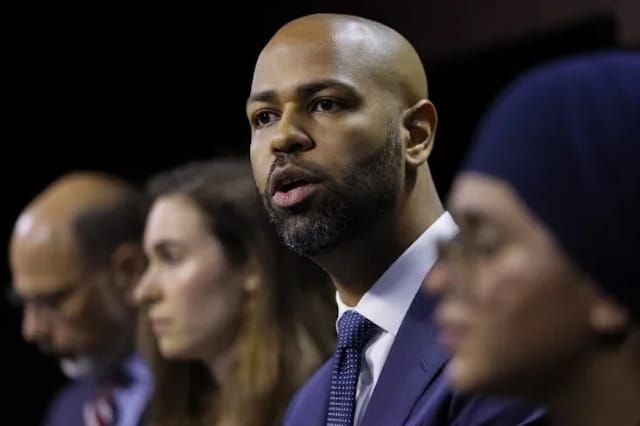
Standing on Parliament Hill immediately following the judgment, National Council of Canadian Muslims (NCCM) CEO Stephen Brown and members of the NCCM team described the ruling as a low point for Canadian democracy.
At an Ottawa news conference, Brown warned that the decision marks "one of the most significant setbacks in terms of rights guaranteed by the Charter in the history of our country" and cautioned that "the floodgates for a full attack on the Charter rights of Canadians [have] been opened".
He noted that three Supreme Court justices voted to strike down the law and explicitly pointed out why it is discriminatory, even though they were narrowly defeated in the 4–3 split.
In its response, NCCM underscored that the fight now shifts squarely into the political and constitutional arena, calling for concerted action on multiple fronts:
- Challenging political leaders who treat the notwithstanding clause as a routine tool to bypass minority rights rather than a measure of last resort.
- Encouraging constitutional reform to place clear limitations on the override power.
- Urging the federal government to recognize that constitutional instruments such as the power of disallowance exist precisely for moments when fundamental freedoms are stripped away.
The Canadian Council of Imams (CCI) echoed that alarm in a statement released immediately after the judgment, warning that the decision opens the door to further restrictions on the fundamental rights of Canadians.
“Perhaps most disturbing is that Canada’s highest court has recognized its authority to issue a declaration of inconsistency with the Charter, yet has chosen not to do so in this case,” said Imam Sikander Hashmi, Executive Director of CCI.
“If even a formal judicial acknowledgment of an infringement of fundamental rights is beyond reach, where are Canadians supposed to turn?”
Imam Hashmi also pointed to the widening reach of Quebec’s secularism measures and the moral contradiction they create for Canada on the international stage.
“What began with restrictions on certain public-sector employees has expanded into schools and even daycare settings,” he said. “How can Canada condemn foreign groups for restricting the educational and career aspirations of women and girls while allowing similar restrictions here at home in the name of secularism?”
Enacted in June 2019, Bill 21 prohibits public-sector workers in positions of authority—including public school teachers, principals, police officers, and government lawyers—from wearing religious symbols such as hijabs, turbans, yarmulkes, crucifixes, and Sikh kirpans while on duty.
To shield the legislation from judicial scrutiny, the Quebec government preemptively invoked Section 33 of the Canadian Charter of Rights and Freedoms, commonly known as the notwithstanding clause, alongside Section 52 of Quebec’s own Charter.
Following four days of hearings in March—one of the longest hearings in the top court's history—all seven justices in English Montreal School Board v. Quebec (Attorney General) agreed that Bill 21 is constitutionally valid and dismissed all appeals brought by 51 groups and individual interveners.
Writing in the judgment, Chief Justice Richard Wagner stated that "Bill 21 is rooted in Quebec's legitimate and historical commitment to ensuring the laicity of the state in a free and democratic society".
On the central question of the notwithstanding clause, the Court ruled that Quebec’s use of Section 33 was proper, noting that the Supreme Court "does not have the power to rewrite the Constitution of Canada or to enact amendments to it," and that "it is not open to the courts to place additional limits on the exercise of the override power".
While all seven justices affirmed one narrow exception—ruling that Section 8’s face-uncovering requirement cannot apply to members of Quebec’s National Assembly because doing so infringes elected officials' democratic rights under Section 3 of the Charter—the core employment bans remain firmly intact.
On the most contested human rights questions, however, the Court split 4–3.
Three dissenting justices—Justices Andromache Karakatsanis, Sheilah Martin, and Michelle O'Bonsawin—voted to strike down the bans on religious symbols and face coverings, finding that the law disproportionately restricts women's freedom of religion and expression under Section 28 of the Charter.
The four-justice majority disagreed, holding that Section 28’s gender equality guarantee is an interpretive provision that creates no standalone right to invalidate a shielded law.
By the same narrow 4–3 margin, while the Court confirmed its authority to issue a non-binding declaration stating when a law violates Charter rights, it declined to issue one in the case of Bill 21.
Civil liberties advocates who have challenged the legislation since 2019 joined Muslim organizations in warning of the ruling's far-reaching consequences.
The Canadian Civil Liberties Association (CCLA) called the judgment a significant setback for equality and religious freedom.
“This is a deeply disappointing outcome,” said Howard Sapers, Executive Director of the CCLA. “Since 2019, we have witnessed how Bill 21 has treated religious minorities, particularly Muslim women, as second-class citizens. This judgment does not restore the rights, opportunities and careers that have been taken away.”
Harini Sivalingam, Director of the CCLA’s Equality Program, warned that leaving the law intact risks emboldening other governments across Canada.
“Bill 21 has already denied a generation of Quebecers the opportunity to pursue their chosen professions in public service,” she said. “Allowing this discriminatory law to remain in force, despite the profound harms it has caused, risks emboldening Quebec and other governments to use the notwithstanding clause to sidestep constitutional accountability and enact laws that disproportionately target minority communities.”
Over the past seven years, the human toll of Bill 21 has been unmistakable, leading to job losses across Quebec as qualified educators and public servants have been forced to change professions or leave the province.
Meanwhile, the precedent set by Bill 21 has continued to expand, with Quebec introducing subsequent measures—such as Bill 94 and Bill 9—to widen restrictions on religious expression in schools, daycares, and other public institutions, alongside recent proposals to prohibit elementary school students from wearing religious symbols.
From an organizational and civic perspective, the unified warnings from NCCM, CCI, and CCLA point to a broader institutional failure that extends beyond the courtroom.
When Bill 21 was passed in 2019, the federal government declined to invoke its constitutional power of disallowance, leaving marginalized communities to wage a years-long, resource-intensive legal battle.
Now, with a narrow 4–3 majority declining to offer even a symbolic declaration that fundamental rights have been infringed, provincial legislatures are effectively left with a roadmap to preemptively override minority protections with minimal constitutional friction.
A healthy democracy is measured not merely by the will of the majority, but by the strength of the guardrails protecting its minorities.
True state neutrality does not require erasing faith from the public square; it requires ensuring that citizens of all backgrounds—and none—can serve their communities without being forced to choose between their conscience and their livelihood. Mutual recognition, not forced conformity, is the foundation of social cohesion.
The Supreme Court’s ruling closes a major legal chapter, but it cannot close the moral question facing Canada.
When judicial remedies are constrained, the responsibility shifts squarely to the conscience of citizens, civil society, and elected leaders.
As NCCM affirmed on Parliament Hill, the battle to ensure that the Charter remains a living shield for the vulnerable—and that governments are held politically accountable when they strip away fundamental freedoms—does not stop here.
Sources
- Supreme Court of Canada, English Montreal School Board v. Quebec (Attorney General), 2026 SCC 41 (November 27, 2026)
- Canadian Council of Imams (CCI), Canadian Imams Deeply Disappointed by Supreme Court Ruling on Quebec’s Bill 21 (November 27, 2026)
- National Council of Canadian Muslims (NCCM), Parliament Hill statement and Ottawa news conference by CEO Stephen Brown (November 27, 2026)
- Canadian Civil Liberties Association (CCLA), CCLA Disappointed by Supreme Court Decision on Quebec’s Bill 21, Calls for Recognition of Its Harmful Impact (November 27, 2026)
- CBC News, Supreme Court of Canada rules Quebec's secularism law is constitutionally valid (November 27, 2026)