
When Lies Prepare the Ground for War
When public discourse becomes saturated with distortion, exaggeration, and deliberate deception, the collective moral compass begins to drift. In such an environment, injustice can be presented as a necessity, and violence can be cloaked in the language of virtue.
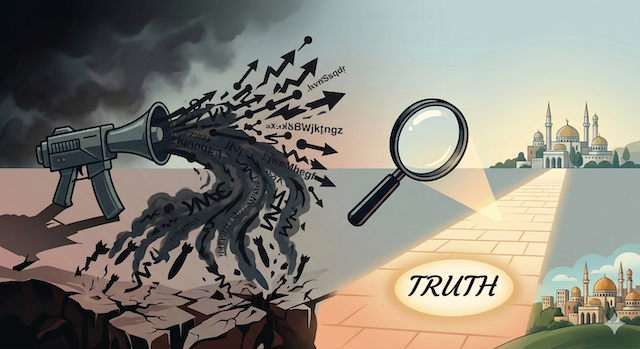
By Muneeb Nasir
Wars rarely begin with bombs.
They begin with stories.
Before armies are deployed and missiles are dropped, a narrative must first be constructed—one that transforms doubt into certainty, fear into urgency, and complex realities into simple moral dramas.
In that narrative, one side becomes the defender of civilization, and the other becomes the threat that must be eliminated.
History shows that such stories are often built on something far more dangerous than mere error or incompetence but on the deliberate promotion of falsehood.
The modern world calls this the “Big Lie”—a falsehood told so boldly and repeated so relentlessly that it becomes accepted as truth.
Yet the Islamic tradition recognized this phenomenon centuries ago.
It gives a name to the one who manufactures such realities: the كذّاب (Kazzāb).
A كذّاب is not someone who simply tells a lie.
The word describes a habitual, systemic liar—someone who repeatedly constructs falsehood until deception becomes their defining trait.
The Qur’an uses this language to condemn those who persistently deny truth and mislead others.
When this moral corruption appears in private life, it harms individuals.
When it appears in public life—within governments, media, and political movements—it can distort the conscience of entire societies.
And when the كذّاب gains control of the narrative, the path to war becomes frighteningly short.
When a Lie Becomes Policy
Few modern examples illustrate this more clearly than the justification for the 2003 invasion of Iraq.
The central claim presented to the world was that Iraq possessed Weapons of Mass Destruction capable of threatening global security.
This narrative was repeated across press conferences, intelligence briefings, and international forums such as the UN.
Fragments of intelligence were elevated to certainty; doubts were dismissed; dissenting voices were marginalized.
The repetition itself became the proof.
What began as a claim soon hardened into an unquestioned premise.
The story had been told loudly enough and long enough that war appeared not only reasonable but necessary.
Years later, the investigations were clear: the weapons did not exist.
But by then the consequences had already unfolded—hundreds of thousands dead, millions displaced, and a region plunged into instability whose effects still reverberate today.
The tragedy was not merely the war itself.
It was the realization that a narrative—repeated with confidence—can override evidence.
The New Amplifiers of Falsehood
If the early twenty-first century revealed the power of the “Big Lie,” the digital age has multiplied it.
In earlier eras, propaganda depended on newspapers, radio and TV broadcasts, and political speeches.
Today, the most powerful megaphones are algorithms.
Social media platforms quietly shape what we see, what we share, and what we believe.
Over time, these systems create echo chambers—information environments where people encounter only the voices that confirm their existing assumptions.
Within these chambers, a claim is repeated thousands of times and begins to feel like common knowledge.
Doubt becomes socially costly. Complexity disappears.
In such spaces, the moral imagination can shrink.
Entire populations can be reduced to caricatures.
War can be framed as rescue from tyranny; domination can be described as liberation or bringing in democracy.
The كذّاب no longer needs only a podium.
He now has an algorithmic amplifier.
The Prophetic Psychology of Truth
Long before modern psychology or media theory, the Prophet Muhammad, peace be upon him, described how truth and falsehood shape the human soul.
He said:
“Truthfulness leads to righteousness, and righteousness leads to Paradise. A person continues to tell the truth until he is recorded with Allah as a truthful one (صِدِّيق – Ṣiddīq).Lying leads to wickedness, and wickedness leads to the Fire. A person continues to lie until he is recorded with Allah as a liar (كذّاب – Kazzāb).”— Sahih Muslim
This hadith reveals that lying is not a single act; it is a trajectory.
Each lie reshapes the conscience.
Each repetition dulls the instinct for truth.
Eventually, the liar becomes what he repeatedly practices.
What is true for individuals can also be true for societies.
When public discourse becomes saturated with distortion, exaggeration, and deliberate deception, the collective moral compass begins to drift.
In such an environment, injustice can be presented as a necessity, and violence can be cloaked in the language of virtue.
A Qur’anic Discipline of Verification
Islam does not merely warn against deception; it also offers a method for resisting it.
The Qur’an instructs believers:
“Believers, if a troublemaker brings you news, check it first, in case you wrong others unwittingly and later regret what you have done” — Qur’an 49:6
This verse establishes a timeless principle: truth requires verification.
Faith does not ask believers to suspend their intellect.
It commands them to discipline it.
In an age of viral information and emotional headlines, this Qur’anic ethic becomes even more urgent.
It calls us to resist the temptation of instant judgment and instead cultivate a habit of careful inquiry.
Verification, in this sense, becomes a moral act.
Guarding the Light of Truth
The greatest strength of the كذّاب is not merely his ability to lie.
It is the exhaustion of those who must constantly refute him.
When the noise becomes overwhelming, many people simply withdraw.
They stop questioning. They stop investigating. They accept whatever narrative dominates the moment.
And that is when falsehood quietly wins.
The Qur’an describes truth as light (نور) and falsehood as something that ultimately fades.
But light must be protected.
It must be carried by those who refuse to surrender their conscience to the loudest voice in the room.
Every generation faces its own version of the Big Lie.
Every generation must decide whether it will repeat it—or resist it.
The path of the believer is clear: to stand with صِدق (Sidq)—truthfulness—even when truth is inconvenient, even when it is unpopular, even when it challenges the narratives of power.
For the كذّاب may dominate the airwaves for a time.
But history—and ultimately divine justice—has always belonged to those who refuse to abandon the truth.