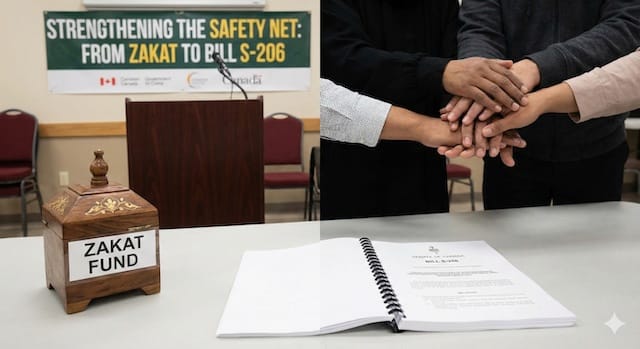
Strengthening the Safety Net: From the Pillar of Zakat to Bill S-206
This Ramadan, we have a unique opportunity to bridge the gap between our spiritual duties and our civic advocacy. We can view our support for Bill S-206 as a form of ongoing charity—a policy that could provide a permanent safety net for generations to come.
By Muneeb Nasir
The economic reality for many Canadians remains challenging.
Despite various efforts to stabilize the economy, the rising costs of housing and basic groceries continue to squeeze household budgets from Halifax to Vancouver.
In our own communities, we see the impact firsthand: food bank lines are longer, and the "working poor" are becoming a larger segment of our population.
During the holy month of Ramadan, our thoughts naturally turn to Zakat—a pillar of Islam.
It is a time for worship, self-reflection and for fulfilling our obligation to the less fortunate.
However, this year, there is a parallel conversation happening in the halls of Parliament that deserves our attention: the debate over Bill S-206, the National Framework for a Guaranteed Livable Basic Income Act.
At first glance, the religious duty of Zakat and a modern piece of legislation might seem unrelated.
Yet, they are both built on the same foundation: the belief that every human being has an inherent right to live with dignity.
A Recognized Right, Not a Favor
One of the most striking similarities between Zakat and a Guaranteed Livable Basic Income (GLBI) is the shift in how we view assistance.
In modern welfare systems, aid is often treated as a "favour" or a "handout" from the state, often involving "means-tests" that can be intrusive and stigmatizing.
In contrast, Zakat is framed as a "recognized right." The Qur’an is explicit on this point:
"And in whose wealth there is a right acknowledged for the beggar and the destitute" (70:24-25)
This aligns remarkably well with the philosophy behind Bill S-206.
Introduced by Senator Kim Pate, this bill seeks to establish a national framework where every Canadian over the age of 17 has access to a guaranteed income.
It isn't a reward for labour or a charity; it is a right of citizenship designed to ensure no one falls below a "livable" standard.
Circulation vs. Stagnation: The Economic Multiplier
Both systems act as vital stabilizers for our local economies.
In Islamic economic teachings, wealth is a trust that must be kept in motion to benefit all of society.
As the Qur'an reminds us, wealth should not "just circulate among those of you who are rich" (59:7).
Zakat targets stagnant wealth—savings and assets that have sat idle—and moves them back into the hands of those who will use them immediately.
Economically, this increases the "velocity of money."
When a low-income family receives support through Zakat or a potential basic income, that money stays in the community.
It is spent at the local supermarket, the neighbourhood mechanic, and the pharmacy.
This creates a multiplier effect, where $1 of support generates significantly more in local economic activity, sustaining jobs and services for everyone.
Understanding Bill S-206 in 2026
As we consider our civic duties this year, it is important to understand what Bill S-206 actually proposes: https://www.ubiworks.ca/guaranteed-livable-basic-income
- A "Livable" Standard: Unlike a simple "basic" income, this bill focuses on a livable amount, adjusted for the actual costs of living in specific regions.
- Non-Replacement Policy: Crucially, the bill specifies that this income must not replace or reduce existing disability supports or health benefits. It is a floor, not a ceiling.
- Current Status: As of February 2026, the bill is under active consideration by the Standing Senate Committee on National Finance. Experts are currently defining how the framework will work across provinces and Indigenous jurisdictions.
Mobilizing This Ramadan: Advocacy as an Act of Faith
This Ramadan, we have a unique opportunity to bridge the gap between our spiritual duties and our civic advocacy.
We can view our support for Bill S-206 as a form of ongoing charity—a policy that could provide a permanent safety net for generations to come.
How can we mobilize?
- Use our community circles to explain that supporting systemic justice is as important as individual charity.
- Organize letter-writing drives to our Senators and MPs, urging them to support the passage of Bill S-206. Take action: https://www.ubiworks.ca/#take_action
Ultimately, whether we look through the lens of faith or public policy, the goal remains the same: a society where the inherent dignity of every person is protected.
By supporting local Zakat and advocating for a national basic income, we are building a Canada that reflects our deepest values of compassion and equity.
Make a 2-Minute Impact for a Better Canada: https://www.ubiworks.ca/#take_action