
Spiritually Homeless in the Age of AI
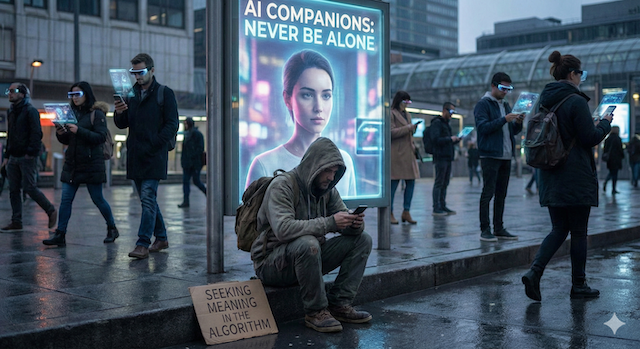
We are no longer just managing social media notifications; we are living in an era of hyper-personalized AI that can predict our interests—and our distractions—before we even feel them. For many, the result is a fragmented mind and a persistent sense of being "spiritually homeless."
By Muneeb Nasir
As we navigate the landscape of 2026, the "distraction economy" has reached a new peak.
We are no longer just managing social media notifications; we are living in an era of hyper-personalized AI that can predict our interests—and our distractions—before we even feel them.
For many, the result is a fragmented mind and a persistent sense of being "spiritually homeless" in a world that feels increasingly insane.
The question for our community is: How do we stay grounded? How do we keep our focus when the world is designed to steal it?
The answer lies in centuries-old practices that act as modern guardrails.
Faith and spiritual rituals—like ritual prayer, meditative reflection, and fasting—are not merely religious obligations.
They are sophisticated tools for reclaiming our mental sovereignty and our humanity.
The Power of the Rhythmic Pause
In a world that never stops, the act of stopping is a radical choice.
Daily prayer (Salah) offers a structured rhythm that breaks the cycle of distraction and digital noise. It forces us to step away from the screen and reconnect with a higher purpose.
The Qur’an provides a clear framework for this: “[Prophet], recite what has been revealed to you of the Scripture; keep up the prayer: prayer restrains outrageous and unacceptable behaviour. Remembering God is greater: God knows everything you are doing.” (29:45),
When the verse mentions that prayer "restrains" us, we can view this in a modern light.
Prayer holds us back from the excesses of mindless consumption and the unacceptable habit of surrendering our focus to digital ghosts.
By turning toward the Divine five times a day, we are training our brains to focus on one thing at a time.
In an era of shrinking attention spans, prayer is the ultimate exercise in deep concentration.
The Post-Prayer Buffer: Finding Stillness
The benefit of prayer doesn’t end when the physical movements stop.
There is a vital tradition of dhikr, or meditative remembrance, performed immediately after the prayer.
This acts as a spiritual "buffer zone," preventing us from rushing headlong back into the chaos of emails and headlines.
A central part of this meditation is the recitation of the "Verse of the Throne" (Ayat al-Kursi): "God: there is no god but Him, the Ever Living, the Ever Watchful. Neither slumber nor sleep overtakes Him. All that is in the heavens and in the earth belongs to Him." (2:255).
In a society that demands we be "always on," this verse offers profound relief.
It reminds us that there is a Power that is truly "Ever Watchful" and never sleeps.
By meditating on this, we can let go of the frantic need to control every outcome.
It shifts our perspective from a stressful, "me-centered" view to a "God-centered" view.
This transition lowers our internal volume and protects us from being overwhelmed by the unpredictability of our digital lives.
Reclaiming Our Will through Fasting
Our modern economy is built on "instant gratification."
If we want food, entertainment, or information, we can have it in seconds.
While convenient, this "on-demand" lifestyle can make us impulsive and reactive.
Fasting—whether the voluntary fasts or the month of Ramadan—serves as a powerful reset.
By choosing to say "no" to basic needs like food and water for a set period, we prove that we are in control of our impulses, not the other way around.
Fasting creates a "mental silence" that builds resilience and gives us back our agency.
Reintroducing the Sacred to a Skeptical World
How do we talk about these practices in an increasingly skeptical and individualistic society?
We must frame them as essential tools for human flourishing:
- Reframing Prayer as "Attention Training": In an era where tech companies sell our focus to the highest bidder, five minutes of prayer is an act of reclaiming our freedom.
- The "Digital Fast": We can bridge the gap by connecting traditional fasting with the modern need for "digital detoxing." Both are about clearing clutter to make room for what matters.
- Community over Individualism: Our society is lonelier than ever. By reintroducing communal rituals, we offer a sense of belonging that social media can never replicate.
Living Sanely in 2026
To live sanely today is to be intentional.
We cannot simply drift with the current of technology and expect to stay mentally or spiritually healthy. We need guardrails.
By leaning into these daily and monthly rituals, we aren't retreating from the world; we are preparing ourselves to engage with it more deeply and with greater clarity.
The "remembrance of God" is indeed the greatest tool we have—not because it takes us away from our lives, but because it finally allows us to be fully present within them.