
Seeing the Pharaohs of Today
When we examine the stories of Pharaoh today, we see a mirror reflecting the modern world’s greatest tragedies. The traits that defined him—hubris, narcissism, and gaslighting—are the very same engines driving today’s "emperors" and the devastating wars they initiate.
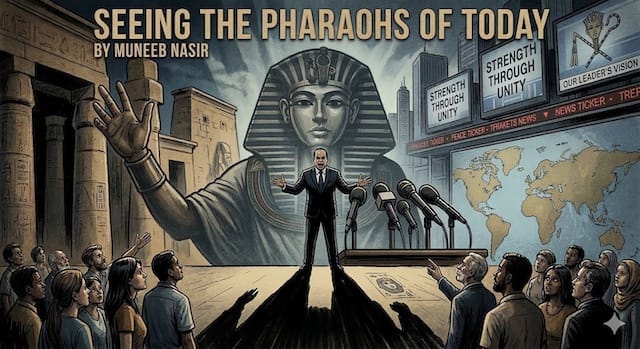
By Muneeb Nasir
The figure of Pharaoh, or Fir’aun, occupies a central place in the Qur’anic narrative.
He is not merely a historical footnote or a specific king of ancient Egypt; he is presented as a timeless archetype of tyranny.
The Qur’an details his rise and fall not just to record history, but to provide a psychological profile of power gone wrong.
When we examine the stories of Pharaoh today, we see a mirror reflecting the modern world’s greatest tragedies.
The traits that defined him—hubris, narcissism, and gaslighting—are the very same engines driving today’s "emperors" and the devastating wars they initiate.
The Blindness of Hubris
Hubris is more than just pride; it is a total loss of contact with reality.
In the Qur’an, Pharaoh’s hubris reaches its peak when he declares, “I am your Lord Most High” (79:24).
By placing himself above all accountability, he creates a vacuum where his word is law and his whims are divine.
In a modern context, we see this when leaders believe they are exempt from international law or moral constraints.
This "God-complex" convinces a leader that they alone can reshape the map of the world, regardless of the human cost.
When a leader believes their legacy is more important than the lives of the people they serve, they have entered the territory of Pharaoh.
They forget that every empire in history eventually meets its "Red Sea" moment—a point of no return where overreach leads to collapse.
The Narcissist’s Mirror
Narcissism in leadership manifests as an inability to see others as human beings with equal rights.
Pharaoh viewed the Israelites not as people, but as tools for his infrastructure projects or threats to his ego.
He famously ordered the killing of newborn sons to protect his own position.
This extreme self-centeredness is what allows modern "emperors" to lead populations into war.
To a narcissist, a soldier is a statistic and a civilian is "collateral damage."
The Qur’an highlights how Pharaoh’s narcissism was fed by his inner circle.
These enablers praised his every move, creating an echo chamber that shielded him from the suffering of the masses.
Today, we see this in the military-industrial complexes and political inner circles that profit from conflict, whispering to the leader that war is not only necessary but glorious.
The Art of Gaslighting
Perhaps the most chilling characteristic of Pharaoh was his mastery of gaslighting—the psychological manipulation of a population to make them doubt their own perceptions of reality.
When Moses (Musa) brought clear signs and a message of liberation, Pharaoh responded by telling his people: “I have told you what I think; I am guiding you along the right path.” (Qur’an, 40:29).
Pharaoh framed himself as the protector of the status quo and Moses as the "terrorist" or "corruptor" who wanted to destroy their way of life.
He portrayed his oppression as stability and Moses’ call for justice as chaos.
We see this exact tactic in modern warfare.
Aggressors often frame invasions as "peacekeeping missions" or "liberation."
They use media and propaganda to convince their populations that up is down, that the victim is the aggressor, and that the only "right path" is the one leading to war.
By the time the population realizes they have been misled, the war is already in motion, and the "Pharaoh" of the day has already consolidated his power.
Breaking the Cycle
The Qur’an reminds us that Pharaoh’s power was ultimately an illusion.
Despite his armies and his monuments, he was unable to stop the simple truth brought by a man with a staff.
The eternal wisdom here is that while tyrants repeat the same mistakes, the end result remains the same: Injustice is unsustainable.
For us the lesson is clear. We must be the voices that challenge the "Pharaonic" traits in our own societies.
We must promote humility by reminding leaders that they are servants, not masters; humanize the "other" by combatting the narcissism that turns humans into targets; and speak truth to power by countering the gaslighting of propaganda with verified facts and ethical clarity.
History is a circle only if we refuse to learn.
By recognizing the Pharaohs of today through the lens of the Qur’an’s timeless narrative, we can better equip ourselves to advocate for a world built on justice rather than the egos of men.