Receiving the Friday Khutba: A Shared Responsibility
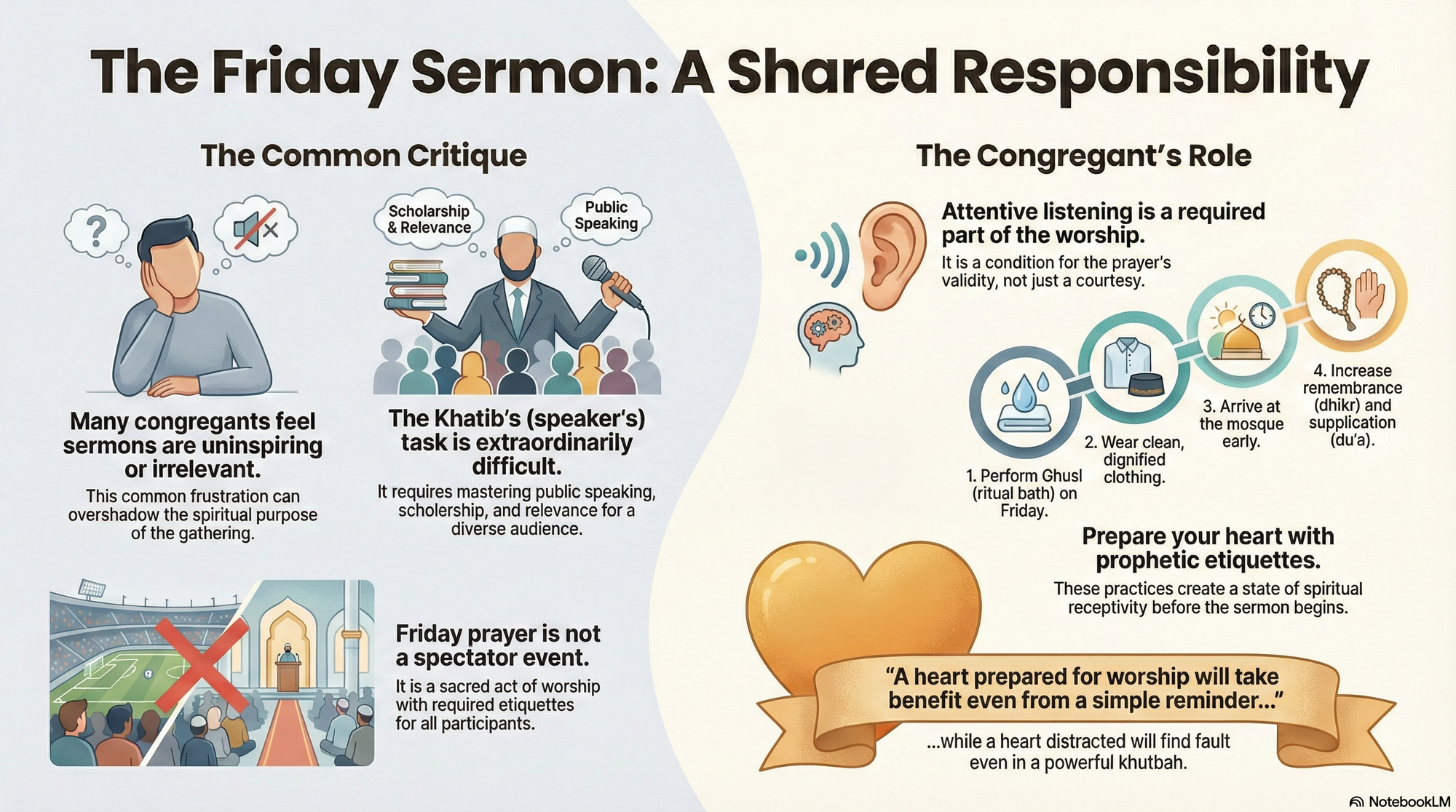
The reality is simple: a heart prepared for worship will take benefit even from a simple reminder, while a heart distracted will find fault even in a powerful khutbah.

By Muneeb Nasir
Every week, Muslims gather for the Friday prayer service (Salaatul Jumu’ah) hoping to be inspired, guided, and spiritually recharged.
And yet, if we are honest, many of us carry a particular angst about the quality of the sermon (khutbah).
We leave saying, “It wasn’t motivational,” or “It wasn’t relevant,” or “The khatib didn’t address the real issues.”
This frustration has become so common that it can overshadow the deeper reality: giving the Friday khutbah is an extraordinarily difficult task—especially in a community as diverse, multilingual, and multi-generational as ours.
In many mosques, the khatib is not a full-time imam but a layperson—someone sincere, knowledgeable to a degree, and willing to give their time, yet without the formal training many expect.
Public speaking, rhetoric, and Islamic scholarship are all separate disciplines, and very few individuals possess mastery of all of them.
Even many trained imams struggle to strike the balance between scholarship and accessibility, between addressing real community challenges and remaining grounded in timeless principles.
It is certainly fair to desire better sermons and to encourage our institutions to invest in training of khatibs.
But there is an equally important question that is rarely asked: how prepared are the congregants to receive the message?
For many, the Friday khutbah is approached passively, almost as if it were just a religious ritual or podcast to be judged or scored rather than a sacred gathering requiring readiness, presence, and inward intention.
Islam, however, does not treat Jumu‘ah as a spectator event—it frames it as a weekly act of worship with clear conditions, etiquettes, and spiritual disciplines.
The Sacred Weight of Jumu‘ah
But for the Friday prayer to be valid, several conditions must be met: it must be performed in congregation; in a public, accessible space; at the time of Dhuhr; with a sermon delivered beforehand; and with the congregation listening attentively, refraining from speech or distractions.
In other words, listening is itself part of the worship—not an optional courtesy, but a condition.
Alongside these requirements, the Prophet Muhammad, peace be upon him, taught a series of preparatory acts that elevate the entire experience.
These are not minor recommendations; they are spiritual habits meant to shape our hearts before we ever hear the khatib speak.
These recommendations include performing ghusl on Friday morning; wear clean, dignified clothing; arrive early, long before the sermon begins; walk to the mosque if possible; recite Surah al-Kahf; increase dhikr, salawat, and heartfelt du‘a throughout the day; seek the blessed hour before Maghrib.
These practices do not merely prepare the body—they prepare the heart.
They create a state of receptivity in which even a simple khutbah can strike deeply, because the listener is spiritually awake.
A Two-Way Covenant
The khutbah is not only a performance to be graded; it is a covenant between speaker and listener.
The khatib must strive for clarity, relevance, sincerity, and Islamic grounding.
But the congregation must strive for presence, humility, discipline, and preparation.
When either side falters, the experience suffers.
Too often, we critique the messenger without examining our own readiness to hear the message.
Imagine how different our Fridays would feel if we approached them with the prophetic etiquettes: if we entered early, calm, in a state of dhikr, having recited Surah al-Kahf, having done ghusl, and having dressed with care.
Imagine how even a modest khutbah would land on hearts softened by preparation.
Beyond Criticism
Wanting stronger sermons is natural—and communities should continue encouraging training, offering feedback, and cultivating a new generation of informed, articulate, and spiritually grounded khatibs.
But that improvement must be matched with a shift in how we, the jamaat (congregants), approach the sacred space.
The reality is simple: a heart prepared for worship will take benefit even from a simple reminder, while a heart distracted will find fault even in a powerful khutbah.
If we meet the Friday prayer with the reverence, preparation, and intentionality taught by our tradition, we may find that the khutbah offers far more than we realized—because we ourselves arrived ready to receive.