
Reassembling the Mirror of Our Humanity
We cannot heal what we refuse to name. We must stop being "neutral" and start being intentional. We have to see the jagged edges of racism and classism and colorism, call them by their names, and then move to dismantle them.
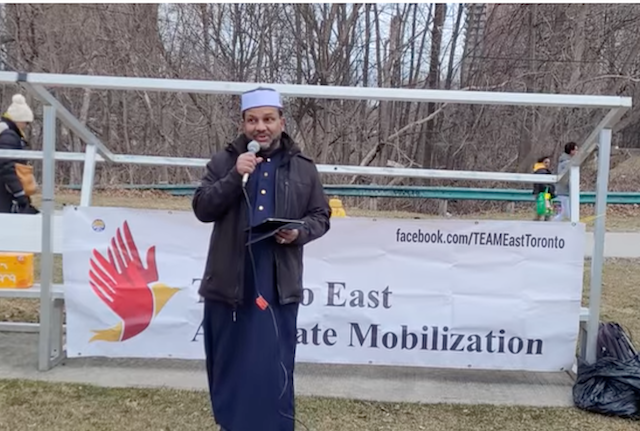
Speech delivered by Imam Irshad Osman at the Unity Rally organized by T.E.A.M (Toronto East Anti-Hate Mobilization) and the Labour Council with other grassroot community organizations, including Muslim-Indigenous Connection (MIC), to commemorate the International Day for the Elimination of Racial Discrimination at the Dentonia Park in Toronto on March 28, 2026.
Assalamu Alaikum (May God’s Peace and Blessings be upon you)!
Good morning everyone!
I stand here today representing T.E.A.M., but I am also here as a neighbour and an Imam who believes that our diversity isn't just a "strength"—it is a sacred responsibility.
The theme of this rally is unity, but let’s be honest with each other. In our city, the mirror of our society, the mirror that reflects our shared justice, isn’t just dusty or blurry. It is shattered and broken.
In a fractured world, we no longer see the fullness of one another. We see fragments: race, religion, status. We allow those fragments to become the basis for judgment and exclusion.
Over time, we mistake the fragment for the whole. This is what racism does. it doesn’t just wound individuals; it shatters our shared vision of humanity.
When a mirror is broken, you get a fragmented reality.
- You get sectarianism, where we only see our own small piece of the glass.
- You get paternalism, where the top decides for the bottom without looking them in the eye.
- And you get orientalism, where the mirror reflects only a distorted, Western view of the East.
I know at events like these, we often hear that racism is "wrong." Of course, yes. But I want to go a little deeper than that today. Because I think we owe each other that honesty.
Discrimination is not accidental, nor simply the result of personal prejudice. It is ingrained in structures, inherited through history, normalised by culture, and reproduced across institutions, including by those that seek to challenge it.
The first Dalit Bishop of the Church of England, Rev. Dr Anderson Jeremiah called this the Architecture of Prejudice.
A system that dehumanises, institutionalises, and controls who has access to power and voice. And the troubling thing about architecture is we don’t always see it because we live inside it and maybe are reproducing the very injustices we seek to address.
Racism, classism, colorism, sexism, ableism, lookism, elitism, credentialism, you name it…..all these are not cultural phenomena. But dangerous parallel systems that arrange humans into hierarchies of value.
Think about the "ordinary" questions we ask: “Where are you from? Where did you study? Who is your grandfather?” They sound harmless. But they rarely are.
They locate people within a social hierarchy and determine, often in subtle ways, how a person will be treated from that moment onward. We have normalized the habit of ranking humans before we even know their names.
The ugly and shocking truth is, as a result of this ranking, we can be both marginalised by the societies around us and exclusionary within our own spaces.
We speak beautifully about inclusion and solidarity while perpetuating inequities of thought and action amongst us.
As a result, sometimes when we see racism and discrimination faced by these “other groups”, we tend to ignore it, justify it, and even perpetuate it because of that distorted view of the shattered mirror.
So, how do we fix it? To eliminate racial discrimination, we must be prepared to do the "dangerous work" of reassembling that mirror. Here are three blueprints for today:
First: We must kill the "phantom of neutrality." We’ve all heard it: "I don’t see color" or "There is no racism in our faith”, or “We treat everyone equally in our workplace”.
It sounds peaceful, but it’s a ghost. Neutrality in the face of systemic exclusion is not a virtue. It is accountability-blindness.
We cannot heal what we refuse to name. We must stop being "neutral" and start being intentional. We have to see the jagged edges of racism and classism and colorism, call them by their names, and then move to dismantle them.
Second: We must move from "apology" to "architecture." We’ve had decades of "sincere regrets" and “tokenism”. But you can’t fix a shattered mirror with a handshake or an apology. Trust is social architecture.
It’s not a warm feeling; it’s a structure built on policy, transparency, and the redistribution of power. We don't just want a "seat at the table" if the table is built on a foundation of exclusion; we are here to redesign the room and rebuild the house.
Third: We must accept that justice is a "state of constant repair." We often talk about equality like it’s a destination, a place we’ll arrive at and finally get to rest. But as anyone who builds community knows, the work of unity is daily maintenance.
It is an active labor. It is a commitment to stay in the tension of the "jagged edges" until every person, regardless of their background, can see their own full humanity reflected back in the glass.
I don't think we need grand declarations today as much as we need honest conversations: within our families, our institutions, our communities, our places of worship.
Who holds power in your organisation? Whose voice is consistently missing from the table? What assumptions have we inherited and never thought to question?
Racism erodes it by sending a brutal message: that some people matter less than others. Rebuilding that trust requires responsibility. More than that, it requires relationship.
Real relationship. The kind that crosses racial and ethnic lines not for the sake of optics, but because we genuinely believe in the dignity of the person in front of us.
As an Imam, let me end this with Islamic terms. Racism and discrimination are not just social issues. They are serious violations of human dignity and a sin against God and humanity. A sin! Not a misunderstanding…not a difference of opinion. A grave sin!
Yes, the mirror is broken. But its fragments still reflect something worth recovering.
Thank you, and Assalamu Alaikum!