
Ramadan and Your Rights in Ontario
The core message of the 2026 guide is clear: individuals in Ontario should not have to choose between their professional or academic obligations and their religious observance.
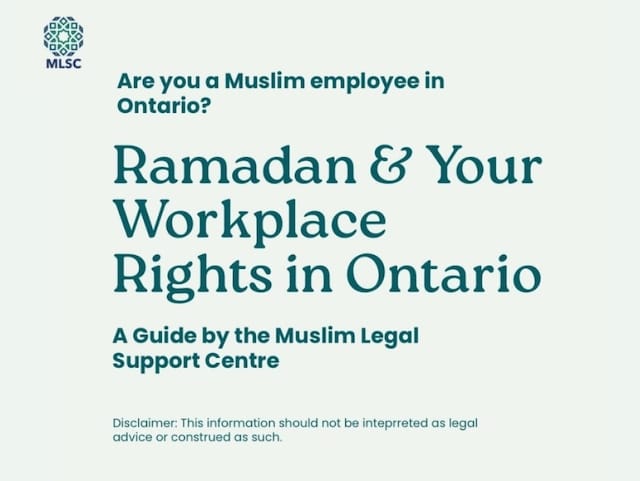
As the month of Ramadan approaches in 2026, the Muslim Legal Support Centre (MLSC) has released an updated resource guide titled "Ramadan & Your Rights in Ontario."
The document serves as a vital tool for Muslim employees, students, and tenants, outlining the legal protections available under the Ontario Human Rights Code.
The core message of the 2026 guide is clear: individuals in Ontario should not have to choose between their professional or academic obligations and their religious observance.
The Duty to Accommodate
At the heart of the guide is the "duty to accommodate."
Under the Ontario Human Rights Code, employers, service providers, and educators have a legal obligation to make reasonable adjustments to accommodate an individual’s religious beliefs and practices, provided these changes do not cause "undue hardship" (significant costs or safety risks) to the organization.
For Ramadan, this often translates to adjustments in scheduling and physical space.
The guide emphasizes that accommodation is a shared responsibility; while organizations must be open to requests, individuals should also communicate their needs clearly and in a timely manner.
Workplace Rights
The MLSC highlights several common workplace accommodations that Muslim employees can request during the holy month:
- Flexible Scheduling: Adjusting start or end times to better manage energy levels while fasting, or allowing for a break at sunset to observe Iftar (breaking the fast).
- Prayer Space: Providing a quiet, private area for the five daily prayers.
- Time Off for Eid: Requesting leave for the Eid-al-Fitr holiday.
- Exemption from Food-Centric Events: Ensuring that employees are not penalized or excluded if they choose not to attend meetings or social gatherings involving food.
Rights in Education
For students, the guide notes that educational institutions—from primary schools to universities—are required to accommodate religious observances. This includes:
- Exam Rescheduling: Moving an exam if it conflicts with prayer times or significantly impacts a student’s ability to perform while fasting or celebrating Eid.
- Attendance Flexibility: Excusing absences for religious holidays.
- Quiet Study Spaces: Access to designated areas for prayer or rest.
How to Request Accommodations
The MLSC recommends a proactive approach. The guide suggests that individuals should:
- Notify Early: Inform employers or teachers well in advance of Ramadan.
- Suggest Solutions: Be specific about what is needed (e.g., "I would like to move my 30-minute lunch break to 5:30 PM to break my fast").
- Document the Request: Keep a record of communications in case of disputes.
Seeking Legal Support
If a request for accommodation is denied without a valid "undue hardship" explanation, or if an individual faces harassment or discrimination due to their faith, the MLSC provides direct support.
They are also hosting a series of community "Know Your Rights" workshops and Iftar events in cities across the province, including Toronto, Mississauga, Hamilton, and Scarborough, to provide further education and support.
For more information or to access the full guide, residents are encouraged to visit the Muslim Legal Support Centre’s website or contact their intake line for confidential summary legal advice.
Other resources:
https://people.utoronto.ca/wp-content/uploads/2023/03/2023-Ramadan-Inclusive-Employer-Guide.pdf
https://www.tdsb.on.ca/Portals/0/aboutus/HumanRights/Ramadan_and_Duty_to_Accommodate.pdf