
Nature as Teacher: How the Qur’an Anticipates Biomimicry
The Qur’an does not allow reflection to remain abstract. It links contemplation to ethical action. Biomimicry is a contemporary expression of an ancient Qur’anic ethic: observe deeply, act humbly, and live in balance.
By Muneeb Nasir
In the Qur’anic worldview, the natural world is far more than a backdrop for human activity or a mere resource to be consumed.
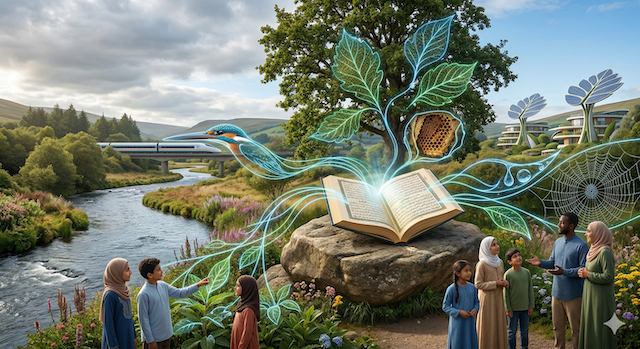
It is a living, breathing revelation—the ‘outspread book’ (al-kitab al-manshur) that sits alongside the ‘written book’, the Qur’an (al-kitab al-mastur).
Nature is filled with signs (ayaat), which we are repeatedly urged to read, reflect upon, and understand.
The Qur’an points to the heart of this connection in a profound passage:
"There are truly signs in the creation of the heavens and earth, and in the alternation of night and day, for those with understanding, who remember God standing, sitting, and lying down, who reflect on the creation of the heavens and earth: ‘Our Lord! You have not created all this without purpose—You are far above that!—so save us from the punishment of the Fire.’" (3:190-191).
This isn't just a call to wonder; it is a call to intellectual and spiritual engagement.
It teaches us that creation is purposeful, balanced, and inherently instructional.
Today, as we face a global climate crisis, a contemporary scientific field called biomimicry is helping us rediscover this scriptural wisdom, offering a practical path toward what researchers call "critical hope."
What is Biomimicry?
Simply put, biomimicry is the practice of learning from and then emulating nature’s time-tested patterns and strategies to solve human design challenges.
It marks a fundamental shift: we stop seeing nature as a warehouse of raw materials and start seeing it as a mentor.
Whether it is mimicking the efficiency of a kingfisher’s beak to design high-speed trains or studying the structure of a leaf to create more efficient solar cells, biomimicry recognizes that nature has already solved many of the problems we currently struggle with.
A Source of Critical Hope
In a world saturated by "eco-anxiety," finding a way forward can feel overwhelming.
In a recent episode of the CBC podcast Ideas, researcher Kari Grain explored the concept of critical hope—a hope that isn't based on blind optimism, but on active practice, evidence, and the courage to face uncomfortable truths.
Biomimicry provides a foundation for this hope.
By looking to nature, we tap into what is essentially a "3.8 billion-year depository of research and development."
This perspective offers a profound sense of relief; it suggests that the burden of solving every global crisis does not rest on human ingenuity alone.
The blueprints for survival, efficiency, and flourishing are already written into the fabric of creation.
We don’t have to reinvent the wheel; we just have to learn how to listen to the ‘Teacher.’
Nature as a Living Classroom
This "critical hope" is deeply rooted in tadabbur (deep reflection).
The Qur’an does not merely ask us to admire nature’s beauty; it challenges us to study how it functions: “Do they not look at the camels—how they are created?” (88:17).
This is an invitation to look at form, function, and adaptation.
Elsewhere, the Qur’an points to the sophisticated life of bees, the mechanics of rain cycles, and the intricate growth of plants.
These are not just poetic flourishes; they are prompts to recognize that the natural world holds the keys to sustainability.
The Principle of the Balance (Mizan)
The core insight of biomimicry is that nature operates on a system of refined efficiency, restraint, and zero waste.
These solutions are not accidental; they are part of what the Qur’an calls mizan, or the "Balance."
The Qur’an reminds us: "He raised the sky and set the balance [of all things], so that you might not transgress the balance" (55:7-8).
Biomimicry translates this into action.
It encourages us to design systems that function in harmony with the environment rather than at its expense.
It shifts our goal from "How can we extract more?" to "How can we belong better?"
From Masters to Stewards
Crucially, the Qur’an frames humanity as stewards (khulafa’) of the Earth, not its masters.
Stewardship implies care, humility, and accountability.
When we approach design with the arrogance of a "master," we create pollution and waste.
When we approach it with the humility of a "steward," we recognize that natural systems—from the filtration of a wetland to the strength of spider silk—often outperform human shortcuts driven by profit.
There is a profound humility in both the Qur’an and biomimicry.
As the Qur'an asks: "This is God’s creation: show me what those besides Him have created" (31:11).
By practicing biomimicry, we acknowledge that the most sophisticated engineering on Earth is already around us, free to observe and learn from.
Investing in a Sustainable Legacy
This shift from extraction to stewardship is not just for scientists and engineers; it is a mandate for our community institutions.
Just as nature operates on a circular, regenerative model, our philanthropy and community building must be sustainable and balanced.
By supporting initiatives that prioritize environmental stewardship and innovative thinking, we are honoring the "Balance" that God has woven into the world.
We are moving beyond mere survival to a state of flourishing that is in harmony with the ayaat around us.
Turning Awe into Action
For the Muslim community, and for humanity at large, the Qur’an does not allow reflection to remain abstract.
It links contemplation to ethical action.
Recognizing that creation was not made "in vain" demands that we build, innovate, and live responsibly.
Biomimicry is a contemporary expression of an ancient Qur’anic ethic: observe deeply, act humbly, and live in balance.
It provides a practical path to move from environmental despair toward a hopeful, active stewardship.
Nature has always been speaking; it is time we finally started to listen.
Sources and Further Reading
- The Qur'an: Translation by M.A.S. Abdel Haleem (Oxford World's Classics).
- CBC Ideas: "The Practice of Critical Hope," featuring researcher Kari Grain.
- Biomimicry Institute: "What is Biomimicry?" — foundational concepts of nature-inspired design.