
From the Year of the Elephant to the Age of the Drone
Surah Al-Fil remains an enduring reminder that human might is inherently fragile, and that no matter how overwhelming an earthly power appears, its downfall often descends from the most unexpected and seemingly insignificant sources.
By Muneeb Nasir
The rapid evolution of modern warfare has left military strategists scrambling to rewrite their doctrines, but a profound blueprint for this contemporary shift was recorded over fourteen centuries ago.
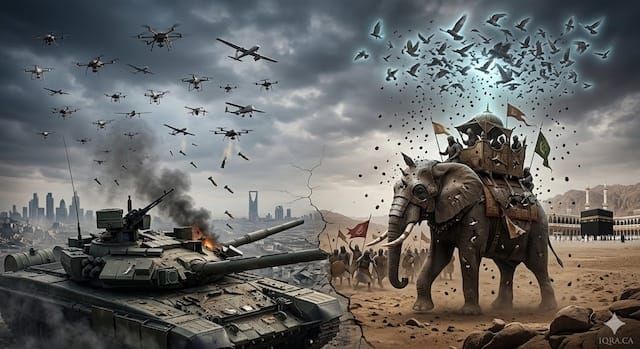
In the current geopolitical landscape, we are witnessing a startling transformation: multi-million-dollar tanks, massive naval vessels, and heavily armored columns—the absolute pinnacles of conventional military might—are being systematically disabled or destroyed by swarms of low-cost, remotely piloted drones.
For those familiar with sacred text, this asymmetric reality mirrors a familiar narrative, carrying an eerie and precise parallel to the descriptions found in the Qur’an.
In 570 C.E.—the same year Prophet Muhammad, peace be upon him, was born—Abraha, a ruler of Yemen, built a grand cathedral in Sana'a with the goal of diverting Arab pilgrims away from the Kaaba in Mecca.
After a man from the Banu Kinana tribe desecrated this new cathedral, an enraged Abraha marched on Mecca to destroy the Kaaba, bringing a massive army equipped with war elephants.
To the casual observer of history, the contest was entirely lopsided.
The defenders possessed nothing that could match the sheer physical scale and crushing force of the advancing empire.
Yet, the narrative shifts entirely with the arrival of birds moving in vast, synchronized flocks or waves (Tayran Ababil)—pelting the invaders with small stones of baked clay (Sijjil).
This miraculous defense is commemorated in Qur'anic chapter, Surah Al-Fil (The Elephant) as a profound demonstration of divine protection over the Sacred House.
The mechanics of that ancient intervention align flawlessly with the tactical realities of the modern battlefield.
A single bird or a lone clay stone achieved nothing on its own.
Instead, it was the collective, distributed nature of the swarm that saturated and ultimately collapsed the army’s defenses.
Today, military engineers use the exact same terminology—"swarm intelligence"—to describe networks of small quadcopters acting in unison to overwhelm sophisticated radar and defense networks.
Furthermore, the delivery of the strike from above, bypassing the thick frontal defenses of the target to exploit structural vulnerability, is precisely how modern kinetic drones operate, dropping precision munitions on the thinnest, topmost armor of a tank.
The resulting devastation described in the Surah is equally vivid and contemporary.
The scripture concludes by describing the defeated force as ‘asfin ma’kul—"cropped stubble" or "chewed-up straw."
Anyone who has viewed recent aerial footage of a mechanized column after a coordinated drone strike will recognize the terrifying accuracy of this imagery.
The scorched, fragmented steel and scattered debris left in the wake of modern asymmetric warfare bear a striking resemblance to that ancient depiction of total, chaotic ruin.
Ultimately, this parallel offers a profound lesson that transcends military tactics, pointing to a timeless truth about human arrogance and technological pride.
Abraha believed his victory was absolute because his weaponry was unmatched in physical scale.
Today, global superpowers are learning a similar, humbling lesson as rigid, expensive military investments are upended by flexible, decentralized, and inexpensive technologies.
Surah Al-Fil remains an enduring reminder that human might is inherently fragile, and that no matter how overwhelming an earthly power appears, its downfall often descends from the most unexpected and seemingly insignificant sources.
“Do you [Prophet] not see how your Lord dealt with the army of the elephant? Did He not utterly confound their plans? He sent ranks of birds against them, pelting them with pellets of hard-baked clay: He made them [like] cropped stubble.”
— Qur’an, Surah Al-Fil (105:1-5)