
From Masjid to Banquet Hall: Preserving the Soul of Ramadan
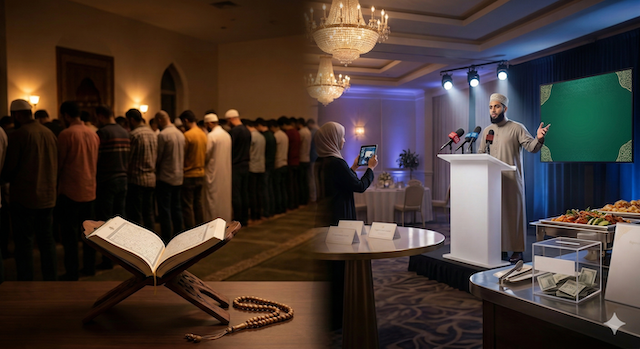
Ramadan was revealed to cultivate taqwa — an inward vigilance, an awareness that Allah sees what others do not. And yet, in many of our cities Ramadan increasingly unfolds beneath chandeliers, stage lighting, and ticketed buffets.
By Muneeb Nasir and Irshad Osman
Allah the Almighty says in the Qur’an:
يَا أَيُّهَا الَّذِينَ آمَنُوا كُتِبَ عَلَيْكُمُ الصِّيَامُ كَمَا كُتِبَ عَلَى الَّذِينَ مِن قَبْلِكُمْ لَعَلَّكُمْ تَتَّقُونَ
O you who believe, fasting is prescribed for you as it was prescribed for those before you, so that you may become mindful of God.” (Qur’an 2:183)
Ramadan was revealed to cultivate taqwa — an inward vigilance, an awareness that Allah sees what others do not.
And yet, in many of our cities Ramadan increasingly unfolds beneath chandeliers, stage lighting, and ticketed buffets.
Iftar galas fill banquet halls. Renowned reciters and charismatic scholars are flown in. Eloquent fundraisers pull heartstrings. Influencers amplify nightly campaigns across social media feeds.
This modern shift reflects that the Muslim community is more organized, more affluent, and more institutionally mature than it was a generation ago.
Almost all Iftar banquets are fundraisers. This is the month of generosity. On one side a variety of food is offered; on the other side donations are sought.
But Ramadan does not ask us how much we built.
It asks us what we purified.
Drift from Worship to Performance
Fundraising for the poor is righteous. Supporting relief efforts is necessary.
But there needs to be a radical clarity about boundaries.
Disclosure and accountability should not be buried under emotions and influence.
Because generosity without vigilance can quietly become performance.
Our community now operates at scale. Events are polished. Marketing strategies are sophisticated.
Return-on-investment calculations shape programming.
But Ramadan also trains us in secrecy. The fast itself is hidden.
When our fasting in Ramadan becomes highly visible, we must work harder to protect what is unseen.
Imam Al-Ghazali warned that the heart can crave reputation as subtly as it craves wealth.
The Imam Between Pulpit and Platform
The Prophet Muhammad, peace be upon him, said:
“Each of you is a shepherd, and each of you is responsible for his flock.” (Bukhari, Muslim)
Traditionally, the Imam’s authority was relational and local. He led the prayers, buried our dead, counselled our families, taught our children.
Today, some Imams carry global platforms. They livestream nightly reflections. They travel city to city in Ramadan. They raise funds for urgent global crises.
Influence can be a mercy. Beneficial knowledge reaching thousands is a blessing.
But when spiritual authority intersects with fundraising power, ethical complexity increases.
Ibn Rajab al-Hanbali wrote that the corruption of intention often begins when religious leadership becomes intertwined with worldly gain.
This includes, nowadays, social media fame.
The shepherd must never appear to graze from the flock. Even the perception of conflict erodes trust. And trust, once lost, is difficult to restore.
Mosques and the Marketplace of Attention
Allah describes the masjid as:
فِي بُيُوتٍ أَذِنَ اللَّهُ أَن تُرْفَعَ وَيُذْكَرَ فِيهَا اسْمُهُ
In houses which Allah has permitted to be raised and that His Name be remembered therein.” (Qur’an 24:36)
The masjid is sacred space.
In recent years, relief agencies frequently partner with mosques during Ramadan, offering well-known speakers and Qur’anic reciters in exchange for fundraising access.
Even sponsorship dollars are given in exchange for fundraising nights.
This arrangement is understandable. Funds are mobilized for real suffering.
Yet Ramadan now carries a saturation of appeals.
Multiple relief organizations visit the same mosque within thirty nights. Emotional intensity rises nightly.
Email lists are gathered. Donor fatigue quietly sets in.
Allah says:
الَّذِينَ يُنفِقُونَ أَمْوَالَهُمُ ابْتِغَاءَ مَرْضَاتِ اللَّهِ وَتَثْبِيتًا مِّنْ أَنفُسِهِمْ
Those who give their charity seeking the pleasure of Allah and strengthening their souls…” (Qur’an 2:265)
Notice the order: seeking Allah first, before the cause, before the campaign, before the matching gift deadline.
If congregants begin to feel like donor pipelines - in exchange for an Iftar buffet, rather than souls in formation and transformation, we risk thinning the spiritual soil from which generosity grows.
Avoiding competition, obtaining donor consent in data collection, disclosing how the funds are used and not used, are spiritual safeguards that Islam requires.
It is preserving donor dignity regardless of the amount one gives.
It is preserving the dignity of the space whose primary purpose is never fundraising.
Professionalization vs Islamic Spirit
There is nothing inherently un-Islamic about professionalization.
The question is whether professionalism remains subordinate to Taqwa.
As our events become more polished, we must ask: Are our hearts becoming more polished too?
Ramadan was never meant to stratify believers by ticket tier. Hunger equalizes us.
Standing shoulder to shoulder in prayer equalizes us.
Taraweeh equalizes us. Recitation of the Qur’an with a trembling heart equalizes us.
The Prophet ﷺ reminded us:
“Allah does not look at your forms or your wealth, but at your hearts and your deeds.” (Muslim)
A Call to Ethical Maturity
We are witnessing the maturation of Muslim civil society in North America.
With that maturation must come ethical clarity:
- Transparent fundraising standards
- Clear compensation and conflict-of-interest policies
- Respectful, opt-in data practices
- Collaboration among organizations to reduce donor fatigue
- Intentional protection of spiritually accessible programming for all income levels
Most of all, we must renew our intentions collectively.
Ramadan is not primarily about mobilizing capital, but about mobilizing the hearts.
It is not for expanding our brand, but for shrinking our ego.
It is an invitation to recalibrate our lives:
To feel the hunger so we remember our fragility.
To give so we loosen our grip on dunya.
When the banquet hall empties and the livestream ends, only one question remains:
قُلْ إِنَّ صَلَاتِي وَنُسُكِي وَمَحْيَايَ وَمَمَاتِي لِلَّهِ رَبِّ الْعَالَمِينَ
Indeed, my prayer, my sacrifice, my living and my dying are for Allah, Lord of the worlds.” (Qur’an 6:162)
Can we preserve that sincerity — beneath the lights, beyond the platforms, within the institutions — so that this rush for growth will not dilute Ramadan?
*Muneeb Nasir is the Chair of the Olive Tree Foundation, a Canadian public foundation (Waqf), the Executive Director of the Cordoba Centre for Civic Engagement and Leadership, and the Managing Editor of the online Canadian Muslim Journal, IQRA.ca.
*Irshad Osman is an Imam by training and a fundraising consultant by profession who holds a Certified Fundraising Executive (CFRE) designation. He has worked with local and international charities raising funds to support human development and disaster relief work.