
From Darkness to Light: Our Mandate for Hope
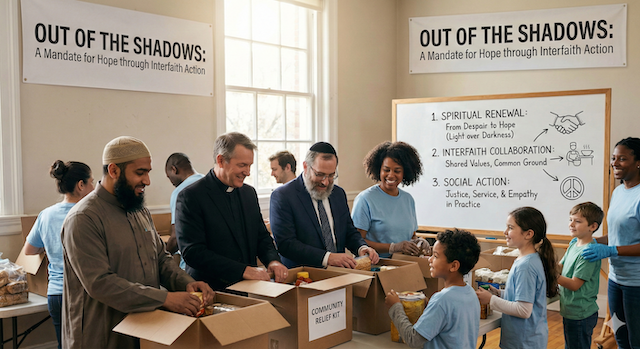
To lead humanity from darkness to light now requires more than spiritual devotion; it requires actionable service and collaborative leadership.
By Muneeb Nasir
We live in a time of unprecedented complexity and disruption.
Despite our technological advancements, a pervasive sense of social, moral, and spiritual darkness—fueled by division, despair, and relentless global conflict—presses down on the human spirit.
In this climate, the shared spiritual mandate to move "From Darkness to Light" is not a mere theological concept; it is the essential call to action for people of faith and conscience today.
This foundational teaching, woven into the very fabric of faith and spiritual traditions, must be our guiding principle for renewal and community building.
The Divine Promise
In the Islamic tradition, the movement from darkness to light (Nur) is an explicit act of divine guidance and mercy.
It is the defining process of salvation and the path for believers who commit themselves to God's will.
The most clear articulation of this principle is found in the Qur’an: "God is the ally of those who believe: He brings them out of the depths of darkness and into the light." (Qur’an, 2:257).
This verse assures the believer that no matter how deep the shadow of ignorance, error, or doubt, divine assistance is always available to illuminate the path.
The use of the plural form of darkness in this verse suggests multiple types of shadows—spiritual, moral, intellectual, and social—all of which are dispelled by the singular, unifying Light of God (Nur).
Furthermore, this theme is linked directly to the purpose of divine revelation itself.
The Qur’an is described as having come to earth to fulfill this function:
"A light has now come to you from God, and a Scripture making things clear," (Qur’an, (5:15).
The journey from darkness to light is achieved through sincere devotion, adherence to the faith's moral framework, and a constant striving for knowledge.
The Shared Heritage in the Abrahamic Tradition
While emphasizing the clarity of the Islamic texts, this truth is part of a shared, powerful teaching in the Abrahamic tradition.
In Judaism, the act of bringing light into the darkness of the world through righteous deeds (mitzvot) and active participation in Tikkun Olam (Repairing the World) is central.
In Christianity, the contrast between light and darkness is used to define the state of believers versus the world. The Gospel of John refers to Jesus as "the light of the world." The moral life is described as walking in the light, having abandoned the deeds of darkness.
The Mandate for Today
Because this light-and-darkness metaphor is shared across our faiths, it gives us a unifying and urgent mandate today.
We must acknowledge that the "darkness" we currently face is systemic: the darkness of polarization, the darkness of economic disparity, and the darkness of communal isolation.
To lead humanity from darkness to light now requires more than spiritual devotion; it requires actionable service and collaborative leadership:
- Be the Light of Service: We must embody the light through impactful campaigns that address real suffering—bringing resources and hope to communities experiencing social and economic darkness.
- Be the Light of Wisdom: We must counter the darkness of misinformation and divisive rhetoric with clear, simple, and unifying messages that draw on the moral consensus of our shared tradition.
- Be the Light of Dialogue: Fostering partnerships and interfaith dialogue shines a light on common ground, proving that the pursuit of peace and justice is a universal, collaborative endeavor.
God describes Prophet Muhammad (peace be upon him) as being sent to be a ‘mercy to all creation.’
Today, faith leaders must reflect that mercy by illuminating a pathway for a wounded world.
The journey from darkness to light is perpetual, but it begins with our clear, collaborative commitment to service and truth.