Demographic Shift: A Profile of Canada’s Muslim Population
With nearly one-third of its members born in Canada and a median age more than a decade younger than the national average, the Muslim population is poised to shape the cultural and economic future of the country for generations to come.
The face of Canada is changing, and census data released by Statistics Canada reveals a Muslim community that is growing rapidly, trending significantly younger than the national average, and becoming increasingly rooted in the Canadian fabric.
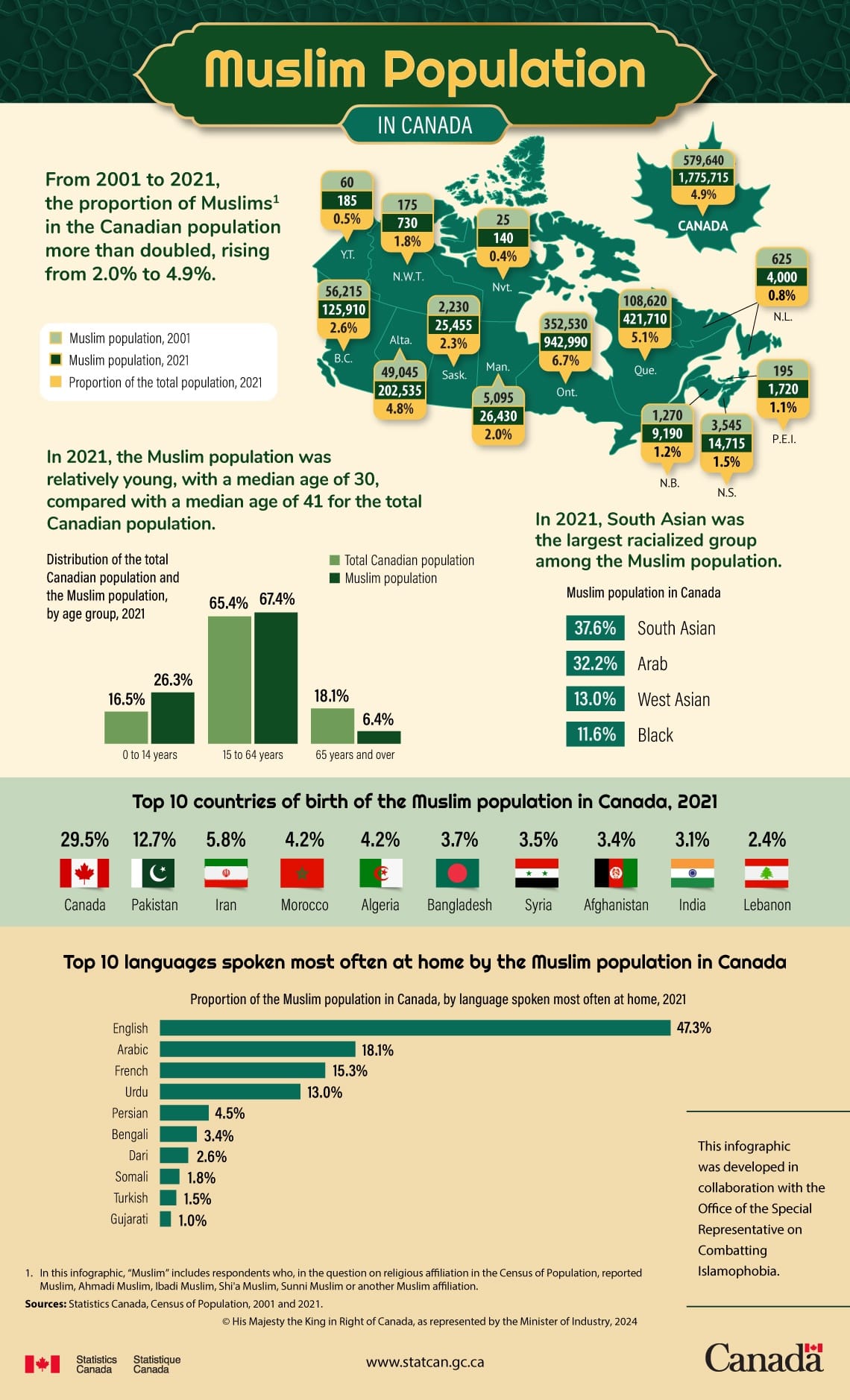
According to the infographic The Muslim Population in Canada (released December 2024), the community has experienced a remarkable demographic expansion over the last two decades.
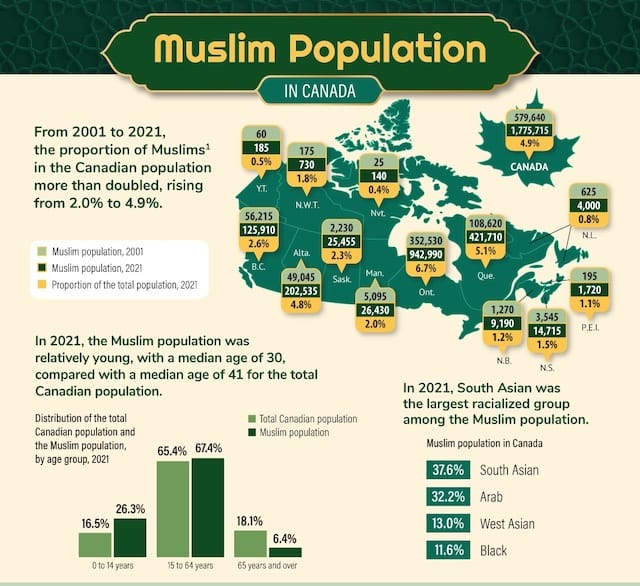
Between 2001 and 2021, the proportion of Muslims in the Canadian population more than doubled, rising from 2.0% to 4.9%. In absolute numbers, the population grew from approximately 580,000 to nearly 1.8 million people.
A Youthful Demographic
Perhaps the most defining characteristic of this community is its youth. The data paints a picture of a population largely in the prime of its working and family-building years.
In 2021, the median age for Muslims in Canada was just 30 years old—a stark contrast to the national median of 41. This gap is further highlighted when looking at specific age brackets:
- Children (0–14): Children make up 26.3% of the Muslim population, compared to just 16.5% of the total Canadian population.
- Working Age (15–64): A solid majority (67.4%) fall into the core working demographic.
- Seniors (65+): Only 6.4% of the Muslim population are seniors, compared to 18.1% of the general population.
This youthful energy suggests that the Muslim community will play an increasingly vital role in Canada’s labor market and social institutions in the coming decades.
Diversity and Roots
The profile also challenges monolithic stereotypes about the community.
While immigration remains a key driver of growth, a significant portion of the population is homegrown.
In fact, Canada is the single most common country of birth for Muslims, with 29.5% born within the country.
For those born outside Canada, the origins are vast and varied, reflecting a truly global diaspora.
The top countries of birth include Pakistan (12.7%), Iran (5.8%), Morocco (4.2%), and Algeria (4.2%).
This diversity is mirrored in racialized identities, with the population identifying predominantly as South Asian (37.6%), Arab (32.2%), West Asian (13.0%), and Black (11.6%).
Integration and Language
Linguistic data further underscores a high degree of integration.
When it comes to the language spoken most often at home, the vast majority of Canadian Muslims primarily use Canada's official languages.
English is the dominant home language for 47.3% of the population, followed by Arabic (18.1%) and French (15.3%).
Other heritage languages, such as Urdu (13.0%) and Iranian Persian (4.5%), also remain vibrant within Canadian households.
Geographic Distribution
While Muslims reside in every province and territory, the population is heavily concentrated in Canada's largest economic hubs:
- Ontario: Home to the largest number of Muslims (942,990), who make up 6.7% of the province's total population.
- Quebec: Hosts the second-largest community (421,710), comprising 5.1% of the population.
- Alberta: Has a significant community of over 200,000, representing 4.8% of residents.
- British Columbia: Home to roughly 126,000 Muslims (2.6%).
Smaller but growing communities are also establishing themselves in the Atlantic provinces and the Prairies, with Nova Scotia and Saskatchewan seeing populations of approximately 14,700 and 25,400, respectively.
Conclusion
The data from Statistics Canada—developed in collaboration with the Office of the Special Representative on Combating Islamophobia—illustrates a community that is not only growing in size but also in complexity.
With nearly one-third of its members born in Canada and a median age more than a decade younger than the national average, the Muslim population is poised to shape the cultural and economic future of the country for generations to come.