Delusional, Unhinged, and Failing: The Ego That Is Destroying the Middle East
The world is being dragged down by the weight of a failing ego and a delusional and unhinged leader. As we look at the global landscape today, the lesson is clear: the most dangerous thing in the world is a superpower that has run out of ideas but refuses to run out of ammunition.
By Muneeb Nasir
History has a repetitive quality when it comes to the rise and fall of great powers.
We often study the rise and heights of empires—their architecture, their culture, their vast trade routes, and their military innovations.
Yet, the most instructive part of their story is usually found in their final acts: the moment they realize they are losing, but choose to escalate anyway.
This phenomenon, often described as the "sunk cost fallacy" on a global scale, is a recurring theme in political systems, especially in hegemonic nations.
Hegemonic powers find it nearly impossible to admit defeat, especially when challenged by smaller, less equipped nations.
They box themselves in, convinced that their prestige is more valuable than the lives of their citizens or the stability of the world.
In doing so, they turn a manageable retreat into a quagmire and catastrophic collapse.
The Psychology of the "Boxing In"
When a superpower enters a conflict, it rarely considers an exit strategy that involves compromise.
For the hegemon, power is not just about physical force; it is about the perception of invincibility.
To admit that a smaller nation has successfully resisted its will is seen as an existential threat to the entire imperial structure.
As the conflict drags on and the smaller nation refuses to submit, the empire begins to escalate.
They send more troops, spend more wealth, and harden their political rhetoric.
They tell their public that "victory is just around the corner," even as the ground beneath them shifts.
This is the moment the trap snaps shut.
By investing so much "prestige" into a winning outcome, the leadership makes it politically impossible to walk away.
They become prisoners of their own propaganda.
The Qur’anic Mirror: Pharaoh and the Illusion of Control
The Qur'an provides profound psychological profiles of this hegemonic mindset, none more vivid than the figure of Pharaoh.
Pharaoh represented the ultimate superpower of his era, possessing unmatched military might and economic control.
When Moses challenged this status quo, Pharaoh did not see a spiritual message; he saw a threat to his hegemonic order.
Pharaoh’s refusal to admit a change in reality led him to a cycle of escalation.
Even as his kingdom suffered through various signs and plagues, his response was to tighten his grip. He told his people:
"But Pharaoh said, ‘I have told you what I think; I am guiding you along the right path.’" (40:29).
This is the classic hallmark of a leader who has boxed himself in.
He becomes the sole arbiter of truth, ignoring the reality on the ground to preserve his ego.
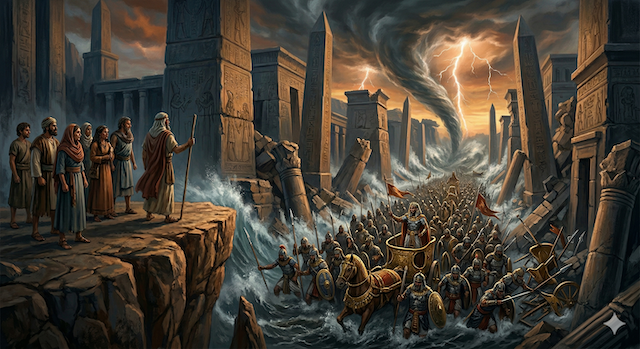
His final escalation—chasing the Israelites into the sea—was the ultimate "all-in" move.
He chose to risk everything on a final show of force rather than admit that his power had limits.
The result was not just his own demise, but the total destruction of his elite military force.
The People of 'Ad: The Delusion of Strength
Another striking example is the people of 'Ad.
They were a civilization of immense physical and architectural strength, building lofty monuments that were "unmatched in the land."
Their downfall came from the same hegemonic arrogance: the belief that their power made them immune to the laws of history and morality.
The Qur’an records their internal monologue:
"As for A'ad, they were arrogant in the land without right, and they said: Who is mightier than us in power?" (41:15).
This question—“Who is mightier than us in power?”—is the mantra of every empire on the brink of overreach.
It is a mindset that views the world through a single lens: raw power.
When a nation believes it is the ultimate authority, it loses the capacity for self-correction.
They view any call for restraint or diplomacy as a sign of weakness, leading them to keep escalating until the "disastrous outcome" becomes inevitable.
The Cost of Refusing to Pivot
In our modern context, we see these patterns repeated.
Whether in the form of endless "forever wars" or economic policies that exploit smaller nations, the refusal to admit a mistake remains the greatest flaw of leadership.
When a hegemonic power scales up a conflict because it cannot bear the "shame" of a strategic withdrawal, the world pays the price.
We see the displacement of millions, the destruction of ancient cultures, and the draining of resources that could have been used for the common good—for education, healthcare, and environmental stewardship.
True leadership, especially from a position of great power, requires the humility to recognize when a path is no longer viable.
In the prophetic tradition, we find that the strongest person is not the one who can overcome others by force, but the one who can control themselves in moments of intense pressure.
As we look at the global landscape today, the lesson is clear: the most dangerous thing in the world is a superpower that has run out of ideas but refuses to run out of ammunition.
Admitting defeat is not just an act of political survival; it is a moral necessity to prevent the world from being dragged down by the weight of a failing ego and a delusional and unhinged leader.
We must strive for a world where "might" is measured by the ability to foster peace, not the stubbornness to prolong a war.