
Beyond the Hype: A Shared Reflection on Charity and Community
Recent headlines regarding financial transparency and reporting discrepancies in the international relief agency sector serve as a cautionary mirror for the entire community. These moments are not opportunities for finger-pointing, but for institutional introspection.
By Muneeb Nasir
The scale of global suffering today is, quite simply, staggering.
From the humanitarian catastrophes across the Middle East to ongoing struggles in Africa and beyond, the need for professional, large-scale relief has never been greater.
We owe a profound debt of gratitude to the international relief agencies that serve as our community’s lifeline to the world.
Their ability to mobilize millions of dollars and coordinate complex logistics in high-risk zones is a testament to the dedication of the staff and volunteers who work tirelessly behind the scenes.
However, as these organizations grow and the digital world evolves, it is a moment for a collective pause.
This isn't about criticizing any one group, but rather an invitation for all of us—donors, local leaders, and global relief agencies—to reflect: Have we allowed the tools of modern marketing to inadvertently steer us away from the simplicity and transparency that define a faith-based community?
The Burden of Visibility
In a world of short attention spans and crowded social media feeds, charity organizations are under immense pressure to remain visible.
To save lives, they must raise funds; to raise funds, they must compete for our attention.
This has led to a sophisticated, high-impact style of marketing that has been effective.
Yet, this success has created an unintended "branding arms race."
We are seeing a shift where the spiritual act of Sadaqah—traditionally a quiet, personal bridge between the giver and the Creator—is increasingly filtered through a lens of "hype."
When we prioritize the spectacle of a fundraiser over the sanctity of the service, we risk transforming giving into a transactional experience, where donors expect "content" in exchange for their donations.
The Challenge of the Middleman
This corporate evolution has introduced a new layer of "middlemen"—influencers, Imams, Qur’an reciters and public speakers who are sometimes paid significant sums to act as the face of a campaign.
While high-profile speakers can help raise more funds, it can feel spiritually dissonant when a significant portion of a donation is redirected toward marketing and "hype."
Charity is an intimate act of worship—a direct connection between the donor, the recipient, and the Creator.
The "Slick" Local Pivot
This pressure has reached our local mosques and community organizations.
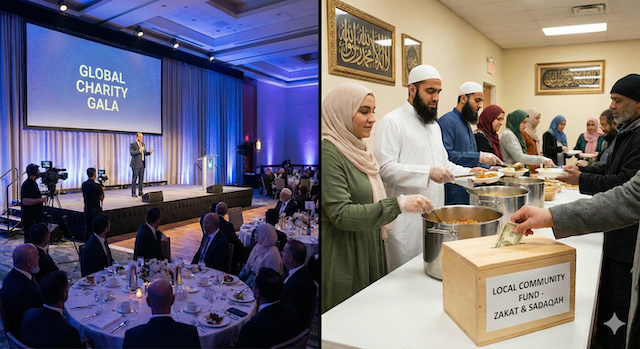
Small, community-based organizations—our masjids, food banks, women’s shelters, disability groups, mental health services and youth circles—now feel they must "keep up."
We see a "reel-ification" of local service, where dedicated volunteers spend hours producing social media clips and slick online posters to make their work look "enticing" enough to compete for local attention.
When we feel forced to prioritize "looking good" over "doing good," we risk hollowing out our spiritual core.
As the Qur’an reminds us, "God commands you [people] to return things entrusted to you to their rightful owners" (4:58).
This Amanah, or sacred trust, applies not just to the money we handle, but to the intentions behind our work and the way we represent the suffering of others.
A Mirror for All of Us
Recent headlines regarding financial transparency and reporting discrepancies in the international relief agency sector serve as a cautionary mirror for the entire community.
When reports emerge of "clerical errors" involving millions of dollars, or questions arise about whether funds reached their stated destination, the damage isn't localized.
It creates a "cynicism" that every honest, hardworking organization—large or small—must eventually pay.
These moments are not opportunities for finger-pointing, but for institutional introspection.
Whether it is an international relief agency managing a multimillion-dollar campaign or a local masjid board overseeing a renovation fund, the standard must be the same: radical transparency and unimpeachable ethics.
We cannot let "slick" marketing become a substitute for rigorous accountability.
Reclaiming the Balance
The path forward is not to abandon our global responsibilities or to stop using modern tools.
Instead, it is to reclaim a sense of balance.
- Valuing the Mundane: We should re-learn how to value the "un-marketable" work: the quiet counseling session, supporting the disabled or mentally ill, cleaning the masjid, and the consistent food distribution that doesn't always fit into a 30-second social media reel.
- Proximity as a Strength: Local organizations should not try to mimic the aesthetics of international relief agencies. Their strength lies in proximity—the ability to offer authentic, human connection and local accountability that a distant marketing campaign cannot replicate.
- Refining Our Intentions: As donors, we can look beyond the "hype." We should support organizations not just because their videos and social media posts are the most enticing, but because their records are transparent and their impact is verifiable.
We are immensely proud of the work our community does to relieve suffering around the world.
But as we continue that work, let us ensure that our successes do not come at the expense of our spiritual soul.
By returning to a model of Prophetic simplicity and rigorous trust, we ensure that our institutions remain worthy of the community’s faith—and more importantly, the Creator's pleasure.