
Are Mosques Losing Out to Online Islamic Programming?
Every Imam and mosque leadership will be asked about the trust placed in them by people who came through their doors seeking transformation and left unchanged, because the masjids were too preoccupied with optics and the inertia of seasonal programming.
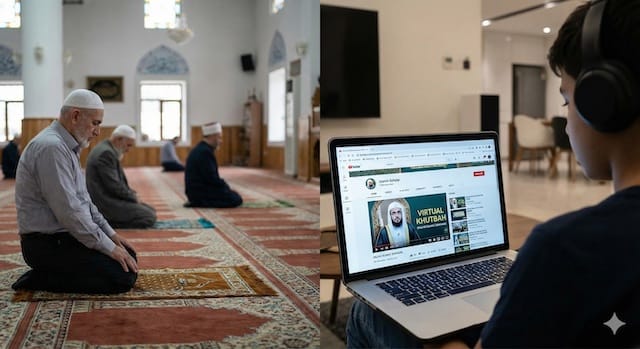
By Imam Irshad Osman
Every year, as the blessed month of Ramadan arrives, something remarkable happens.
Mosques that stood half-empty through the year suddenly overflow. Men who had not attended Friday prayers in months return. Families arrive for Taraweeh. Youth who had drifted come back.
On the first night of Taraweeh, I felt that remarkable energy: packed rows, children squeezed between their fathers, and sisters overflowing into the hallway. People carry quiet hopes that this Ramadan might be different. This Ramadan, something would change. This Ramadan, they would transform.
And yet, year after year, I have watched mosques and Islamic centres respond to that energy in ways that fall short of what people are seeking, even more so now than a decade ago. The deeper hunger that people bring with them often goes unacknowledged and unfed.
Ramadan was never meant to be just a season
The Qur’an is unambiguous about the purpose of fasting. "O you who have believed, decreed upon you is fasting as it was decreed upon those before you so that you may become righteous." (Al-Baqarah: 183). The operative word is tattaqoon: to grow in God-consciousness (taqwa) and moral excellence. It is not merely to feel spiritual, nor simply to complete a ritual. It is to be transformed in character.
The Prophet ﷺ reinforced this with striking clarity: "Whoever does not give up false speech and acting upon it, Allah has no need of his giving up food and drink." (Bukhari).
At its core, Ramadan is a 30-day character-building bootcamp: a training ground to purify the heart, discipline the self, and prepare the believer for the eleven months that follow.
However, somewhere along the way, many of our masjids have drifted from this mandate. They have become very good at something else instead.
What We Have Become Very Good At
Walk into most mosques this Ramadan and you will find something genuinely beautiful.
Elaborate iftars, and huffaz with exceptional voices whose recitation moves grown men and women to tears.
Fundraising nights that raise hundreds of thousands of dollars, and live-streamed Taraweeh that sometimes goes viral on social media. These are not bad things. Community, generosity, and the beauty of Qur'anic recitation are gifts from Allah, and I am not dismissing them.
However, the honest question every mosque leadership should ask is whether these have become the primary offering, crowding out what people came seeking in the first place.
Are these the most important things we can offer to those who walk through our doors in Ramadan with profound expectations, knowing their fasting will still be accepted without these voluntary acts?
The Gap Between What People Need and What We Offer
A 2022 survey by the Institute for Social Policy and Understanding found that mosque attendance spikes three to five times in Ramadan, with many of those returning congregants being people who rarely or never attend otherwise.
They arrive with a rare openness, a window of tawbah (repentance) that may not stay open for long. What many of them find, however, is programming designed for those already committed, not for those trying to reconnect with their faith and reform themselves.
To be fair, most masjids do offer educational sessions in Ramadan. However, a closer look at the content reveals that most programming centres on the fiqh of fasting: what nullifies the fast, how to manage diabetes during Ramadan, how to stay hydrated during long days, and how to stay healthy. These topics are legitimate and increasingly relevant given our modern consumption habits.
Yet these topics are, by definition, temporary. They expire when the month ends. They do not equip a Muslim to be more patient with his family in Shawwal, more honest in his business dealings in Dhul Hijjah, more aligned with the Qur’an in Muharram, or more merciful in his social interactions throughout the year.
What is largely absent is the kind of programming that speaks to why we are really here. Thematic lecture series on purifying the heart from envy, pride, and anger, the very diseases fasting is prescribed to cure.
Structured Qur’anic tafseer that connects the divine text to the struggles our congregations are actually living through.. Honest, grounded conversations about the modern challenges facing our youth, our families, and our communities.
As a result, the deeper spiritual hunger people bring through the doors each Ramadan largely goes unfed and unmet.If we look back a decade, we can see one major reason for this gap. We have largely left this crucial role of education and character refinement to the internet.
The online platforms stepped in
Online platforms led by popular scholars and charismatic teachers have stepped in with precisely the kind of substantive content that many masjids have stepped away from.
Muslim viewership and engagement with this content increase significantly every Ramadan. This is admirable work, and I say that sincerely.
However, online content has real limitations that we should not ignore. Research on video engagement shows that for long-form content over ten minutes, average viewer retention often sits between 25% and 50%.
Even for well-produced educational videos, only the top 5% retain 77% of their audience through to the end. The rest lose the majority of their viewers well before the most substantive material is covered.
This is not a failure of the content. It is the nature of the medium. Online consumption is built around distraction. There is always another notification, another recommendation, another reason to disengage.
Masjids are different
The masjid, however, is something else entirely.
The masjid offers something that no screen can replicate.
The Prophet Muhammad said: "No people gather together in one of the houses of Allah, reciting the Book of Allah and studying it among themselves, except that tranquility descends upon them, mercy covers them, angels surround them, and Allah mentions them to those who are with Him." (Muslim).
That promise is about a gathering, an embodied, in-person experience, where the Noor of a scholar's character and wisdom transfers to those sitting before them in ways no algorithm will ever be able to match. It cannot be replicated by a phone screen at midnight, period.
Crucially, many of the people who return to the mosque in Ramadan are precisely those who do not consume online Islamic content regularly.
They are not watching popular Ramdan talk series. They are not subscribed to the highly followed YouTube channels.
The masjid is their only touchpoint with meaningful Islamic learning. What we offer them – or fail to offer – may determine whether that window of renewal widens or quietly closes for another year.
Masjids have a Wilayah. Let us honour it
The masjid carries a Wilayah, a guardianship, over its congregation.
Every Imam and mosque leadership will be asked about the trust placed in them by people who came through their doors seeking transformation and left unchanged, because the masjids were too preoccupied with optics and the inertia of seasonal programming.
Ramadan does not change people automatically. It is a Mawsim…a season of fertile possibility. Like good soil, it only yields what is planted.
The congregation is ready. They come every year, with all their complications and inconsistencies, because something in them knows that this month holds the possibility of becoming someone better.
The question every mosque must ask this Ramadan is: Are we prepared to deliver? Do we understand their Ramadan expectations? Have we developed content tailored to them? In short, what are we planting?
A thematic series on the diseases of the heart.
A living Tafseer of a Qur'anic surah. A frank, grounded conversation about faith, doubt, family, and purpose, delivered in person, by someone whose presence and sincerity can transfer to those sitting before them.
This is what the masjid was built for. And it is a role we must not continue to outsource.