
“This Is My Mosque” — A Story of Faith, Courage, and Belonging
From the sisters’ entrance to the main hall, one young woman’s journey reveals how inclusion strengthens faith and community.
By Mirza Shafi
Fatima grew up in Toronto, where winters could be long and dreams needed to be big just to survive the cold.
She was the kind of student teachers loved to call on — sharp, curious, and full of confidence.
In her public school, she seemed to be everywhere: president of the Girls Empowerment Club, debate team captain, food drive organizer.
It was a world where every girl’s voice mattered.
But on Fridays, that world shifted.
Her father would take the family to the local mosque — a squat brick building that smelled faintly of carpet and cardamom tea.
Fatima and her mother never entered through the main doors.
They took the narrow path around the side, where a small sign read: “Sisters’ Entrance.”
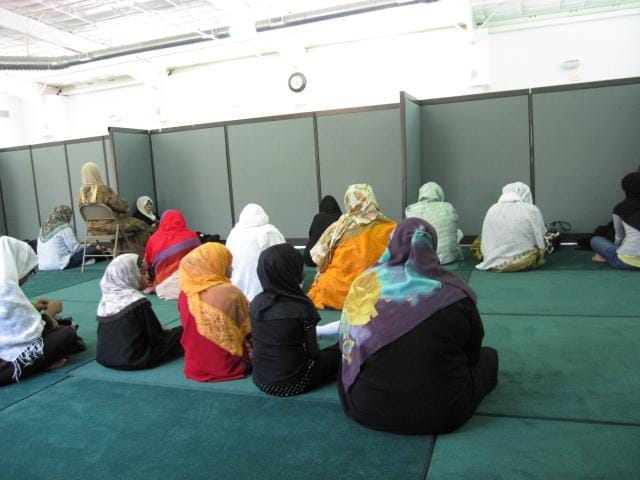
Inside, a curtain barrier divided the prayer hall.
The women’s section was small.
The speakers crackled and the sound muffled, and sometimes the imam’s voice faded into static.
When prayer ended, the men lingered in the main hall — chatting, laughing, sharing tea.
The women quietly gathered their shoes and slipped back out through the side door.
Fatima didn’t have the words for it then, but she felt it — that quiet message that said, “You don’t quite belong here.”
At school, she thrived.
She learned that girls could be scientists, athletes — even prime ministers.
But at the masjid, when she once suggested starting a youth group for girls, one of the uncles smiled and said, “Maybe when you’re older, beta. Focus on your studies.”
So she did. But she also began studying her faith — on her own terms.
While in high school, her Sunday school teacher, Sister Mariam, told a story that changed everything.
When Caliph ʿUmar (RA) once tried to limit dowries, a woman in the masjid stood up and corrected him — quoting the Qur’an: “do not take any of her bride-gift back, even if you have given her a great amount of gold.” (Qur’an 4:20).
ʿUmar paused, then said: “The woman is right, and ʿUmar is wrong.”
Fatima’s eyes widened. “In the masjid?” she asked.
“Yes,” said Sister Mariam. “And he listened.”
That story cracked something open.
She would learn about Khadijah (RA), the Prophet’s first supporter; Aisha (RA), the scholar whose students included great men; and Nusaybah (RA), the warrior who defended the Prophet ﷺ in battle.
Islam, she realized, wasn’t the problem.
The problem was how people had narrowed it and restricted it.
When she turned seventeen, her father took her to a community meeting at the mosque.
Eight elderly men sat at the front, kind but tired, discussing donations and deficits.
Not once did they mention youth or women.
When a young woman politely asked for a better sound system in the women’s prayer area, one elder sighed.
“Sister, we’ve always done it this way.”
That night, on the drive home, her father was quiet for a long time. Finally, he said, “Our elders built these walls. But it’s your generation that has to open the doors.”
Those words stayed with her.
For the first time, Fatima saw her mosque differently — not as a place that excluded her, but as a place waiting for her to reclaim it.
A place where one day she could walk through the main doors, head high, and say with certainty: “This is my masjid — and I belong here.”