
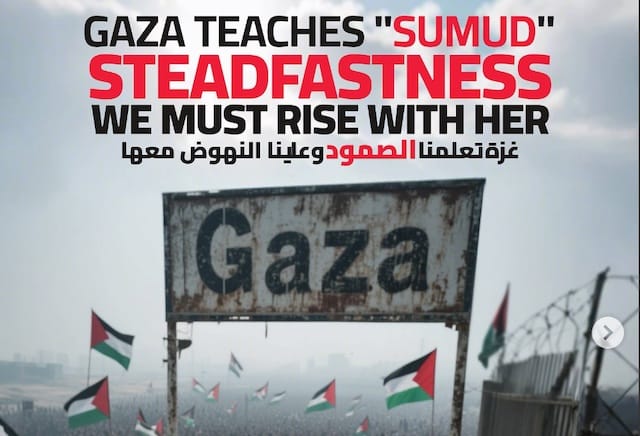
Sumud: Gaza’s spiritual defiance against erasure
In the ruins, Palestinians repeat: Hasbunallahu wa ni‘mal wakeel—'God is enough for us, and He is the best disposer of affairs.' This is sumud, faith as resistance.
By Muneeb Nasir
Rev. Munther Isaac, the Palestinian Christian pastor in Bethlehem, said during his 2024 Christmas message:
“In our steadfastness – sumud, let us have eyes of faith to perceive and believe that every Herod will pass, every Caesar will fade, for Empires have an expiry date.”
Alongside this Christian witness, Palestinians in Gaza often utter a prayer that has become an anthem of their struggle: “Hasbunallahu wa ni‘mal wakeel” (حَسْبُنَا اللَّهُ وَنِعْمَ الْوَكِيلُ) — God is enough for us, and He is the best disposer of affairs.
Together, these words capture the spiritual heart of sumud.
They express defiance against erasure and radical trust in One God.
To say “We are steadfast” and “God is enough” is to resist despair, refuse to surrender dignity, and insist that life will not be extinguished even in the shadow of genocide.
Sumud is not only a political or cultural stance—it is deeply spiritual.
It reflects the Islamic virtue of sabr, the patience and steadfastness God calls believers to practice in the face of hardship.
Sabr emphasizes patience, inner endurance and trust in God.
Sumud transforms that patience into visible, active perseverance.
It is faith made tangible: families refusing to abandon their homes, farmers tending scorched fields, communities insisting on life and dignity despite siege and starvation.
In Gaza, patience is not passive—it is a steadfast resistance, a moral witness, and a spiritual defiance against erasure.
In this way, sumud is both the Palestinian embodiment of sabr and a universal call to endure with courage, hope, and faith.
Today, sumud is lived under siege, hunger, and genocide.
Starvation has been weaponized: families are deliberately deprived of food and water.
Safety has been stolen—there is no shelter from bombs, no refuge from violence.
Parents risk death for flour; children waste away in hunger, their schools shuttered, their futures uncertain.
Farmers see their orchards uprooted, their fields razed.
This is not a tragic accident of war—it is calculated cruelty, designed to break a people and eventually ethnically cleanse their land.
And yet, even in the face of such brutality, Palestinians rise each day and proclaim through their survival: We are steadfast.
For those of us outside Gaza, sumud is a summons. .
If sumud is their witness, solidarity must be ours.
To speak, to act, to refuse indifference—that is what this moment demands.
For to remain silent in the face of genocide is to side with oppression.
But to stand with the people of Gaza is to insist, with them: life, dignity, and justice will prevail.
This is their gift to us: sumud.
A word, a witness, a way of life.
And if we dare to receive it, it may shape our own journey—calling us to endure, to resist, and to insist on life.
When words fail, recall the prayer of the steadfast: “Hasbunallahu wa ni‘mal wakeel” (حَسْبُنَا اللَّهُ وَنِعْمَ الْوَكِيلُ) — God is enough for us, and He is the best disposer of affairs.