
Palestinian-Canadians Challenge Canada on Gaza Genocide
The lawsuit was filed last year on behalf of two Palestinian-Canadian men, Hany Batnigi and Tamer Jarada, whose families have suffered unimaginable losses as a result of Israel’s genocidal campaign in Gaza since October 2023. Their lived experience is at the heart of this legal challenge.
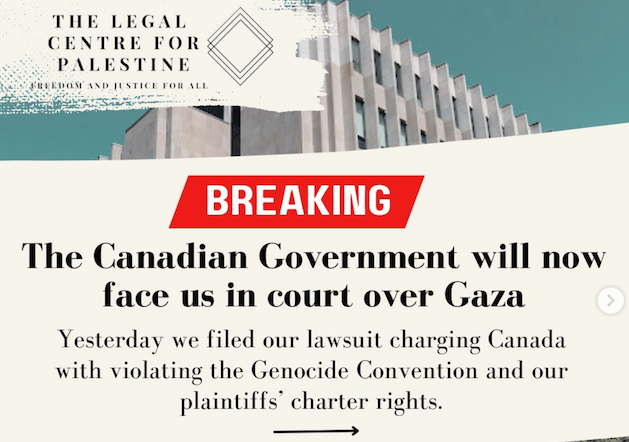
The fight for accountability over the unfolding tragedy in Gaza has moved into a Canadian courtroom.
A legal team—the Coalition for Canadian Accountability in Gaza (CCAG)—is facing off against the Government of Canada in a landmark case alleging Canada’s failure to prevent genocide.
CCAG is composed of the Legal Centre for Palestine, the International Centre of Justice for Palestinians – Canada (ICJP – Canada), Hameed Law and A. Dimitri Lascaris Law Professional Corporation.
The lawsuit was filed last year on behalf of two Palestinian-Canadian men, Hany Batnigi and Tamer Jarada, whose families have suffered unimaginable losses as a result of Israel’s genocidal campaign in Gaza since October 2023. Their lived experience is at the heart of this legal challenge.
The Coalition's core argument is direct and devastating: Canada had early and consistent knowledge of the significant risk of genocide in Palestine over the last two years yet failed to take all reasonable measures within its power to prevent it.
They argue this failure constitutes a breach of Canada’s duties under the Canadian common law and, crucially, a violation of the Charter rights—specifically, the rights to security of the person (Section 7) and to equal protection and benefit of the law (Section 15)—of the plaintiffs.
In a move that has drawn sharp criticism from the legal team and activists, the Government of Canada has chosen not to defend its actions on the merits.
Instead, it has filed a motion to dismiss the entire case, arguing the court has no jurisdiction, calling the matter a "political question," and dismissing the case as a "waste of time."
The government's challenge essentially forces the plaintiffs, Mr. Batnigi and Mr. Jarada, to fight for their fundamental right to be heard before they can even present their evidence of Canada's alleged failure.The hearing is a crucial battle for access to justice.
As the Legal Centre for Palestine stated, "we are fighting for access to justice to enable Hany and Tamer to have their day in court."
This case is about more than just a procedural argument; it represents a profound moral and legal test for Canada.
- Canada’s Obligations: As a signatory to the 1948 Genocide Convention, Canada has a legally binding duty to prevent genocide. The Coalition aims to demonstrate that this international obligation must be enforceable under domestic law, particularly when the government’s failure to act directly impacts the rights of its citizens.
- Charter Rights: The plaintiffs argue that Canada’s actions and inactions—including its alleged active support through arms trade, military cooperation, and the discriminatory treatment of Palestinian-Canadians seeking to evacuate their families—have violated the fundamental rights guaranteed by the Charter.
If the court allows the government's motion to strike, it risks setting a dangerous precedent: insulating the government's foreign policy from judicial review, even when that policy allegedly facilitates international crimes and infringes on the constitutional rights of Canadians.
For Mr. Batnigi, Mr. Jarada, and the Coalition for Canadian Accountability in Gaza, the stakes could not be higher.
They are fighting to hold one of the world's most prominent signatories of the Genocide Convention accountable and, in doing so, affirm that Canadian law protects all its citizens, regardless of their ethnic or national origin, from the state’s complicity in the gravest of crimes.
The two sides presented their arguments on November 27th, and the judge is expected to issue a decision on the motion to dismiss by the end of the year or in early 2026.