
Nuzhat Jafri and the Canadian Council of Muslim Women
The CCMW is a model organization. No matter where you turn, you can only feel admiration. The organization works with the Muslim community but also provides education to the wider Canadian society and consults with government and policy makers.
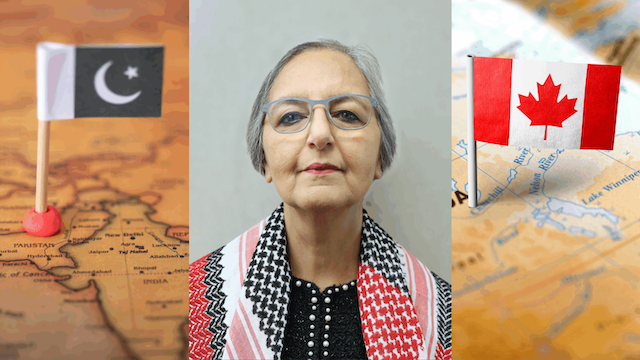
By Brian Carwana
As October is Islamic History Month in Canada, I thought we should take the opportunity to look at an organization that has not only been contributing to Canadian society for over 40 years but that continues to expand its marvelous work with each passing year.
I have been familiar with the Canadian Council of Muslim Women for years and with its Executive Director Nuzhat Jafri.
I’ve not worked closely with Nuzhat but she and the CCMW have always been impressive. The sheer expanse of the organization’s activities is stunning and many of their resources are just top drawer.
So, let’s take a look at this incredible organization and the woman who leads it.

Background
Nuzhat was born in Pakistan but moved to Canada as a child.
She loved languages and has studied seven of them at one time or another in university, with French literature and poetry becoming her area of focus.
She imagined being a translator but life goes in funny directions and she spent much of her career in the civil service and eventually at some of the country’s largest banks.
However, she also got involved with an organization founded in 1982 – the Canadian Council of Muslim Women.
Nuzhat was always interested in social justice and was raised in a very welcoming and inclusive Muslim home.
She was drawn by the CCMW’s inclusive attitude towards all Muslims (regardless of sect, dressing choices, etc.) and its desire to foster greater opportunities for Muslim women.
She volunteered for the CCMW, eventually joined its board, and in 2018, became its executive director.
What is the CCMW about?
Nuzhat indicated that the CCMW has always been “committed to the equality, equity and empowerment of Canadian Muslim women and girls.”
She adds “we want to empower women and girls to have agency and to be able to advocate for themselves.” The organization is “made up of Muslim women from across the country. All that is required is that you identify as a Muslim woman. They can be gender diverse, ethnically diverse, racially diverse, have a disability, as long as they identify as a Muslim woman and accept our guiding principles. Our first guiding principle is that we are guided by the Qur’anic injunction towards mercy, mercy and justice. We abide by that. God is merciful and every human being deserves God’s mercy and justice…..We don’t question people. We welcome diversity and difference.”

Its Projects
It is quite stunning to see the long list of projects the CCMW is involved in (see the list under their Projects tab on their website).
“We focus a lot on education. Education around employment, gender-based violence, legal rights, etc. We have several projects aligned with this.”
Jafri outlined a recent major project on barriers and facilitators for Muslim women’s employment. “It’s to help them understand what hinders and what can help their employment prospects and career advancement. And also we provide resources for employers on how to recruit and retain Muslim women.”
She added that they have a major conference on employment on November 6 and 7 called I Belong, You Belong with an impressive list of speakers and where they’ll be unveiling new resources through their toolkits.

But employment is just one issue they tackle. “Right from the start of CCMW’s work, we’ve worked on gender-based violence. Right now, we have a project focusing on sexual harassment in the workplace. It’s taboo in our community as in many. No one wants to talk about it. Our research showed that Muslim women who experience sexual harassment at work didn’t know what to do. They couldn’t go to their families because it’s taboo. They didn’t know whether to report it or whether it was sexual harassment. We felt we had to tackle it.”
The CCMW’s program (called WISH for Workplace Interventions in Sexual Harassment) – focuses on what the women know, their knowledge gaps, if they need legal supports, etc.
“We also do a lot of education on Islamophobia. We look at online hate. And we do a lot of work on gendered Islamophobia. Islamophobia focuses inordinately on women. They get attacked because they have a hijab on. Especially Black women. When there’s policy or legislation the government is introducing, we will comment on that. So we do education not only in our community but in the wider community and to government and policy makers.”
Hopeful Stuff
Nuzhat noted there’s a lot of “doom and gloom” out there so they also “have some really positive initiatives to balance the negative stuff that happens.”
To that end, since 2007, they’ve had the Women Who Inspire Awards. “These women are nominated at the grassroots. The criteria are their commitment to women’s equality, their grassroots activism, that they are role models, their leadership, and their commitment to diversity and inclusion. When you hear the women and their stories, you’re in awe of what they’ve done. It’s a chance for us to showcase the women in our community who are doing wonderful things and who are making real contributions to Canada.”

They also offer scholarship programs and, on the academic front, they have a Muslim Women Scholars series and a Thought Leaders Series showcasing key thinkers and their work.
In short, they showcase both role models and leading scholarship on issues affecting Muslim women.
Back to Gender-Based Violence
I steered our conversation back to this topic because, as someone who recommends resources to police, I have frequently pointed officers to the CCMW site.
It is really incredible with not only resources, but with a service of connecting a woman in need with supports (therapists, legal experts, case workers, imams). The site also has translations in seven languages. “Yes, we coordinate legal and support services for victims of gender-based violence.”
In addition, the CCMW has an “emergency bursary to help victims deal with paying for lawyers, paying rent, etc. It’s not a lot but it’s something to tide them over.”
Moreover, the CCMW is currently in the midst of a 2 year pilot in Ontario where they’ve opened the first Muslim women’s legal clinic. “There are a lack of services that are culturally competent and affordable. So the legal clinic is free of charge. It’s the first and only service of its kind in Canada.”

Conclusion
The CCMW is a model organization. No matter where you turn, you can only feel admiration. Here is a group of impressive Muslim women (and a few men) highlighting and uplifting other impressive Muslim women (through awards, scholarships, etc.) as well as providing support to women facing barriers, oppression or violence.
The organization works with the Muslim community but also provides education to the wider Canadian society and consults with government and policy makers.

And they model inclusivity. It does not matter how you dress, what sect you belong to, your race, age, etc.
There is a space for you and others both like you and who differ from you.
In short, the CCMW is what they say are – Muslim and Canadian, aiming to support and contribute to both these identities and communities.
(Brian Carwana has a PhD in religion, a business degree, and worked as a strategy consultant. He is the Executive Director of Encounter World Religions where he has been teaching people about ethno-religious communities and facilitating actual “encounters” for 20 years. This article is reprinted with permission of the author and originally appeared on the ReligionsGeek website).