
Making Islamic History Month a Year-Round Civic Tradition
For Muslims in Canada, the challenge is not only to celebrate our history once a year but to make that history a continuous act of engagement.
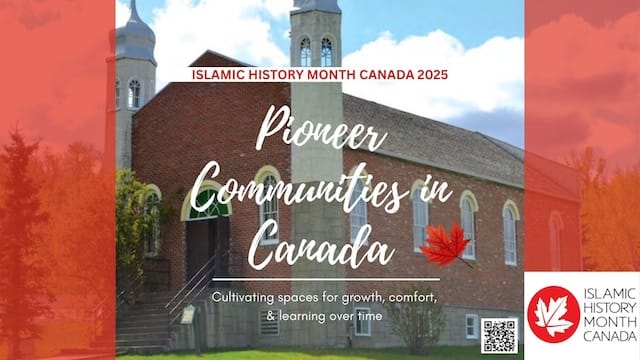
By Muneeb Nasir
Each October, mosques and Muslim organizations across Canada mark Islamic History Month (IHM) with lectures, exhibitions, and events.
What began as a national proclamation in 2007 has grown into a vibrant tradition — a time when Muslim communities proudly share the richness of Islamic civilization and the contributions of Muslims to the world.
In recent years, these celebrations have moved beyond mosques, centres and community organizations into public spaces — libraries, malls, schools, and municipal venues.
In doing so, Islamic History Month has become a meaningful opportunity for outreach and dialogue.
For many Canadians, it’s their first encounter with their Muslim neighbors and their culture and history beyond the headlines.
This success, however, reveals an even greater potential.
Islamic History Month can be more than a once-a-year celebration; it can serve as the foundation for a year-round civic and community engagement program that deepens public understanding and strengthens local relationships.
A useful model already exists.
In the country, the Doors Open program has invited the public into heritage sites, architectural landmarks, and cultural institutions that are usually closed to visitors.
In Ontario, over nine million visits have been made to Doors Open events across the province, with participants exploring museums, buildings, archives — and often places of worship.
The success of this initiative rests on a simple but powerful principle: access creates understanding.
When people are welcomed into a space, whether a historic church or a neighbourhood mosque, they encounter stories and experiences that break down barriers and build connections.
Muslim institutions can adapt this model by transforming Islamic History Month into an ongoing civic engagement framework.
Instead of being limited to a few days of programming each October, mosques and Islamic centres could open their doors throughout the year — offering guided tours, storytelling sessions, heritage walks, and educational partnerships that make them visible and accessible parts of the civic landscape.
Imagine more mosques participating in its city’s Doors Open weekend, inviting neighbours for a guided tour, a talk on Islamic beliefs and practices and conversations about faith and community life.
Visitors could explore different areas of the building, learning something new at each stop, almost like collecting stamps on a “Heritage Passport.”
Inside, displays could tell stories of early Muslim settlers in Canada — the pioneers who built the first mosques, the families who arrived decades ago and helped shape neighbourhoods, the artists, scholars, and volunteers who continue to enrich Canadian society.
Short videos, oral history recordings, or QR codes could link visitors to a digital archive of stories and photographs such as the Muslim in Canada Archives.
Mosques could also collaborate with local heritage festivals and architecture programs, allowing their design, calligraphy, and craftsmanship to be featured as part of the city’s cultural landscape.
Beyond October, communities might host regular “Open Mosque Sundays” or neighbourhood heritage walks such as the one curated by Muslim historian Hassam Munir that trace the history of Muslim-owned businesses and community institutions, connecting the past to the present.
Schools, too, can play a vital role.
Educational tours beyond Islamic History Month can give students a first-hand look at Islamic art, science, and faith traditions, helping them understand the historical depth of the Muslim world and its ongoing contributions to Canadian life.
For youth within the Muslim community, these programs can be empowering.
Young people can document local history through podcasts, short films, or virtual tours, becoming the storytellers and curators of their community’s living heritage, such as what the Muslim Media Hub is doing.
By taking ownership of this narrative, they bridge generations and share their pride with wider audiences.
To sustain this work, institutions could publish short annual reports or digital booklets summarizing attendance, visitor experiences, and new partnerships formed each year.
Over time, this builds a valuable archive of community engagement and provides continuity from one generation of volunteers to the next.
Turning Islamic History Month into a sustained civic initiative requires commitment, creativity, and collaboration.
It means opening our doors not only physically but also intellectually and spiritually — making mosques places of encounter as well as worship.
Such outreach has transformative potential.
It can deepen public trust, strengthen interfaith and intercultural dialogue, and allow young Muslims to see their identity reflected proudly within Canada’s multicultural fabric.
It also positions the mosque as a living heritage site — a space where history is not only remembered but shared and renewed.
Municipal governments, school boards, libraries, and heritage organizations are natural partners in this effort.
Just as the Doors Open program relies on collaboration with cities and volunteers, Muslim institutions can formalize partnerships that embed their heritage programming into civic life.
A modest annual budget and a volunteer outreach committee could help sustain these efforts beyond the month of October.
The rewards are lasting.
A mosque that regularly opens its doors for guided visits and storytelling sessions becomes not only a spiritual centre but also a cultural bridge — a visible and trusted part of the community’s civic fabric.
It invites neighbours to learn, connect, and share in Canada’s collective story.
In doing so, Islamic History Month could evolve from an annual awareness campaign into a standing civic tradition — one that fosters understanding, builds relationships, and celebrates the diversity of our shared heritage.
For Muslims in Canada, the challenge is not only to celebrate our history once a year but to make that history a continuous act of engagement.