
Lives Lived: Dr. Thomas Ballantyne Irving (1914–2002)
A Canadian scholar who gave North American Muslims their first Qur’an translation in contemporary English
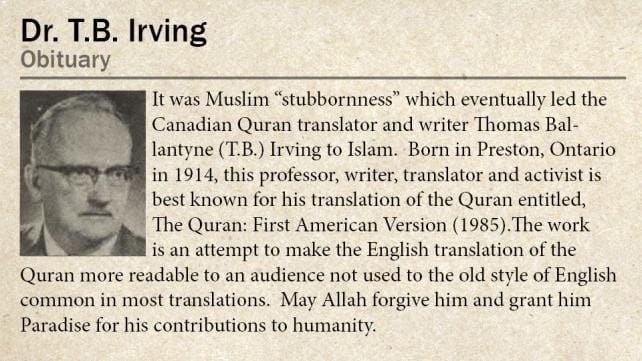
Thomas Ballantyne Irving’s story begins in Canada.
Born in 1914 in Preston, Ontario—now part of Cambridge—into a family of Scottish ancestry, he would grow into a scholar of languages and faith whose work shaped Muslim life across North America.
Though much of his professional career unfolded in the United States, Irving’s intellectual journey and spiritual transformation were rooted in Canada.
From an early age, Irving showed a gift for languages.
He earned a bachelor’s degree in modern languages at the University of Toronto, then a master’s degree at McGill University in Montreal, before completing a PhD in Near Eastern Studies at Princeton University.
His academic training gave him the tools to engage deeply with Arabic, Islamic history, and the literature of Spain and the Americas.
It was also in Canada, in the early 1950s, that Irving embraced Islam. In Toronto, he took the name Al-Hajj Ta’lim Ali Abu Nasr.
His curiosity had been sparked years earlier by a missionary’s description of Muslims’ steadfastness:
“I remember especially a missionary returned from India stating how the ‘Mohometans’ (Muslims) were so obdurate in adhering to their religion; that was my first encounter with Islam, and it roused an unconscious admiration in me for their steadfastness to their faith and a desire to know more about these ‘wicked’ people.’”
That admiration became a lifelong commitment.
As an academic, Irving taught at Canadian institutions such as the University of Guelph and McGill.
His career also took him to leading universities in the United States—Princeton, the University of Minnesota, and the University of Tennessee, where he retired as Professor Emeritus in Spanish and Arabic in 1980.
Afterward, he became dean of the American Islamic College in Chicago. In 1983, the government of Pakistan awarded him the Star of Excellence for his contributions to Islamic scholarship.
But Irving’s most enduring achievement came in 1985, with his groundbreaking translation The Qur’an: The First American Version.
It was the first Qur’an translation by a North American Muslim, and it was aimed not at scholars but at the growing community of English-speaking Muslims in Canada and the U.S.
“A new generation of English-speaking Muslims has grown up in North America which must use our scripture differently than their fathers would have done,” he wrote in the introduction. “Their thinking roots have become distinct on a new continent without the familiar use of our holy tongue, and a great difference has developed between their customs and their ancestral faith.”
His aim, he explained, was “not so much to scholars as to godly minds and especially to those who are growing up speaking English, and thus need a simple, clear text of the historic writ to guide them.”
The translation drew criticism from some Muslims who objected to its contemporary idiom or its title.
Yet it was also praised. The late scholar Ismaʿil al-Faruqi noted: “It makes refreshing reading even after all the other translations have been read.” For many young Muslims in Canada and the U.S., it was the first Qur’an they could truly relate to.
Irving’s scholarly contributions went well beyond translation.
He was considered a leading authority on Muslim Spain, particularly the Umayyad period.
His book Falcon of Spain highlighted the achievements of ʿAbd al-Rahman I, whom he called a “great statesman.”
His wider body of work included Growing Up in Islam; The Qur’an: Basic Teachings (with Khurshid Ahmad and Manazir Ahsan); Religion and Social Responsibility; Tide of Islam; Islam Resurgent; Islam in Its Essence; Polished Jade; Stories of Kalil and Dimna; The Mayas Own Words; and more. He also published widely in Spanish on Central American literature and Islamic history.
Though he spent much of his later life in the U.S., Irving never lost his Canadian connection.
His embrace of Islam in Toronto tied him to the beginnings of the Canadian Muslim community.
In 1968–69, he served as a director of the Islamic Foundation of Toronto during its formative stage, helping the organization acquire its first centre on Rhodes Avenue.
His involvement came at a time when Muslims in Canada were still small in number and just beginning to organize institutions that would later grow into major community hubs.
In his later years, Irving endured a long struggle with Alzheimer’s disease.
He died on September 24, 2002, in Mississippi, at the age of 88, and was buried there.
His passing, sadly, went largely unnoticed in Muslim community media or institutions, both in Canada and the U.S.
Abdul Malik Mujahid of Sound Vision, one of the few Muslim leaders who visited him near the end, wrote movingly of his condition:
“While Dr. Irving did not need monetary or medical help, he would have appreciated hearing from Muslims, especially those who benefited from his work as a writer and scholar. Although he could not talk and could only eat with the help of a feeding machine, he was conscious. I visited him last year, while he was in a nursing home. Standing next to his bed, I felt each time I said Shahadah (the Islamic declaration of faith), he moved as though he was trying to respond to it.”
His quiet passing was reminiscent of Abdullah Yusuf Ali, another great Qur’an translator, who died alone in London some fifty years earlier.
Both men, despite their service to generations of Muslims, slipped away with little notice from the communities they had served.
Irving could be, in his own words, “obdurate”—unyielding in his convictions, sometimes to the frustration of colleagues and community leaders.
In the 1960s through the 1980s, when Canadian Muslim institutions were still fragile, his bluntness sometimes clashed with those who preferred a quieter approach.
Yet his vision—that Islam in North America must grow authentically from its own soil rather than be imported wholesale from elsewhere—was ahead of its time.
As a linguist, he understood how language shapes identity.
His translation of the Qur’an’s opening line as “In the name of God, the Merciful, the Mercy-Giving” offered English-speaking Muslims a fresh encounter with familiar words.
He insisted that the Qur’an must speak to new generations in clear, living English, just as it had spoken in Arabic to earlier ones.
Dr. Irving was a passionate defender of his arguments, a scholar who challenged assumptions and asked Muslims in Canada and the U.S. to think critically about their presence in the West.
He was, as one colleague put it, “ahead of his time and rarely recognized in his day for his work and contributions.”
From Preston, Ontario, to Princeton, from Toronto mosques to Tennessee classrooms, his journey reminds us of the responsibility to honour scholars and visionaries even when they fade from public view.
And it leaves behind a simple message he often repeated:
Be someone. Do something. Help someone. Be with Allah.