
In the Prophet’s ﷺ Month of Mercy, Gaza Is Our Karbala
As in Karbala, betrayal is not only foreign. Muslim rulers, wrapped in the garb of piety, normalize oppression, shake hands with tyrants and sign accords, and prefer silence to sacrifice. Like Yazid, they cling to power while innocent blood soaks the earth.
By Muneeb Nasir
At this time of year, many Muslims around the world celebrate the birth anniversary of the Prophet Muhammad ﷺ, the Messenger of Mercy and Justice.
But this year, as we remember his legacy, our hearts are shattered by the cries from Gaza—a land now drowning in blood and rubble.
A genocide unfolds before our eyes, not in distant history, but in our own century, echoing the tragedies humanity has faced again and again.
And as we reflect on the Prophet’s life, we cannot escape the memory of his beloved family—the Ahl al-Bayt—and the most searing wound in our history: Karbala.
In 680 CE, the Prophet’s ﷺ grandson, Imam Husayn ibn Ali, stood on the scorching plains of Karbala.
Surrounded, starved, and cut off from water, he was brutally slaughtered alongside his companions and family.
His “crime”?
Refusing to bend his neck to tyranny.
Refusing to legitimize a ruler who trampled justice and desecrated the Prophet’s message.
Yazid’s army claimed the banner of Islam even as they massacred the Prophet’s household.
Today, Gaza bleeds with the same truth.
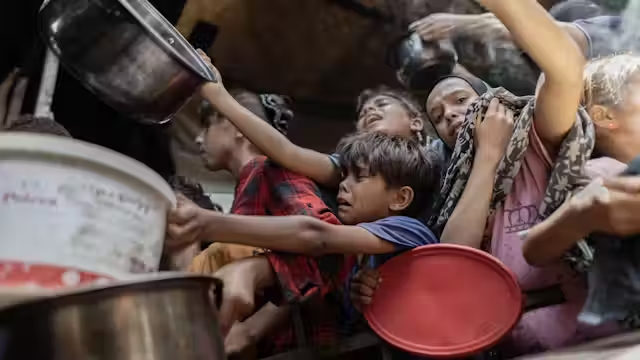
Besieged, starved, and bombarded, her people are crushed beneath rubble, their children denied food and water, their families annihilated—all while the world watches in silence.
And as in Karbala, betrayal is not only foreign.
Muslim rulers, wrapped in the garb of piety, normalize oppression, shake hands with tyrants and sign accords, and prefer silence to sacrifice.
Like Yazid, they cling to power while innocent blood soaks the earth.
Karbala is not a relic of the past.
It is a mirror, held up to every generation.
Imam Husayn did not rise for power or for a throne—he rose to preserve the soul of Islam from becoming a hollow ritual without justice.
As one writer observed, “When we forget Karbala, we forget that Islam without sacrifice and courage becomes a shell—ritual without soul, words without truth.”
Gaza asks us the same question Imam Husayn once did: Will we stand for justice, or will we surrender truth to tyranny?
Too many of us mourn Imam Husayn in tears each year, yet betray him in action.
We invoke his name but tolerate leaders who starve Gaza’s children, who trade away their people’s dignity for illusions of power, who bury the Qur’an’s call for justice beneath hypocrisy.
Justice is not optional. To abandon it is to betray the Prophet ﷺ himself.
The lesson of Karbala is not ancient—it is alive, urgent, burning before us.
Silence is complicity.
Ritual without courage is hypocrisy.
The sands of Karbala were drenched with Imam Husayn’s blood so Islam would never be a mask for tyranny.
Today, the rubble of Gaza is drenched with Palestinian blood, demanding the same awakening, stripping away our excuses, and forcing us to ask: Where do we stand? With the oppressed or with the oppressor?
History will remember.
God will judge.
And Gaza, like Karbala, will testify.