
In Memoriam: Professor Abdulaziz Sachedina, A Beacon of Scholarship and Bridge-Building
Prof. Sachedina was a beacon of intellectual rigour and moral clarity whose work had a profound and lasting impact on academia, theology, and ethical discourse across the world.
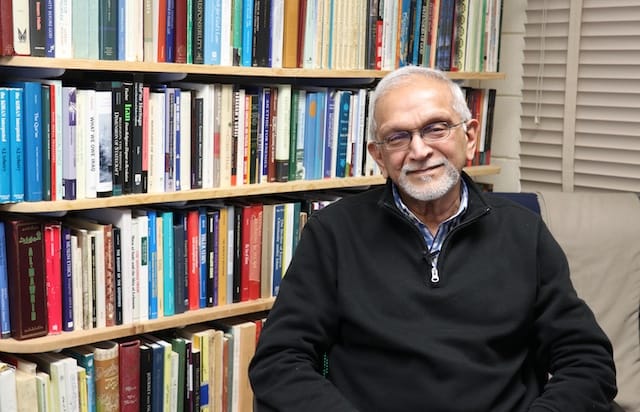
The global community of scholars and faith leaders mourns the passing of Professor Abdulaziz Abdulhussein Sachedina, who died on 3 December 2025 at the age of 83.
His death marks the loss of a truly towering figure in contemporary Islamic studies and a tireless advocate for interfaith understanding.
Prof. Sachedina was a beacon of intellectual rigour and moral clarity whose work had a profound and lasting impact on academia, theology, and ethical discourse across the world.
A distinguished scholar, Sachedina’s intellectual journey was as diverse as it was deep.
Born in Tanzania in 1942 into a Shia family of Indian descent, his early life exposed him to rich multicultural perspectives, instilling a profound appreciation for tolerance and coexistence that would define his life’s work.
His education spanned continents and traditions, combining modern humanities study at Aligarh Muslim University in India with classical seminary learning in Iran, including engagement with the disciplines at the seminary of Qom.
This unique blend of traditional religious knowledge and modern scholarly methods became the hallmark of his intellectual approach.
Sachedina brought this synthesis to the West, completing his doctoral studies at the University of Toronto.
He went on to establish himself as a leading authority during his decades-long tenure at the University of Virginia, and later held the International Institute of Islamic Thought (IIIT) Chair in Islamic Studies at George Mason University.
Dr. Sachedina also served as Toronto Emmanuel’s Distinguished Visiting Professor of Islamic Studies in 2011-2012, marking the beginning of Emmanuel’s Muslim focus in the Master of Psychospiritual Studies program. He taught in the area of Islamic theology, ethics and practice.
His teaching portfolio was impressively broad, covering Islamic theology across both Sunni and Shia traditions, religious pluralism, and comparative Qur’anic studies.
Pioneering Contributions to Ethics and Rights
While he was widely recognized for his groundbreaking work in Shia studies—such as his seminal book, Islamic Messianism, and his analysis of political authority in The Just Ruler in Shi’ite Islam—Prof. Sachedina's greatest legacy lies in his pioneering efforts to bring classical Islamic thought into urgent dialogue with contemporary ethical challenges.
He is widely credited with establishing Islamic bioethics as a formal academic field, offering critical and compassionate guidance on issues like end-of-life care and medical decision-making.
Perhaps most impactful was his tireless advocacy for human dignity and universal rights.
In books such as Islam and the Challenge of Human Rights, he offered a theological foundation for the compatibility of Islam with universal human rights, championing the values of equality, pluralism, and justice within Muslim societies.
A Legacy of Dialogue
Prof. Sachedina dedicated his life to being a bridge-builder.
He sought to connect diverse theological traditions, scholars and practitioners, and the world of faith with universal human values.
His intellectual contributions were not confined to the classroom; he actively participated in building intellectual institutions, nurturing rigorous inquiry, and fostering meaningful interfaith dialogue.
He demonstrated that deep faith could be articulated with principled openness, promoting a compassionate understanding of Islam rooted in universal human values.
His work continues to inform scholars, students, and community leaders worldwide who strive for collaboration, service, and meaningful change.
Professor Abdulaziz Sachedina leaves behind a distinguished academic record and an enduring ethical vision.
As the global community mourns his passing, we honour his memory with gratitude for his profound service to scholarship, his generosity of spirit, and the intellectual bridges he built that will continue to inspire new generations of thinkers for decades to come.